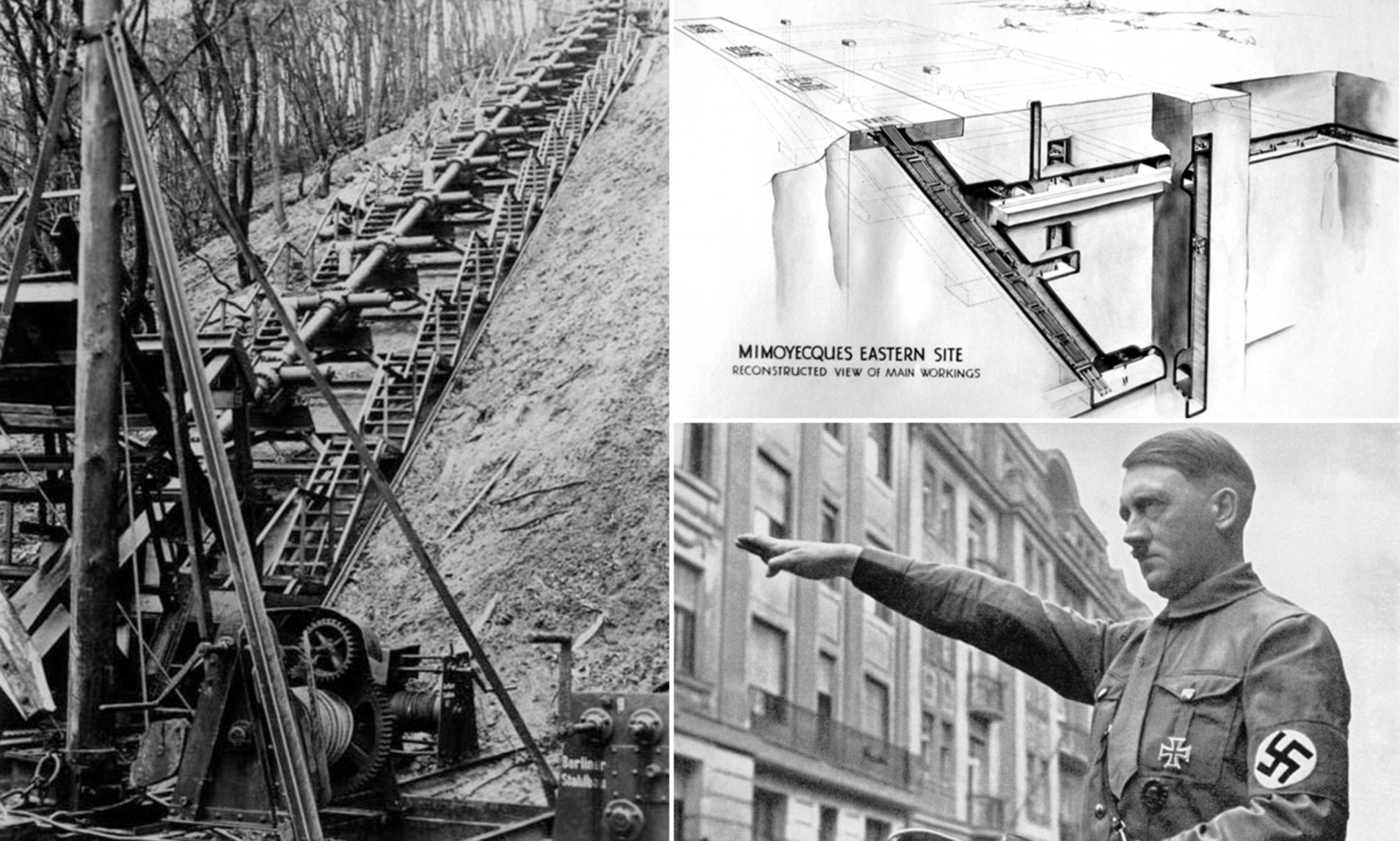
By 1942, things had started to go wrong for Hitler, as World War II’s tide turned against Germany. He needed some cheer, and got it when German ballistics engineer August Condors told the Fuhrer of a new weapon that could knock Britain out of the war. Condors had designed a super cannon with a 417-foot-barrel that, if placed near the English Channel, could shell London. 50 such guns, Condors promised, could devastate London with 3000 shells every day, and destroy the British capital. Hitler gave his blessings, and work on the Vergeltungswaffe 3 (Vengeance Weapon 3), or V-3 cannon, began.
A Revived Nineteenth Century Concept

The V-3 cannon, sometimes called the Hochdruckpumpe (“high-pressure pump”), was one of the lesser-known but most ambitious of Nazi Germany’s super weapons. It was conceived as a long-range, multi-charge gun that could bombard London from the other side of the English Channel. It stood alongside programs like the V‑1 flying bomb and the V‑2 rocket as part of Hitler’s “Vengeance Weapons” scheme. However, the V-3’s story was ultimately one of grandiose engineering and political enthusiasm, that ended in real world disappointment.
It eventually proved a dud due to repeated failure in the face of Allied air power, physics, and unrealistic expectations. The idea was quite innovative, though, even if sequential side-charges to accelerate a projectile down a barrel was not new. The concept can be traced to earlier nineteenth century designs by American inventor Azel Storrs Lyman, who explored adding additional propellant along the barrel to keep increasing projectile velocity. German engineer August Conders, employed by armaments conglomerate Rheinmetall, revived and championed the idea in WWII.
The V-3 Cannon Design

Conders’s V-3 cannon design was based on a very long barrel, lined with multiple angled combustion chambers. Each chamber would contain a secondary propellant charge timed to ignite as the projectile passed, providing additional bursts of acceleration. If all charges fired in perfect sequence, the projectile could reach exceptionally high velocities, far in excess of the capabilities of conventional artillery. German planners hoped that it could lob 140 mm fin-stabilized shells more than 100 miles, far enough to hit London.
To bring the concept to life, the Germans began to construct a massive underground bunker complex at Mimoyecques in 1943. Located in northern France’s chalk hills and pointed toward London, the site was intended to house multiple V-3 cannon batteries. Each consisted of long steel barrels positioned at a fixed angle, and buried beneath the hill for protection. Organisation Todt, which oversaw much of Germany’s large military construction works, oversaw the project, which involved significant slave labor. Workers carved deep galleries into the hillside, elevator shafts, ammunition handling systems, and angled gun tunnels extending over 120 meters.
A Weapon Born of Desperation

The V-3 cannon plan called for 25 barrels, each to be supplied with sequential charges fed from the underground magazines. Adolf Hitler saw the V-3 as a wonder weapon that could bypass Allied air superiority, and terrorize the British civilians. As with the V-1 and V-2 programs, desperation drove the project: by 1943, the war had shifted sharply against Germany. Long-range bombardment was meant to give Germans a psychological and political edge they could no longer secure on the battlefield. The vision was grand, but engineering realities proved stubbornly uncooperative.
First problem was barrel strength. The barrel needed to withstand enormous pressures. As each side-charge ignited, stress patterns formed that risked deforming or rupturing the barrel. Especially since the secondary chambers were set at 45 degrees. Metallurgical limitations of mid-war Germany made producing such large, stress-tolerant tubes extremely difficult. Another issue was charge time. The system required microsecond-level coordination. If a secondary propellant charge ignited too early or too late, the projectile could slow, destabilize, or even destroy the barrel. Achieving the precise timing necessary with 1940s electronics and mechanical sensors was extremely challenging. Eventually, designers abandoned electronics and sensors altogether. In a modified design, the blast travelling up the barrel would ignite each secondary propellant as it passed by.
Technical Difficulties Delayed the Project

Projectile design was also complicated. V-3 cannon projectiles were unlike traditional artillery shells. Long and fin-stabilized, they resembled oversized darts. Standard shells weighed 310 pounds/ 140kg, with a 55 pound/ 25kg charge. They needed to be both aerodynamic, and able to survive the intense acceleration forces inside the barrel. The chosen ammunition was produced by Wollheim & Co., but reliability remained inconsistent. Rate of fire was another issue, as the weapon was intended to fire up to one round every six seconds. That was extraordinary, especially for a gun over 400 feet long.
The heating, wear, and logistical demands for such a rate of fire turned out to be proved wildly unrealistic. Together, those problems ensured that the V-3 never came close to becoming the decisive strategic weapon Hitler had hoped for. British intelligence increasingly suspected a large-scale installation at Mimoyecques in 1943. A major element in identifying the threat was aerial reconnaissance conducted by aircraft such as the de Havilland Mosquito, which photographed new tunnels, construction activity, and suspicious infrastructure pointing directly toward London. Allied analysts did not understand what they were looking at, but figured it was nothing good. So they decided to destroy the site and deprive the Nazis of whatever they intended to do with it.
Destruction of the Super Gun Site

The Allied response unfolded in several waves, starting with Royal Air Force bomber raids. In late 1943, RAF Bomber Command targeted the Mimoyecques site. The underground tunnels were deep, though, and early attacks had little effect. The breakthrough came in July, 1944, with 12,000-lb “Tallboy” earthquake bombs designed by the British engineer Barnes Wallis. Dropped by Avro Lancaster squadrons, Tallboys penetrated deep into the chalk, and collapsed the tunnels and ventilation systems. Several bombs detonated inside the galleries, killed hundreds of workers and technicians, and rendered the facility unusable.
Construction of the V-3 cannon site effectively ceased after the Tallboy attack. The Germans tried to clear the rubble and resume limited work, but the site had been fatally compromised. By then, the Allies had started their breakout from the Normandy beachheads and began to sweep through and liberate France. In September, 1944, the abandoned compound fell to advancing Canadians, before the V-3 had ever fired a shot at London. Although the main V-3 site was neutralized, Germany still wanted to test and use the concept. Smaller, simplified V-3 versions were installed near Lampaden, Germany, in late 1944, from which they shelled Luxembourg.
A Modified V-3 in Action

The shorter V-3 cannons in Lampaden lacked the full design’s elaborate angled chambers, but still used the multi-charge principle. In December 1944, during the Battle of the Bulge, they began to fire at Luxembourg City, held by American forces. Hundreds of shells were fired before the bombardment ceased in January, 1945. Around a dozen people were killed, and some property damage was inflicted, but the bombardment had no military significance. Range and accuracy were poor, reliability was low, and the weapon was more a curiosity than a serious threat. By early 1945, advancing American troops captured the guns, ending their brief operational use. The V-3 program collapsed under a combination of engineering overreach, Allied pressure, and strategic irrelevance. Several factors stand out, of which over-engineering was the most salient.
The concept was elegant in theory, but demanded precision mechanics and materials beyond what wartime Germany could reliably produce. The weapon’s fixed position also proved a serious vulnerability. Unlike mobile artillery or transportable rockets, the V-3 installation was immobile and conspicuous. Once detected, Allied air power could, and did, destroy it. When Winston Churchill found about the V-3, he opined that if the Nazis had pulled it off, it would have been the most destructive conventional attack ever launched against a city. The reality might have been different from his fears and the Fuhrer’s hopes. The V-3s warhead’s effectiveness was low. Even if it had operated as planned, the 140 mm shells carried relatively small explosive charges. Compared to the destruction inflicted on London during the Blitz and the later V-1 and V-2 rocket attacks, the V-3s impact might been limited.
Significance and Legacy of the V-3 Cannon

The strategic timing of the V-3 cannon turned out to be the greatest problem of all. Despite all the hurdles, Hitler might have still pushed through in order to wreak havoc on the British capital. However, the weapon could not be ready before 1945, long after the war’s momentum had shifted irrevocably. The Reich no longer had the time or resources to perfect such a complex device. The V-3 was one of Nazi Germany’s more obscure super weapons that never came close to fulfilling its intended role.
The Mimoyecques site has been transformed into the Fortreresse de Mimoyecques museum. It is a memorial to the forced laborers and bombing victims who died during construction. Engineers and historians view the V-3 as an example of a grand strategic vision that outpaced technological capability. The weapon’s fundamental concept of sequential acceleration along a barrel has occasionally resurfaced in scientific discussions. Modern electromagnetic railgun research, has drawn from the idea, although in an entirely different technological context. The V-3 cannon was a testament to late-war Germany’s desperation and ingenuity. It was technical marvel in theory, a logistical nightmare in practice, and a strategic failure overshadowed by more infamous “Vengeance Weapons”.

_________________
Some Sources & Further Reading
Ford, Roger – Germany’s Secret Weapons in World War II (2000)
History Halls – Weird Weapons: WWII’s Great Panjandrum
Hogg, Ian V. – Germany Artillery of World War Two (2002)
King, Benjamin, and Kutta, Timothy – Impact: The History of Germany’s V-Weapons in WWII (1998)

