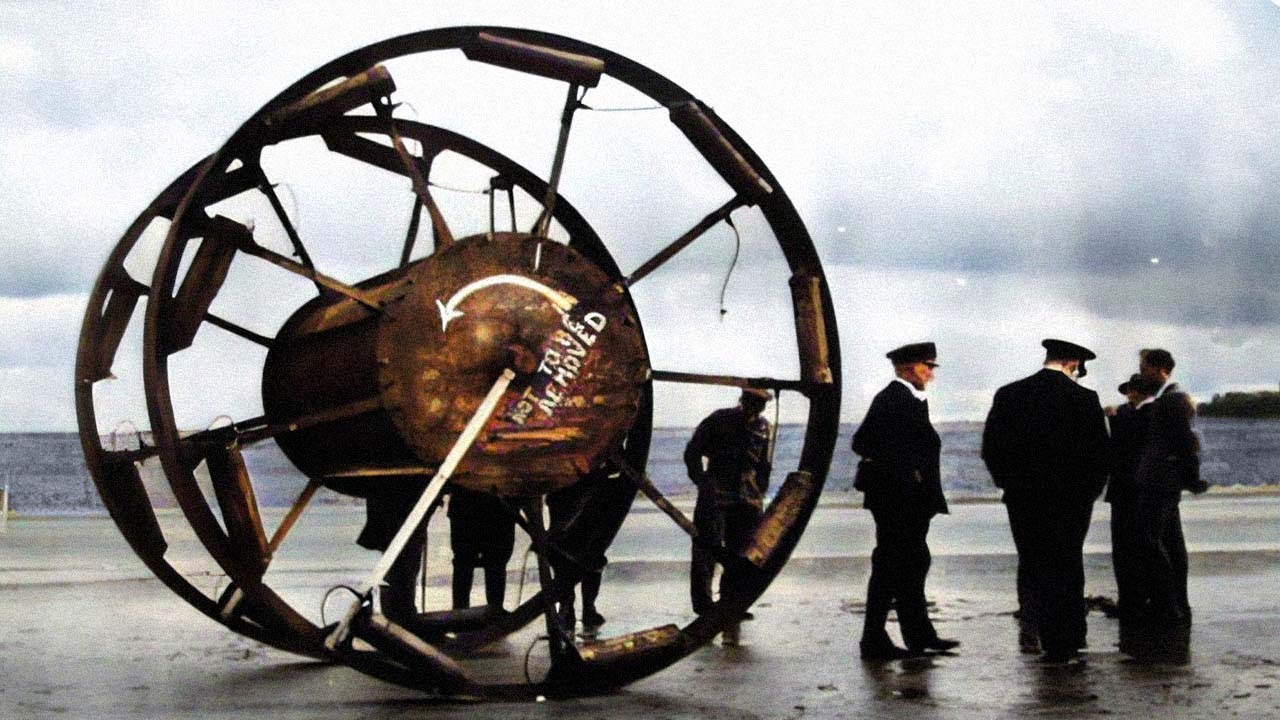
As the Allies in World War II made plans for an amphibious invasion of Nazi-occupied France, one of their chief concerns was the German fortifications that lined the potential landing sites. The British eventually came up with an innovative prototype weapon that planners hoped would clear enemy obstacles ahead of the eventual D-Day landings: the Great Panjandrum. It looked like something straight out of Looney Tunes and the febrile mind of a Wile E. Coyote. Below are some fascinating facts about that cartoonish weapon.
Propelling an Explosives-Filled Drum With Rockets

The Great Panjandrum was a project commissioned by the British Admiralty’s Directorate of Miscellaneous Weapons Development. It consisted of a large drum that was stuffed with a ton of explosives. Attached were wheels, that were propelled by angled rockets. The idea was to ignite the device from a platform at sea. Then the angled rockets attached to the wheels would make them rotate rapidly. That would launch the contraption at targets and obstacles on shore, and blow them up. That would clear the way for follow on troops who would land hot on the Great Panjandrum’s heels.
The weapon was supposed to be developed in secrecy. However, tests were carried out on a British beach that was popular with vacationers. So the trials were witnessed by huge crowds. The design’s key flaw emerged at the first trial run in 1943: the weapon refused to move in a straight line. When the rockets were ignited and the device was launched, it made its way up the beach in a reasonably satisfactory manner at first. Then one of the wheels malfunctioned, which caused the Great Panjandrum to careen wildly off course.
An Inability to Move in a Straight Line

The prototype weapon’s inability to move in a straight persisted in subsequent trials. In test after test, it was impossible to get the rockets on both sides to ignite at the same time or continue to fire simultaneously. After weeks of troubleshooting, the developers returned to the beach with an improved version of the contraption. This time, a third wheel had been added to the device to increase its stability. That test was an even greater embarrassment than earlier ones. Although the weapon initially hurtled toward the beach, it failed to reach the shore.
Instead, the Great Panjandrum made a wide turn, and doubled back toward the craft that had launched it. While that was going on, some of the rockets detached from the prototype weapon’s wheels, and proceeded to launch themselves at observers on the beach, whistle over their heads, or explode underwater nearby. Despite the awkward failed trials, planners still had faith in the device’s potential as a useful weapon. So the designers returned to the drawing board to work out the bugs.
The Great Panjandrum’s Greatest – and Final – Failure

When the Great Panjandrum’s designers finally figured that they had it under control, they conducted a final make or break demonstration in front of an assembly of admirals and generals. As described in a BBC documentary: “At first all went well. Panjandrum rolled into the sea and began to head for the shore, the Brass Hats watching through binoculars from the top of a pebble ridge […] Then a clamp gave: first one, then two more rockets broke free: Panjandrum began to lurch ominously.
It hit a line of small craters in the sand and began to turn to starboard, careering towards Klemantaski, who, viewing events through a telescopic lens, misjudged the distance and continued filming. Hearing the approaching roar he looked up from his viewfinder to see Panjandrum, shedding live rockets in all directions, heading straight for him. As he ran for his life, he glimpsed the assembled admirals and generals diving for cover behind the pebble ridge into barbed-wire entanglements. Panjandrum was now heading back to the sea but crashed on to the sand where it disintegrated in violent explosions, rockets tearing across the beach at great speed”. The project was immediately scrapped over safety concerns.

_________________
Some Sources & Further Reading
Imperial War Museums – Second World War Weapons That Failed
Times, The, June 5th, 2009 – Replica of the Great Panjandrum, 1944 Super Weapon, to be Tested

