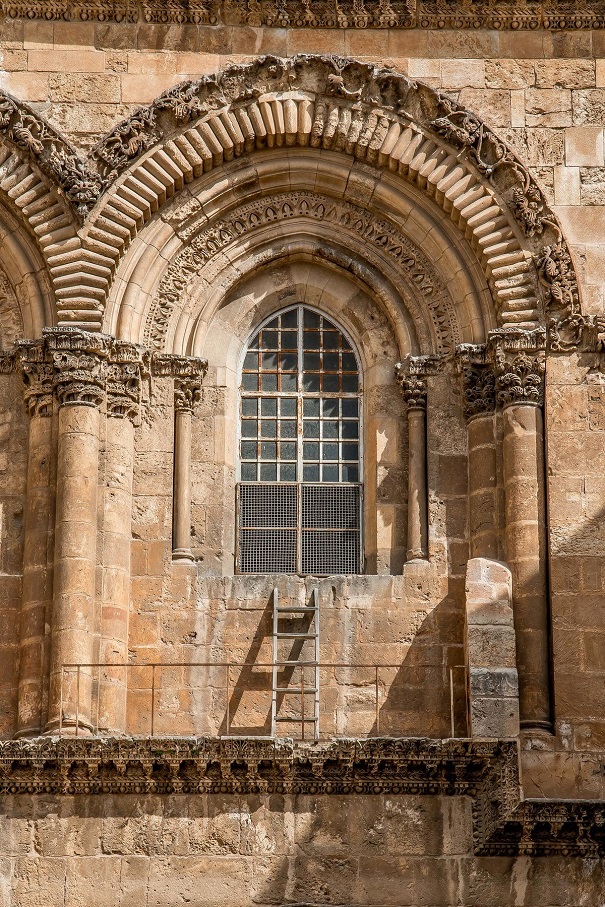
The Immovable Ladder of the Church of the Holy Sepulchre in Jerusalem is one of Christianity’s most curious artifacts. It is a simple wooden ladder that has not been moved for centuries. Resting on a ledge beneath a window above the church’s entrance, it has come to represent both the complexity of Christian denominational relations, and the protracted struggle over control of one of Christianity’s holiest sites.
The Delicately Shared Church of the Holy Sepulchre

The Church of the Holy Sepulchre, located in the Old City of Jerusalem, is one of Christianity’s holiest sites. It is revered by most Christian traditions as the site of both the crucifixion and the tomb of Jesus Christ. Over the centuries, the church became a focal point of Christian devotion and pilgrimage. It also became a focal point of intense rivalry among different denominations. Control over various sections of the church was fiercely contested by the Greek Orthodox, Roman Catholic, Armenian Apostolic, Coptic, Ethiopian, and Syriac Orthodox churches.
By the eighteenth century, the disputes had escalated and gotten out of control. So the Ottomans, who ruled Jerusalem at the time, intervened to impose a delicate balance known as the Status Quo. The Status Quo arrangement was formalized in 1757, and reaffirmed by later decrees and international agreements. It froze ownership and usage rights of the church exactly as they were at that time. No part of the structure, furniture, or even movable objects could be altered, repaired, or relocated without the consent of all the communities involved – a nearly impossible requirement given their historical tensions. The Immovable Ladder became the most visible symbol of that arrangement and its absurd rigidity.
The Immovable Ladder

The ladder itself is believed to have been placed there sometime before 1757. Its original purpose was mundane: perhaps used by a monk or custodian to access the balcony or clean the windows. Some traditions claim that Armenian monks used it to tend to potted plants. Or perhaps they used it to gain access to a small outdoor space connected to their quarters. Whatever the reason, by the time the Status Quo was established, the ladder was already in place. As a result, per the terms of the agreement, it could not be moved without unanimous approval. From that moment on, it became “immovable”. Made of cedar wood, the ladder has been replaced or restored several times due to decay. However, it was always done in precisely the same spot and form, preserving the illusion of unbroken continuity.
Over the centuries, visitors and pilgrims have recorded its presence in drawings, paintings, and photographs, attesting to its symbolic endurance. The earliest known depiction dates from 1728, which confirms that it predated the Ottoman decree and solidifies its legendary status. The Immovable Ladder is more than a curiosity. It encapsulates the fragile coexistence among the Christian communities that share the Church of the Holy Sepulchre. Despite their shared veneration of the site, disagreements have often erupted into physical altercations. Even seemingly trivial issues like a chair’s placement or the timing of processions have led to violence inside the church.
Legacy and Significance of the Immovable Ladder

The ladder, immovable and visible to all, serves as a constant reminder of both the necessity and the difficulty of maintaining peace in a sacred yet divided space. Interestingly, there have been occasional attempts to move the Immovable Ladder. In 1997, a prankster temporarily removed it. That sparked outrage, until it was quietly returned. On another occasion, it was relocated briefly for restoration work, before it was replaced exactly as before. Each time, the act of moving it, even momentarily, provoked anxiety, illustrating the deep symbolic weight it carries.
Today, the ladder is a paradox: a minor object imbued with immense meaning. It reflects not only the frozen politics of the church, but also a broader commentary on human nature. Religious devotion, historical memory, and institutional pride can create a situation where even a simple ladder cannot be moved. For many pilgrims, the sight of the ladder above the church’s entrance is both humbling and thought-provoking. It is an emblem of the enduring divisions within Christianity and a quiet call for reconciliation.

_________________
Some Sources & Further Reading
Coast Daylight – The Church and Ladder: Frozen in Time
History Halls – The Man Who Laughed Himself to Death Watching ‘The Goodies’
Montefiore, Simon Sebag – Jerusalem: The Biography (2011)

