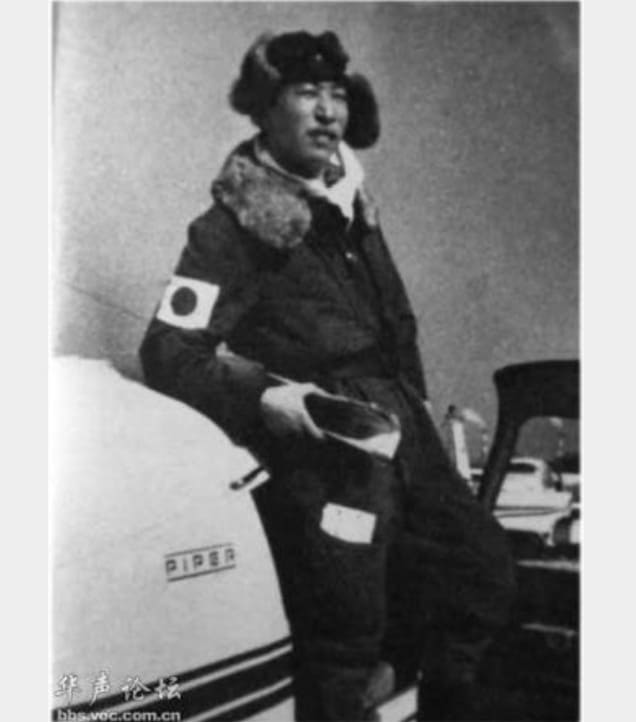
American aircraft manufacturer Lockheed had a problem with its F-104 fighter. It sucked. A poorly designed airplane, it had a tendency to spin out of control and crash. Lockheed could have tried to fix the problem, but that would have been expense. It was cheaper to simply bribe foreign government officials into buying the F-104, despite its defects. One guess which option Lockheed went with. In Japan, Lockheed hired Yoshio Kodama, a World War II war criminal who became a Yakuza boss, as a “consultant”. He brokered bribes for Japanese government officials. About $3 million went to the office of a Japanese prime minister, and millions more to Japanese defense officials. Japan duly inked deals to buy F-104s. When news came out, it set in motion a scandal. It also triggered a bizarre episode in which a porn star, Mitsuyasu Maeno, flew a kamikaze plane into Kodama’s house.
Mitsuyasu Maeno Was Troubled From Early On

Mitsuyasu Maeno was born in Tokyo in 1946, or possibly 1947 according to some sources. He later adopted the stage name Soichiro Maeno for his acting career. Maeno’s early life and upbringing are not widely documented. What is clear, however, is that he was a complex figure shaped by personal struggles and ideological influences. He attended acting classes in the United States during the late 1960s. That experience likely contributed to his development as a performer and his later search for meaning.
His private life was unstable: Maeno was married twice, and both marriages ended in divorce. Reports indicate that he had struggles with mental health, and even attempted suicide before 1976, long before his infamous attack. Politically, Maeno came under the influence of right wing and ultranationalist thought. Especially the writings and worldview of Yukio Mishima. A controversial Japanese author, Mishima attempted a coup and then committed seppuku in 1970 in protest of post-war reforms. Mishima’s valorization of traditional samurai values and criticism of post-war Japan’s “peace constitution” resonated with Maeno.
Becoming a Porn Star

Maeno’s acting career was largely tied to Japan’s “Roman Porno” subgenre. Softcore erotic films, they were produced mainly by the Nikkatsu studio from the early 1970s onward. Porn offered better pay for struggling actors than mainstream cinema, and Maeno appeared in numerous pornos by the mid-1970s. His credits included titles like Tokyo Emmanuelle among others. To Western audiences today, “Roman Porno” may seem like a fringe genre. In 1970s Japan, however, it was pervasive, and made up two thirds of the country’s films at one time.
Although he was not a top mainstream star, Maeno’s erotic filmography made him a recognizable figure among certain niche audiences. It was his political actions, not his acting, however, that etched his name into history. Which begs the question: why would a 29-year-old porn actor mount a kamikaze attack? To understand that, we must examine mid-1970s Japan’s turbulent political climate, and the Lockheed bribery scandal. In the early 1970s, Lockheed Corporation was revealed to have paid bribes to secure aircraft contracts around the world. In Japan, the scandal implicated senior politicians and political fixers.
Lockheed and the Yakuza Boss

One of the central figures in Japan’s side of the scandal was Yoshio Kodama. A wealthy ultranationalist and influential right-wing leader, Kodama was connected the yakuza, Japan’s organized crime. Kodama had served in WWII, and was arrested afterwards and charged as a war criminal. He was recruited by US intelligence, however, which arranged for his release and dismissal of charges in exchange for his cooperation in anticommunist efforts. He then went on to build a powerful post-war political network, and became one of the country’s richest men. Many Japanese were appalled by Kodama’s role in the Lockheed affair – the bribery, political manipulation, and circumvention of public accountability. It all came to symbolize the corruption and moral decay of Japan’s political elite. Some felt outrage, others despair. Among the most radical was Mitsuyasu Maeno.
At one point, Maeno had admired Kodama, due to their shared ultranationalist views. By early March, 1976, however, he had grown deeply disillusioned with him. Maeno’s worldview was shaped by an idealized vision of bushido, the samurai code of honor and sacrifice. He was especially moved by a romanticized view of WWII kamikaze pilots who gave their lives in battle. To Maeno, the Lockheed scandal embodied a betrayal of Japan’s honor and traditional values. In this climate, Maeno conceived a shocking idea. He would fly an airplane into Kodama’s house as a political assassination attempt, and a symbolic act of protest.
Banzai!

On March 23rd, 1976, Mitsuyasu Maeno and two friends arrived at Chofu Airport in the western suburbs of Tokyo. He was dressed in a stylized kamikaze uniform, complete with white scarves, rising-sun insignia, and headbands. Maeno told airport officials that he was shooting publicity footage for a film about kamikaze pilots, and that he had rented a Piper Cherokee for the purpose. In reality, that was just a ruse. Maeno’s two friends accompanied him in another plane, one of them acting as a cameraman, under the pretense of filming.
For about an hour, Maeno and his companion plane circled over Tokyo. Then, near Kodama’s affluent neighborhood in Setagaya, he radioed his wingman and said he had “business in Setagaya”. It was a reference to Kodama’s home. Maeno then cut his engine, radioed “Tenno heika banzai!” (“Long live the Emperor!”), a traditional wartime kamikaze shout. He dove with his airplane into the Kodama residence’s second floor veranda at approximately 9:50 AM. The plane crashed and exploded into flames, and Maeno was killed instantly on impact.
Global Fascination With the Bizarre Demise of Mitsuyasu Maeno

The crash started a fire and injured servants in the house. Kodama himself was in another room, however, and escaped without injury. He was carried out of the residence in a blanket by his yakuza bodyguards. They quickly quelled the fire, and clashed with reporters on the scene. Police investigation later confirmed that Mitsuyasu Maeno had acted alone, and dismissed early speculation of a wider conspiracy. Unsurprisingly, a porn actor in a kamikaze uniform crashing a plane into a political fixer’s home drew widespread attention.
People in Japan and abroad were fascinated. Some segments of the Japanese public, embittered by the Lockheed scandal and the feeling that the powerful were above the law, expressed a degree of sympathy for Maeno’s anger. The scandal had exposed an unsavory side of Japan’s political system, and many felt that justice had failed. To those people, Maeno’s act, while extreme, was an expression of the frustration and disillusionment of the era. However, while many sympathized, many others rejected Maeno’s reasoning and method.
Sympathy and Condemnation

An editorial in the Mainichi Shimbun questioned the revival of militaristic symbolism. It likened what Mitsuyasu Maeno had done to a young German in a Nazi uniform committing suicide. It noted that such imagery was deeply troubling more than thirty years after WWII. A former member of Japan’s WWII tokkotai kamikaze units criticized Maeno’s act as self-serving and performative, rather than truly patriotic. However, he grudgingly acknowledged the technical skill involved in the plane’s descent – a picture perfect kamikaze dive. Others saw Maeno’s choice to adopt wartime iconography as a disturbing revival of sentiments Japan had tried to leave behind.
In the immediate aftermath, Kodama faced legal consequences from other aspects of the Lockheed affair. The proceedings dragged on, however, and were never resolved before his death in 1984. Maeno’s dramatic end ended his life, but it launched a lasting cult notoriety. Among enthusiasts of Japanese Roman Porno, he continued to attract interest decades after his death. His story has also found echoes in popular culture. Chilean novelist Antonio Skarmeta, for example, referenced Maeno’s film work in The Dancer and the Thief. It highlights how even obscure cultural figures can become touchstones for later art.
The Legacy of Mitsuyasu Maeno

Mitsuyasu Maeno is often remembered as one of the last kamikaze-style attackers. A post-war civilian, he adopted wartime symbolism to pursue political violence. His act stands apart from both historical WWII kamikaze missions, and modern suicide terrorism. It resonates in its own way in discussions about how individuals interpret honor, sacrifice, and political ideals. Maeno’s story is extreme and paradoxical: a blend of fringe cinema, nationalist ideology, political protest, and violence. Culturally, he embodied the contradictions of 1970s Japan – a society navigating rapid modernization, lingering wartime memory, and cultural liberalization.
Politically, Maeno’s bizarre suicide attack highlighted the intensity of public anger over corruption scandals and disillusionment with established institutions. Symbolically, his use of kamikaze imagery tied him, however controversially, to Japan’s military past, even as the nation had tried to distance itself from wartime militarism. In the view of many historians and commentators, Maeno’s action “aptly summed up the obscenity of it all”. It reflected a moment when politics, personal turmoil, and media spectacle collided in a dramatic and unsettling way.

_________________
Some Sources & Further Reading
Boulton, David – The Grease Machine (1978)
History Halls – Arms Dealer Basil Zaharoff: The Modern Era’s First ‘Merchant of Death’
Kaplan, David E. – Yakuza: Japan’s Criminal Underworld (2003)
Time, April 5th, 1976 – Kamikaze Over Tokyo
Newest Articles
- American Presidents: Abraham Lincoln, Hall of Fame Wrestler
- Henry Jennings: The Privateer-Turned-Pirate Who Set the Stage for the Caribbean’s Golden Age of Piracy
- Fighting Women: Tomoe Gozen, the Fearsome Female Samurai
- From the NFL to the Sands of Iwo Jima: Medal of Honor Recipient Jack Lummus
- The Zanj Rebellion: The African Slave Revolt That Rocked Medieval Mesopotamia

