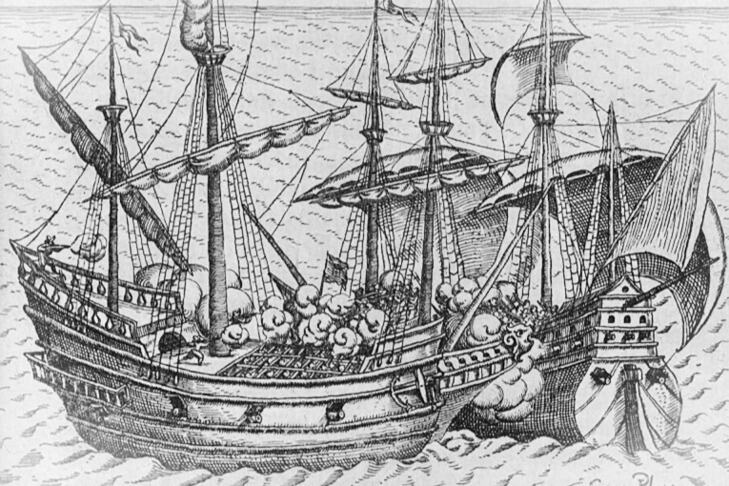
Mary Wolverston, better known as Lady Killigrew, occupies a colorful and somewhat shadowy place in Elizabethan piracy history. Born circa 1525 into the Wolverston family of Suffolk gentry, she grew up in a coastal world where smuggling, wrecking, and opportunistic raiding were common parts of the maritime economy. Her background shaped her into one of the most notorious and unusually well-connected female pirates in English history.
Born Into Piracy

Piracy was in Mary Wolverston’s blood: her father, Phillip Wolverston, was involved in many piratical ventures. So Mary was raised in an environment where the line between legitimate seafaring enterprise and outright piracy was thin. She married Sir John Killigrew of Arwenack, a member of a powerful Cornish family based in Falmouth. The Killigrews had long enjoyed a reputation for combining respectability with clandestine raiding, often under the guise of privateering. Their strategically situated fort and manor near Falmouth’s harbor gave them control over a crucial stretch of coastline. That enabled profitable legitimate dealings with foreign merchants, covert participation in illegal smuggling networks, and opportunistic piracy.
Mary’s marriage thus provided a natural extension of the life she had known in Suffolk. Together, she and Sir John became deeply involved in Cornwall’s semi-official maritime predation. Cornwall in the sixteenth century lay at a crossroads of intense commercial activity and great political tensions. Piracy, under the pretense of legalized “privateering”, was abetted or even encouraged by English authorities. England’s relations with Spain and the Low Countries fluctuated in those days. That created opportunities for privateers to plunder “enemy” ships while maintaining a veneer of legality. Lady Killigrew and her husband took advantage of the confusion.
The Pirate Queen of Cornwall

Mary Wolverston was not just a mere accomplice to her husband’s ventures, but an active organizer. She oversaw the distribution of stolen cargo, and sheltered pirate crews at her residence, Arwanack House. Her home became a notorious safe haven where loot could be stored and contraband quietly sold. The Killigrews did not prey solely on foreign ships on the high seas, however. They also preyed in English waters on foreign and English vessels. Mary’s most infamous exploit occurred in 1582, after the death of Sir John, when she was in her late fifties. By then she had already been suspected of involvement in various acts of piracy. Her social standing and connections had shielded her from prosecution.
The incident that finally brought her to trial involved a Spanish ship, Marie of San Sebastian, anchored near Arwaneck House. Under the pretext of hospitality, Lady Killigrew welcomed the ship’s master as a guest at her residence. While the captain was ashore, Mary ordered her men to seize the vessel, loot its cargo of wine and fabrics, and sink it off the coast. When the theft was discovered, she attempted to blame local sailors, but her role quickly became too obvious to ignore. There were witnesses, and the captain complained to the local authorities. They did nothing, however: the local magistrate was Lady Killigrew’s son, and he sabotaged the investigation. Livid, the captain went to London and complained to the Spanish ambassador, who in turn pressured the government to act.
Legacy of Lady Killigrew

Queen Elizabeth I was forced to act: Lady Killigrew had been too reckless. Instead of discrete piracy far away that could be ignored, she had engaged in brazen piracy in English waters. The queen could not afford to overlook the crime, so officials were sent to investigate. They uncovered the local coverup, and found pirated goods from the Marie of San Sebastian in Killigrew’s house. She and her chief accomplices were arrested and tried at Launceston for piracy and fencing of stolen goods. They were found guilty, and sentenced to death.
Killigrew’s conviction was significant: an aristocratic woman, connected to one of Cornwall’s most influential families, found guilty of an offence usually associated with renegades and seafaring outlaws. Two of Killigrew’s accomplices were executed, but the queen commuted the lady’s sentence to imprisonment. She was later pardoned – likely due to the Killigrew family’s political usefulness, Mary’s status as a gentlewoman, and the lavish bribes doled out by her son. After her pardon, she largely disappears from the historical record, which suggests that she lived out her remaining years quietly.
The legend of Lady Killigrew persisted. To later generations, Mary Wolverston embodied the turbulent maritime culture of Elizabethan England. It was a world in which social privilege could coexist with lawlessness. A time when a determined woman could command crews, plan raids, and defy international law with remarkable audacity. Whether remembered as a villain or a pioneering figure of female piracy, Lady Killigrew’s story remains one of the most striking examples of how piracy had infiltrated the very heart of the English gentry.

_________________
Some Sources & Further Reading
Baring-Gould, Sabine – Cornish Characters and Strange Events (1909)
History Halls – Fighting Women: Fearsome French Buccaneer Anne Dieu-le-Veut
Sharp, Ann Wallace – Daring Pirate Women (2002)

