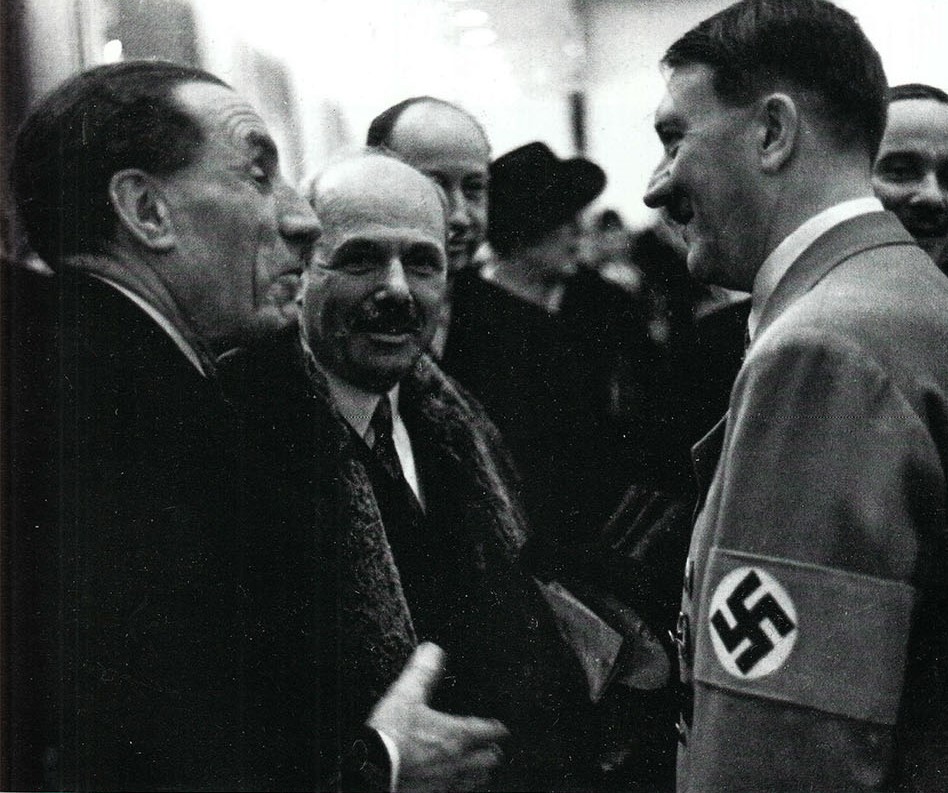
Louis Renault, the French industrialist and founder of Renault Automobiles, was a complex figure. His life reflects both the heights of defiant wartime patriotic innovation, and of supine wartime collaboration with the enemy. He was revered as a national hero for his engineering genius and contributions to France’s survival in World War I. He was reviled as a collaborator with France’s Nazi occupiers in World War II. His journey from hero to heel is a tale shaped by ambition, pragmatism, and the fraught politics of occupation.
An Innovative Automotive Designer

Louis Renault was born on February 12th, 1877, in Paris, the youngest of five children in a middle class family. Fascinated by mechanics from an early age, he converted a small shed at the family home into his workshop. In 1898, he built his first vehicle, the Renault Voiturette, or small car. Manufactured between 1898 to 1903, it quickly gained attention for its advanced features, including direct-drive transmission and a compact design. That success convinced him to establish the Renault Freres (Renault Brothers) Company in 1899, with his brothers Fernand and Marcel. Renault automobiles soon established a reputation for durability, innovation, and racing performance.
Marcel Renault died during the 1903 Paris-Madrid race – and event that deeply affected Louis, who thereafter avoided driving in races. However, he remained committed to motorsport as a testing ground for car technology. In the process, he came up with numerous innovative designs, many of which are still with us today, such as drum brakes, compressed gas ignition, and hydraulic shock absorbers. Fernand Renault passed away in 1909, leaving Louis in sole control of the company. By the eve of the First World War, Renault was one of France’s premier car manufacturers, known for both luxury vehicles and practical motorcars for the middle class.
In Addition to Automotive Genius, Louis Renault Was the Father of the Modern Tank Design

The outbreak of WWI in 1914 thrust French industry into a critical role. Like many industrialists, Renault pivoted production toward military needs. His factories produced trucks, munitions, and later aircraft engines. One of his greatest contributions came in 1917, when the French Army requested a new armored vehicle. Renault responded with the FT-17 light tank, a revolutionary design that featured a fully rotating turret, rear engine, and front crew compartment. The FT-17 became the template followed by nearly all tanks from then until today. Lightweight and maneuverable, it gave the Allies a significant edge in the war’s final offensives.
More than 3000 FT-17s were produced during the war, Renault’s role in supplying both vehicles and logistical support through his trucks made him a national hero. Marshal Ferdinand Foch, supreme Allied commander, credited Renault’s contributions as vital to victory. In recognition, Louis Renault was awarded the Grand Cross of the Legion of Honor. In the 1920s and 1930s, he expanded his industrial empire. Unlike rivals Citroën and Peugeot, Renault pursued a diverse strategy, and produced everything from luxury cars to buses, tractors, and even airplanes. He maintained an iron grip on the company, and ran it as a patriarchal figure with a reputation for being both brilliant and difficult.
The Controversial “Ogre of Billancourt”

Through his factories, Louis Renault became one France’s biggest employers. His authoritarian style and resistance to unionization created frequent labor conflicts, though. To his workers, he became known as “the ogre of Billancourt” – the site of his main factory. Despite that, Renault remained celebrated as an industrial pioneer. He championed vertical integration, and ensured that Renault manufactured most of its own parts, rather than rely on suppliers. However, the political climate of the 1930s posed increasing challenges. Strikes, the rise of socialism, and the looming threat of another war tested Renault’s worldview.
He remained staunchly conservative, mistrustful of the left wing Popular Front government, and skeptical of France’s ability to withstand another conflict. He also grew increasingly paranoid, reclusive, frightened of the rising power of labor unions, and stridently anti-Semitic. The latter was fueled by a fierce rivalry with his chief French automotive competitor, Citroen, whom Renault referred to as “le petit juif” (“the little Jew”). He eventually retreated to his country estate, a massive castle on the River Seine near Rouen.
From WWI Hero to WWII Collaborator

When Germany invaded France in May, 1940, the rapid collapse that followed shocked the nation. Paris fell in June, and the Vichy regime under Marshal Pétain took power, surrendered, and collaborated with the Nazis. French industry, now under occupation, faced an agonizing choice: resist and face destruction, or cooperate. Louis Renault, who was in his sixties, chose cooperation. He argued that keeping his factories running would preserve jobs, and avoid confiscation by Germany. His Billancourt plant began to manufacture trucks, engines, and other equipment for the Wehrmacht.
In the next four years, until France’s liberation in 1944, Renault’s factories produced more than 34,000 vehicles for the Nazis. He later insisted that his goal was to keep the company alive for postwar France. However, critics saw his compliance as betrayal and collaboration. Unlike some industrialists who fled or sabotaged their factories, Renault worked closely with German authorities. His company profited, while French workers endured forced labor conditions. Public perception turned sharply against him. Resistance groups accused him of aiding the enemy, while Allied bombers repeatedly targeted Renault factories as legitimate military assets.
Death in Murky Circumstances

In March, 1942, the Billancourt plant was heavily damaged by British bombers. The attacks killed hundreds of French workers, and intensified the controversy surrounding Renault’s choices. When Paris was liberated in August, 1944, the tide turned decisively against those suspected of collaboration. Now free to express themselves once again, French newspapers clamored for Renault’s head. Once hailed as a national savior, he was now seen as a traitor. Three weeks later, he surrendered on condition that he not be jailed until indicted.
Already suffering from ill health, he was nonetheless taken to Fresnes Prison, and held on charges of collaboration with the Nazis. Behind bars, he reportedly suffered serious mistreatment and neglect. Within weeks, on October 24th, 1944, he died under murky circumstances. The official cause of death was reported as uremia – high levels of urea in the blood. However, no autopsy was conducted to support that conclusion. Years later, his widow claimed that he had been tortured and beaten to death by prison guards. His death occurred before he could stand trial, so his case was left unresolved.
The Nationalization of Renault’s Company

Louis Renault was posthumously charged with “guilty enrichment obtained by those who worked for the enemy”. The new French government swiftly nationalized his company in January, 1945, and cited his wartime collaboration as justification. It was the only major car manufacturer to be permanently seized by the state. The company was renamed Régie Nationale des Usines Renault, and under state control, it became a cornerstone of France’s postwar industrial recovery. For decades, Louis Renault’s name was synonymous with collaboration. His widow and descendants fought to rehabilitate his reputation, and argued that he had been unjustly accused and denied a fair trial. They claimed Renault’s actions had been pragmatic attempts to preserve his company, not ideological support for Nazism.
Lawsuits seeking restitution of the nationalized company have continued into the twenty first century. However, French courts have consistently upheld the state’s decision. To date, we are left with a story that defies simple categorization. As the creator of one of the most iconic vehicles of WWI, Louis Renault helped secure France’s victory in that conflict, and established himself as a national hero. His FT-17 tank remains celebrated in military history. However, his choices in WWII, whether driven by pragmatism, conservatism, or self-preservation, stained his legacy and painted him a collaborator.
The Complicated Legacy of Louis Renault

Historians remain divided about the legacy of Louis Renault. Some argue that he had little choice under occupation, and did what he could to safeguard his factories and workers. Others emphasize his willingness to engage with the Germans when other industrialists resisted. His death in custody without trial ensured that ambiguity would remain. What is undeniable is the lasting impact of his work. Renault’s company, nationalized and rebuilt, went on to become a symbol of modern France, and produced affordable cars like the Renault 4CV that mobilized a new generation. His engineering vision helped shape both military and civilian technology in the twentieth century.
Renault’s journey from celebrated World War I innovator to disgraced World War II collaborator is emblematic of the dilemmas faced by industrial leaders in times of national crisis. His genius and patriotism in the First World War was overshadowed by the choices he made under occupation in the second. Whether remembered as a pragmatic survivor, a traitor, or a victim of postwar vengeance, Renault embodies the contradictions of a man who lived through France’s darkest and most triumphant hours. His legacy remains controversial: a reminder that heroism and betrayal can be separated by the thinnest of lines.

_________________
Some Sources & Further Reading
History Halls – Jean Moulin: The Hero Who Unified the French Resistance in World War II
Paxton, Robert O. – Vichy France: Old Guard and New Order, 1940-1944 (2001)
Time Magazine, February 6th, 1956 – Was He Murdered?

