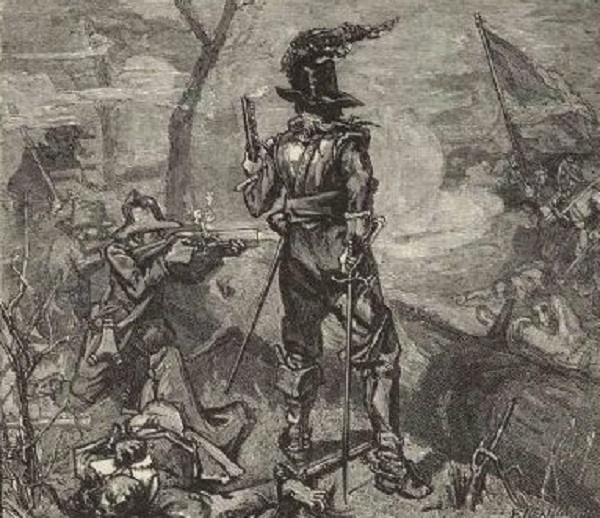
The American Revolution was not the first time Americans fought against an oppressive monarch. When the English Civil War erupted in the 1640s, a New England regiment crossed the Atlantic to fight for Parliament. By the 1650s, Parliament had won, and King Charles I had been captured, tried, convicted, and beheaded. England was ruled by Parliament, and eventually became a Commonwealth ruled by a Protector, Oliver Cromwell. Royalists and Parliamentarians still fought on a small scale from time to time, though. The last of those fights, the Battle of the Severn, was fought on American soil in 1655.
The English Civil War in the American Colonies

The Battle of the Severn, March 25th, 1655, was the last battle of the English Civil War. Fought near Providence – today’s Annapolis, Maryland – it was a violent manifestation of deep political and religious tensions within the colony. Maryland had been founded in 1632 as a haven for English Catholics under the proprietorship of the Calvert family. It was not exclusively Catholic, though, and soon developed a mixed population of Catholics, Anglicans, and increasingly influential Puritan settlers. Marylanders were not immune from the English Civil War’s turmoil. It crossed the Atlantic, and by the early 1650s, had polarized the colony’s factions and eroded the proprietary government’s authority.
The immediate origins of the battle lay in competing claims to legitimate governance. After King Charles I was executed, the victorious Parliamentarians empowered commissioners to oversee colonies deemed sympathetic to the monarchy. In Maryland, many of the commissioners were sympathetic to Providence’s Puritan community. They challenged the authority of Governor William Stone, who represented the proprietary regime under Lord Baltimore. Stone had tried to enforce an oath of loyalty to the proprietary government, but that had alienated the Puritans. They considered it incompatible with their allegiance to the new Commonwealth government in England.
The Battle of the Severn

The Puritan commissioners seized control of Maryland’s government in 1654. In response, Lord Baltimore ordered Governor Stone to retake the colony by force if necessary. Stone assembled a small force of around 130 men, many of them Catholic loyalists, and sailed up the Chesapeake Bay early in 1655. His aim was to reassert control over the Puritan stronghold at Providence. The Puritans, forewarned and better prepared, mustered a somewhat larger force of around 175 men. They were led by Captain William Fuller, a staunch Parliamentarian. Fuller’s men were well armed, disciplined, and supported by the community’s religious fervor. They viewed the coming confrontation as part of a broader struggle against royalist oppression.
The Battle of the Severn was brief but decisive. As Stone’s flotilla approached the mouth of the Severn River, Fuller ordered his men to open fire. Stone’s forces tried to land, but they were outmaneuvered and quickly overwhelmed. Eyewitness accounts describe a short but intense firefight, followed by the rapid collapse of proprietary resistance. Many of Stone’s men surrendered once it became clear that their situation was hopeless, while others fled into nearby woods. Stone himself was wounded and captured. It was a lopsided Puritan victory. Fuller side lost only two killed, while Stone lost seventeen killed, thirty two wounded, and most of his force captured.
Legacy of the Battle of the Severn

Governor Stone had surrendered after he was promised leniency. After the victory, however, the Puritans condemned him and nine of his officers to death for rebellion against the Commonwealth. Four were executed, but Stone and the others were saved when Providence’s women pleaded that they be spared. The Battle of the Severn solidified Puritan control over Maryland for several years. During their period of dominance, they tried to reshape the colony’s laws and governance along more rigidly Protestant lines. Notably, they repealed the Toleration Act of 1649, a landmark statute that guaranteed religious freedom for Trinitarian Christians.
That marked a stark, but fortunately only temporary, retreat from Maryland’s founding principles of relative tolerance. The political winds soon shifted again. Oliver Cromwell restored Lord Baltimore’s authority in the late 1650s. Once the proprietary government was reestablished, many Puritan reforms were rolled back. The Battle of the Severn stands as a vivid illustration of how transatlantic ideological conflicts penetrated colonial life. It was an early example of armed conflict over questions of governance, religious liberty, and allegiance. A century later, those issues would result in a far greater clash with royalist forces on American soil.

_________________
Some Sources & Further Reading
Baltimore Sun, March 25th, 2005 – English Civil War Led to Battle on Severn
Gambrill, John Montgomery – Leading Events of Maryland History (1904)
History Halls – Revolutionary War Heroine Cybil Ludington, the Female Paul Revere

