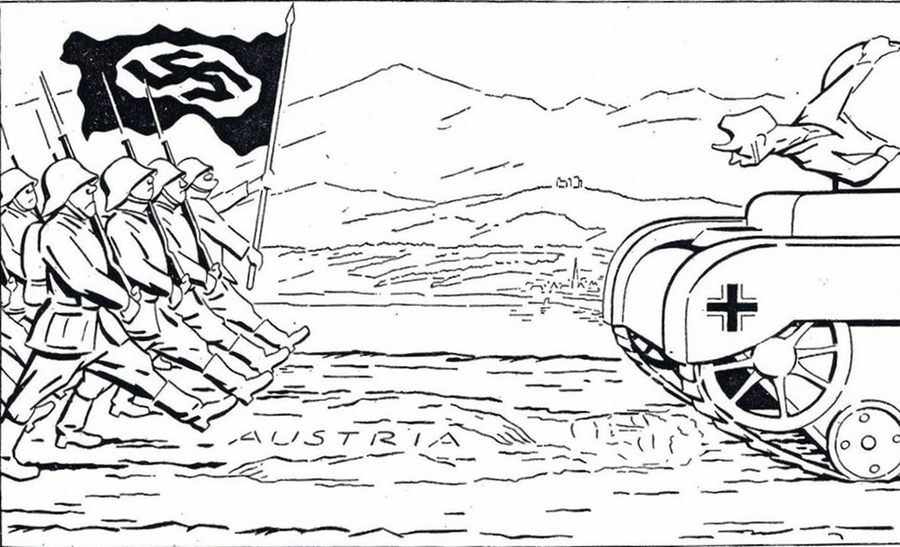
In March, 1938, Hitler ordered the Anschluss of Austria – the annexation of the Reich’s smaller, ethnically German-speaking neighbor. The Anschluss was one of the pivotal moments in the lead-up to World War II. It was Adolf Hitler’s first major act of territorial expansion. It was also a crucial test of the Western powers’ resolve to resist Nazi aggression. Their passive reaction, shaped by fear of another devastating war, internal political divisions, and a misplaced faith in appeasement, emboldened Hitler and paved the way for further territorial seizures and WWII.
The Roots of the Anschluss

The unification of Austria and Germany had long been mulled in German-speaking Europe. The collapse of the Austro-Hungarian Empire in 1918 left behind a small and vulnerable ethnically German Austria. Many Austrians hoped to unite with Germany as a way to secure political stability and economic survival. However, the 1919 Treaty of Saint-Germain-en-Laye, which formally ended Austria’s role in World War I, expressly forbade any political union between the two nations. The victorious Allies, particularly France and Britain, wanted to prevent the reemergence of a powerful Germanic bloc in Central Europe.
In the interwar years, Austria became a fragile republic beset by political turmoil. The country was sharply divided between conservatives, socialists, and later fascists, while its economy struggled amid inflation and unemployment. By the early 1930s, Austrian politics had turned authoritarian under Chacnellor Engelbert Dollfuss. In 1934, he established a one-party corporatist regime, and sought to maintain independence from Nazi Germany. When Dollfuss suppressed the Austrian Nazi movement, Hitler responded with hostility. Austrian Nazis attempted a failed coup in July, 1934, in which Dollfuss was assassinated.
Hitler and Mussolini Were Not Always Best Friends

The 1934 Austrian Nazi coup attempt failed largely because of Benito Mussolini. Back then, Il Duce and the Fuhrer had not yet become allies. The Fascist dictator, distrustful of Hitler, mobilized Italian troops along the Austrian border, and warned Germany against interference. That show of force saved Austrian independence for a few more years. Within a year, however, the European balance shifted dramatically. Italy’s invasion of Ethiopia in 1935 led to international condemnation and sanctions from the League of Nations. That drove Mussolini into Hitler’s arms. In 1936, Germany and Italy formed the Rome-Berlin Axis, which set the stage for cooperation between the fascist powers.
Without Italy on its side, Austria was left without a strong protector. Meanwhile, Hitler’s confidence grew. He had already remilitarized the Rhineland in March, 1936, in direct violation of the Treaty of Versailles. He met no serious resistance from France or Britain. That success convinced him that the Western powers lacked the will to act militarily against him. In Austria, the new Chancellor Kurt Schuschnigg tried to maintain independence by balancing between Germany and Italy. He was undermined, however, by the Austrian Nazi movement, which continued to grow in influence, encouraged and supported by Berlin.
“God Save Austria”

By early 1938, Hitler was determined to bring Austria into the Third Reich. The first step towards Anschluss was taken on February 12th, 1938, when Hitler summoned Austria’s Chancellor Schuschnigg to a meeting. It took place at the Fuhrer’s mountain retreat at Berchtesgaden, where Schuschnigg was subjected to an intense and humiliating interrogation. Hitler demanded that Austria lift its ban on Nazi political activity, and appoint key Nazis to ministerial positions. Most notably, he wanted Austrian Nazi politician Arthur Seyss-Inquart appointed minister of the interior. That would effectively give Germany control of Austria’s police and internal security. Schuschnigg reluctantly agreed under threat of invasion.
Upon his return to Vienna, Schuschnigg hoped to regain the initiative with a direct appeal to Austrian nationalism. On March 9th, 1938, he announced a plebiscite to be held on March 13th, asking voters whether they supported “a free and independent Austria”. Hitler reacted furiously. He viewed the vote as a direct challenge, and issued an ultimatum demanding Schuschnigg’s resignation and cancellation of the plebiscite. Schuschnigg faced external pressure from Germany, internal pressure from Austrian Nazis, and lacked military support from abroad. So he resigned on March 11th, declaring, “God save Austria”. Seyss-Inquart immediately took over as chancellor, and invited German troops to restore “order”.
The Anschluss

Hitler gave the orders, and on March 12th, 1938, German forces crossed the border into Austria without any resistance. They were greeted by cheering crowds waving swastikas and flowers, in scenes that were often used in Nazi propaganda films. However, those celebrations often masked the reality that many Austrians, especially Jews and others opposed to the Nazis, were terrified. The next day, Hitler triumphantly entered Vienna. In a speech at the Heldenplatz, he proclaimed the unification of Austria and Germany.
The German dictator declared that the Anschluss fulfilled the destiny of the German people. A carefully orchestrated plebiscite held on April 10th, 1938, produced a suspiciously high 99.7% approval rate for the union. Austria ceased to exist as an independent state, and became the German Reich’s province of Ostmark. The Western powers’ response was one of protest without action. Britain and France issued mild diplomatic notes condemning Germany’s violation of Austrian sovereignty, but offered no military or economic measures. The League of Nations, already discredited after its failures in Manchuria and Abyssinia, did nothing.
Why Did the Western Powers Fail to Act?

Several factors explain the international passivity, of which the Western Powers’ policy of appeasement was foremost. Both Britain and France were still deeply committed to avoiding another war at almost any cost. The memory of WWI and its massive casualties and devastation haunted an entire generation. Many politicians, especially British Prime Minister Neville Chamberlain, believed that revising the harsh terms of the Treaty of Versailles could satisfy Germany and preserve peace. To them, the unification of Germans under one state did not seem inherently unjust.
There was also a widespread perception that the Anschluss was inevitable. Many in the West viewed the union as the natural outcome of cultural and linguistic ties between the two nations. Austria was economically weak and politically unstable, and unification with Germany could solve its problems. The principle of national self-determination, invoked by US President Woodrow Wilson in WWI, was also cited to defend the union. British Foreign Secretary Anthony Eden was skeptical of Hitler’s methods. However, he acknowledged that the British public had little appetite to oppose what appeared to be a popular movement.
The Start of a Catastrophic Policy of Appeasement

Lack of military preparedness was another motive for the Western Powers’ inaction. France was politically divided and unprepared for war, while Britain’s rearmament had only just begun. Neither felt ready to confront Germany militarily in 1938, especially over Austria, which lay outside their immediate spheres of influence. In addition, the international framework of collective security had collapsed by 1938. The League of National had demonstrated its inability to enforce peace with its dismal failures to halt the Japanese seizure of Manchuria or the Italian invasion of Ethiopia. The absence of American involvement, and the lack of coordination between France, Britain, and smaller European states, meant that collective resistance to aggression was practically impossible.
The Anschluss had far-reaching consequences. It gave Germany significant strategic and economic advantages. At a stroke, the Third Reich gained control over Austria’s industries, resources, and manpower. Austria’s gold reserves and foreign exchange strengthened the German economy, while the Austrian army was absorbed into the Wehrmacht. Germany now also had a new frontier directly adjacent to Czechoslovakia, Hitler’s next target. Equally important was the psychological impact. Hitler’s bloodless victory reinforced his belief that Britain and France would not resist further expansion. That emboldened him to turn his attention to the Sudetenland in Czechoslovakia, leading to the Munich Agreement later that year. The Western powers’ failure to act in Austria was thus momentous. It set a precedent of appeasement that continued until the outbreak of WWII the following year.
Legacy of the Anschluss: A Demonstration that Appeasement Emboldens Evil

For Austria, the consequences were tragic – especially for Jews, as the Anschluss unleashed a wave of anti-Semitic violence. Austrian Nazis and civilians humiliated Jews in the streets, looted their property, and sent thousands to concentration camps. Vienna, once a vibrant center of Jewish culture, became one of the first places where the Holocaust began. Historians often cite the Western powers’ reaction to the Anschluss as a milestone in interwar diplomacy’s failure. It exposed the League of Nations’ hollowness, and as the negative consequences flowed in swift succession, the futility of appeasement. Chamberlain and others believed that peace could be preserved by accommodating some of Hitler’s demands. In practice, every concession strengthened the Nazi regime, further emboldened Hitler to make greater demands, and made war more likely.
The Anschluss was more than a political union. It was a clear demonstration of Hitler’s aggressive intentions, and the moral weakness of the international community. It showed that the post-WWI order could be dismantled piece by piece if the bad guys moved quickly and decisively, while the good guys hesitated and dithered. The Western powers’ non-reaction to the Anschluss marked not merely the end of Austria’s independence, but the end of the Western powers’ own peace and security. A mere two years after Hitler strode triumphantly through Vienna, German troops were marching past the Arc de Triomphe in Paris, and Luftwaffe bombers were pummeling London during the Blitz.

_________________
Some Sources & Further Reading
Bukey, Evan Burr – Hitler’s Austria: Popular Sentiment in the Nazi Era, 1938-1945 (2000)
Gehl, Jurgen – Austria, Germany, and the Anschluss, 1931-1938 (1963)
Shirer, William L. – The Rise and Fall of the Third Reich: A History of Nazi Germany (1990)
If you liked this, you will also like History Halls – Mistakes: The Great Leap Forward that Set China Back

