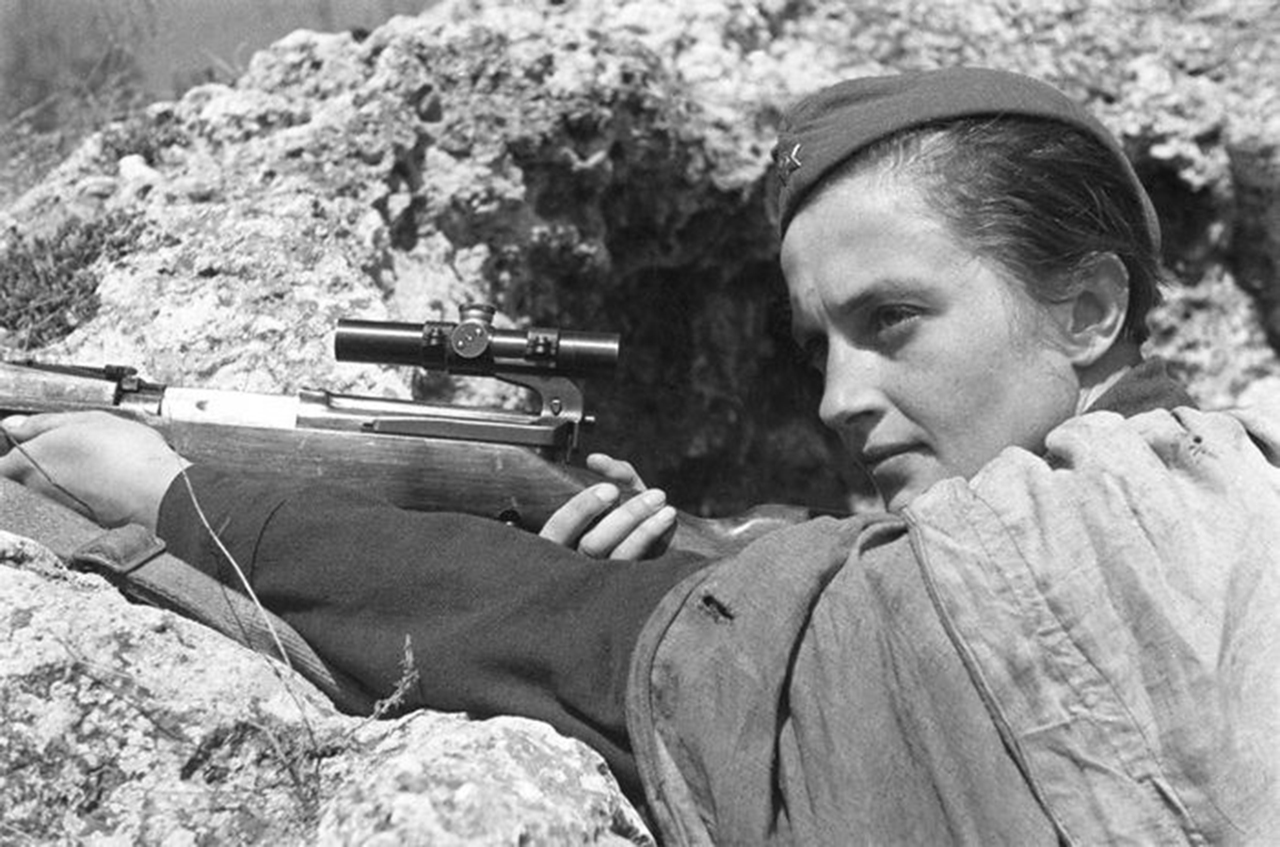
Red Army soldier Lyudmila Mikhailovna Pavlichenko, nee Belova, was World War WII’s deadliest female sniper: her tally of confirmed killed fascists was 309. She became a national heroine and celebrity, and was taken out of combat to perform public relations, in which role she toured Allied countries to drum up further support for the Soviet Union’s war effort. Below are some fascinating facts about history’s deadliest female sniper.
The World’s Deadliest Female Sniper

Pavlichenko was born to Russian parents in the Ukraine in 1916, and her family moved to Kiev when she was young. Pavlichenko was a tomboy in her childhood, and was fiercely competitive in all sports and athletic activities. As a teenager, she joined the shooting club of a paramilitary sports organization, the Volunteer Society for Cooperation With the Army, Navy, and Aviation.
Pavlichenko proved a natural with firearms, and excelled as a sharpshooter. She earned a marksmanship certificate for those skilled at precise shooting, and was awarded a coveted Voroshilov Sharpshooter badge. At age sixteen, she got married and had a son, but soon divorced. To support herself, she got a job as a grinder in a military factory.

Pavlichenko wanted to become a history teacher, so she attended Kiev University. There, she also competed in track as a pole-vaulter and sprinter. She also took a six-month sniper course run by the Red Army. When the Germans attacked the USSR in 1941, she was eager to fight the invaders.
At the time, Pavlichenko was 24-years-old, and in her fourth year of higher education. She quit college, and rushed to Odessa to enlist in the Red Army. The powers that pushed Pavlichenko to become a nurse – a role deemed more suitable for women. She declined, and insisted that she was fit and able to fight in the front with the infantry.

A Sniper Who Initially Went Into Battle Without a Rifle

Things eventually got bad enough as the Nazis plunged ever deeper into the USSR for the authorities finally relent and allow Lyudmila Pavlichenko to join the Red Army’s 25th Rifle Division. Because of dire equipment shortages, she was not issued a rifle. Instead, she was given some fragmentation grenades. She got her first taste of combat on August 8th, 1941, as her unit fought desperately to defend a hill.
Pavlichenko finally got her hands on a firearm when a fallen comrade handed her his Model 1891 Mosin-Nagant bolt-action rifle. She promptly demonstrated her lethality by shooting two enemy soldiers. From then on, she was officially designated a sniper. It was a hazardous job: in WWII, the Red Army trained and deployed 2000 female snipers, of whom only 500 survived to see war’s end.

The first two kills in August, 1941, were just a foretaste of what Pavlichenko would do to upon the invaders. Over a two-and-a-half month stretch, in what came to be known as the Siege of Odessa, German troops and their Romanian Axis allies sought to seize the Black Sea port city. She served in the battlefield throughout, and piled up an ever-growing body count of dead fascists.
By the end of August, Pavlichenko had over 100 confirmed kills, and had been promoted to the rank of senior sergeant. By the time the siege ended with the fall of the city, Pavlichenko’s body count had climbed to 187. The Soviets retreated to Sevastopol on the Crimea. There, she fought with the defenders in another siege for eight months.

Visiting Vengeance Upon the Fascists

Lyudmila Pavlichenko married a fellow sniper during the war, but it turned out to be a tragically brief marriage: her husband was fatally injured by mortar fire a few days after the wedding. That gave her yet another reason to visit vengeance upon the fascists. By May, 1942, her confirmed body count reached 257, and she was commissioned as a lieutenant.
As the number of her confirmed kills rose, commanders turned to Pavlichenko for ever more hazardous tasks. The most dangerous of those were counter-sniping missions: duels against enemy snipers. Pavlichenko excelled in those engagements, in which snipers patiently and quietly stalked each other. Death was the price paid by the first one to make a mistake, and survival was the winner’s prize.

Pavlichenko fought and won dozens of sniper duels. The most memorable one that stuck in her mind was against a particularly skilled German sniper she was ordered to eliminate during the Siege of Sevastopol. Pavlichenko carefully stalked him, even as he stalked her, for three days amidst the debris and wreckage of the city’s ruins.
As she recounted, her opponent eventually made “one move too many”, and ended up as one of thirty six enemy snipers eliminated by her. As the Siege of Sevastapol progressed, Lyudmila Pavlichenko’s lethal reputation grew. She began to train other snipers, and by the time the siege ended, Pavlichenko’s trainees had killed roughly one hundred enemy soldiers.

309 Confirmed Killed Fascists

Lyudmila Pavlichenko’s confirmed kill count reached 309 by June, 1942. By then, she had earned the nickname “Lady Death”, and was a famous Soviet national heroine. She was also-well known to the enemy. The Germans tried to bribe Pavlichenko, and sent messages across the front lines via loudspeakers that blared stuff like: “Lyudmila Pavlichenko, come over to us. We will give you plenty of chocolate and make you a German officer”.
Unsurprisingly, that did not work. So the inducements became threats. Towards the end of her time in Sevastopol German loudspeakers blared: “If we catch you, we will tear you into 309 pieces and scatter them to the winds!” Pavlichenko was not scared. Indeed, the fact that the fascists knew exactly how many of them she had killed brought her great joy.

Pavlichenko was gravely wounded in June, 1942, by mortar shell fragments that hit her face and head. Stavka, the Soviet High Command, was not about to let a national heroine die because of inadequate medical care in the besieged and hard-pressed Sevastopol if they could do anything about it. So they ordered her evacuated by submarine.
Pavlichenko spent about a month in a hospital, recovering from her wounds. She was eager to return to the front lines, but unbeknownst to her, her combat career was over. The powers that be decided that having already eliminated more than three hundred fascists, Lady Death had fought enough. From then on, she would be more valuable to the war effort doing PR than killing Nazis.

From Combat to Public Relations

After her close brush with the Grim Reaper, Soviet authorities decided not to further risk the life of Lyudmila Pavlichenko, who by then had become a national heroine. They figured she would be more valuable to the national war effort as a trainer who prepared other snipers for the rigors of combat. She would be even more valuable in a public relations role, both at home and abroad.
In late 1942, the hard-pressed Soviets desperately wanted their allies to launch a second front to relieve the pressure on them. So Pavlichenko was sent to America to drum up support for a second front. She became the first Soviet citizen received by a US president, when Franklin D. Roosevelt welcomed her to the White House. She also became a lifelong friend of First Lady Eleanor Roosevelt, who invited her to tour the United States and recount her experiences.

A ‘Girl Sniper’ in America
Pavlichenko was taken aback by the American press. She had been in combat for a year and killed over 300 enemy soldiers, but was referred to as the “Girl Sniper”, and was questioned about the kind of lipstick and makeup she used on the front lines. As she recalled: “One reporter even criticized the length of the skirt of my uniform, saying that in America women wear shorter skirts and besides my uniform made me look fat”.
Pavlichenko stolidly plugged on, and won great applause in a Chicago speech when she stated: “Gentlemen, I am 25 years old and I have killed 309 fascist occupants by now. Don’t you think, gentlemen, that you have been hiding behind my back for too long?” During her tour, Pavlichenko spoke of the lack of racial segregation in the Red Army, and its gender equality – both matters in which America’s military lagged far behind.

Away From the Front Lines

By the time she left America, Pavlichenko had made an impression. She even inspired Woody Guthrie to write a hit song about her, Miss Pavlichenko. Her PR tour also took her to Britain and Canada. When she arrived in Toronto, she was greeted by thousands of well-wishers, and presented with a scope-mounted sniper rifle, now on display at the Central Armed Forces Museum in Moscow.
In Britain, Pavlichenko gave speeches, visited factories and the ruins of Coventry Cathedral, and accepted donations for the Red Army. Despite her best efforts, however, Pavlichenko and the Soviets had to wait for the second front. It was to be another two years before the Western Allies invaded France in June, 1944.
Pavlichenko After the War

When she returned to the USSR, Pavlichenko was promoted to major, given the country’s highest military distinction, the title Hero of the Soviet Union, as well as the Order of Lenin – the highest civilian distinction – twice. She repeatedly requested that she be returned to the front lines, but was never allowed back into combat, and trained snipers until war’s end. Afterwards, she resumed her studies and graduated from Kiev University with a history degree.
Unfortunately, Pavlichenko struggled with depression and PTSD for many years. In 1957, during a visit to Moscow, Eleanor Roosevelt insisted that she see her friend, Pavlichenko. Amidst high Cold War tensions, the reunion took place under KGB supervision. The two women gave their attendants the slip long enough to catch up, laugh, and reminisce about the months spent together touring America. Lyudmila Pavlichenko, history’s most lethal female sniper, passed away in 1974 after a stroke.

_________________
Some Sources & Further Reading
History Halls – Fighting Women: The Trung Sisters
National World War II Museum – “Lady Death” of the Red Army: Lyudmila Pavlichenko
Pavlichenko, Lyudmila – Lady Death: The Memoirs of Stalin’s Sniper (2018)
Vinogradova, Lyuba – Avenging Angels: Young Women of the Soviet Union’s WWII Sniper Corps (2017)

