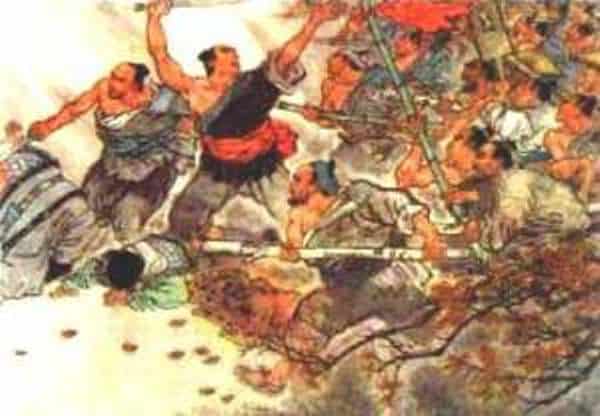
Chinese peasants were routinely exploited and oppressed for thousands of years. Like many of their peers around the world, they were forced to patiently endure their lot. On occasion, however, things got so bad that their patience snapped. When that happened, they rose in rebellions that rocked the country and terrified the upper classes. One such was the Red Eyebrows Rebellion, which erupted in 15 AD and led to years of turmoil and bloodshed.
Political Turmoil Amidst Disasters and Growing Peasant Resentment

The Yellow River was the cradle along whose banks China’s civilization emerged. It has not always been nurturing, however: the Yellow River is also known as the “River of Sorrows” because of its volatility and tendency to course change or flood from time to time, often with dire consequences. One such time was a stretch between 2 – 11 AD, when catastrophic course changes led to floods, famines, and widespread dislocation and hardship. Amidst the sufferings, civil war erupted in 8 AD.
That year, a government official named Wang Mang (45 BC – 23 AD), who had ruled China for years through a puppet emperor, overthrew the Early Han Dynasty that had reigned over China for two centuries. He declared himself emperor, and founded the short-lived Xin Dynasty. The political turmoil, natural disasters, hardships and hunger, took place against a backdrop of an increasingly exploited and resentful peasantry. Their chief grievances were a rise in debt bondage, through which farmers unable to pay back usurious loans were enslaved, and a steady consolidation of agricultural land into large tracts controlled by powerful magnates.
The Rise of the Red Eyebrows

Traditionally, Chinese agriculture had been dominated by a class of independent peasant yeomen who owned their small farms. Over time, however, powerful figures began to take over those small holdings, and consolidate them into giant agricultural estates. The former small plot owners and their descendants became tenant farmers or serfs. They were forced to till what had once been their own family farms on behalf of others, or were kicked off the land altogether and reduced to a life of itinerant wanderers.
In response to the turmoil and to protect the peasants’ interests, a secret society emerged and began to organize. Its leader spoke through mediums, and organized bands of armed Chinese peasants known as the Red Eyebrows. They took their name from the color of the eyebrows of their members, who painted their faces to look like demons. Their first act of armed resistance occurred in 15 AD, and their popularity steadily grew. By 17 AD, the Red Eyebrows movement had morphed into a widespread peasant rebellion led by a Fan Chong.
Victory, Followed by Debacle

As peasant revolts exploded across China, back in the imperial palace, Emperor Wang Man, also known as the “Usurper Emperor”, proved politically incompetent. In 19 AD, his response to the Red Eyebrows Rebellion and other peasant uprisings was to raise taxes. That took a bad situation and made it worse, as the tax hikes fueled and supercharged the preexisting revolts, and triggered new uprisings. Soon, various rebel bands began to consolidate into a massive insurrection under the banner of the Red Eyebrows and the leadership of Fan Chong.
The Red Eyebrows displayed their power in 23 AD, when they played a key role in the defeat and overthrow of Emperor Wang Mang and ended his short-lived Xin Dynasty. That allowed an opening for a member of the Han family, Liu Xuan, to reestablish the Han Dynasty and declare himself emperor. His rule did not sit well with the Red Eyebrows, however. So they overthrew Liu Xuan, and placed a child Han descendant on the throne as a puppet emperor.
The peasant rebels then proceeded to rule China in their puppet ruler’s name. However, while militarily brilliant, the Red Eyebrows were politically inept. They proved incompetent at governance and administration, and their misrule soon led to widespread revolts. Their puppet emperor was overthrown and replaced by another Han descendant, Liu Xiu. He forced the surrender of the Red Eyebrows and brought their movement to an end, then went on to found the Later Han Dynasty, which reigned for two centuries.

_________________
Some Sources & Further Reading
Encyclopedia Britannica – Wang Mang, Emperor of Xin Dynasty
History Halls – Peasant Rebellions: When the Downtrodden Fight Back
Thomsen, Rudi – Ambition and Confucianism: A Biography of Wang Mang (1988)

