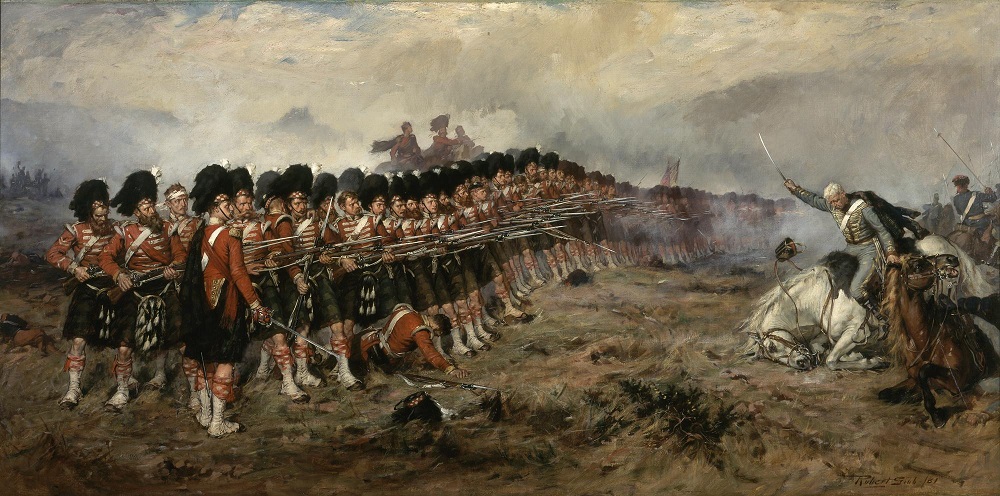
The “Thin Red Line” at the Battle of Balaclava in 1854 is one of British military history’s most enduring images. It captured the Victorian imagination, and was immortalized in journalism, art, and legend. Unlike the chaotic Charge of the Light Brigade, which occurred the same day and ended disastrously, the Thin Red Line represented discipline, courage, and steadfastness. Also, unlike the Charge of the Light Brigade, it ended with success, not failure.
The British Base at Balaclava

The Crimean War (1853 – 1856) was fought primarily between the Russian Empire and an alliance of Britain, France, the Ottoman Empire, and later, Sardinia. The conflict was rooted in rivalry over influence in the declining Ottoman Empire, and control of the Black Sea’s strategic waterways. Britain and France sought to prevent Russian expansion at the expense of the Ottomans, lest it disrupt the balance of power in Europe and threaten trade routes to India. In September, 1854, allied forces landed on the Crimean Peninsula and marched on the Russian stronghold of Sevastopol.
After the bloody but successful Battle of Alma, the allies began a long siege of Sevastopol. The Russians tried to break the siege through offensives against the allied supply base at Balaclava, a port on the southern Crimean coast. It was there, on October 25th, 1854, that the famous “thin red line” was formed. The Battle of Balaclava consisted of a series of Russian attacks that sought to cut the allied lines. It produced three distinct moments that became legendary: the stand of the Highland Brigade – the Thin Red Line; the charge of the Heavy Brigade; and the catastrophic Charge of the Light Brigade.
The Russian Cavalry Advance

Early in the morning of October 25th, 1854, Russian forces advanced towards Balaclava. Their objective was to seize the town, and disrupt allied logistics. The British commander, Lord Raglan, had deployed his forces thinly to cover a broad front. The included the 93rd Sutherland Highlanders Regiment of Foot, commanded by Sir Colin Campbell, a seasoned officer known for his stern discipline and courage. His Highlanders, clad in their dark tartan kilts and red jackets, were stationed on a ridge to cover Balaclava’s approaches. At around 9:00 AM, a large body of Russian cavalry, estimated at around 2,500 horsemen, advanced toward the British position.
Normally, infantry faced with cavalry would form a square, a formation designed to repel mounted troops. However, Campbell did not have enough men to form an effective square: he had fewer than 500 Highlanders with him. Instead, he made the bold decision to stretch his men out in a thin, two-deep line across the ridge. That went against convention, which called for a line at least four-deep to withstand cavalry. However, Campbell wanted to maximize firepower, and thought it worthwhile to sacrifice mass in order to achieve that. It was a gamble: cavalry could punch through and break such a thin line if it faltered.
The Stand of the 93rd Sutherland Highlanders Regiment of Foot

The Highlanders did not falter, and stood firm as the Russian cavalry confidently approached. Campbell refused to let his men retreat Balaclava, and declared: “There is no retreat from here, men. You must die where you stand”. His words stiffened their resolve. The Russians advanced confidently, expecting the infantry to break. When they came within 800 yards, Campbell ordered the Highlanders to fire a volley. A disciplined line of musket fire cracked across the field, and halted the Russian charge.
The Russian horsemen collected themselves, regrouped and tried again, but the Highlanders delivered another deadly volley at 500 yards. The enemy cavalry wavered, stopped in its tracks, then turned around and withdrew, unwilling to break themselves against the steady red-coated line. Some Highlanders started forward, eager to countercharge the wavering Russians. Campbell steadied them with a cry of: “93rd, damn you Highlanders for all that eagerness!” The regiment stayed put, and held its position protecting the approach to Balaclava as the Russians rode away.
“The Thin Red Line Tipped With Steel”

The stand of the 93rd and the Thin Red Line might have passed into obscurity, were it not been for the reporting of William Howard Russell, the correspondent for The Times. Russell witnessed the stand, and immortalized it in a dispatch in which he wrote that nothing stood between the Russians and the vulnerable British base “but the thin red line tipped with steel”. His vivid phrase entered history as the “Thin Red Line”, symbolizing the fragility of the British position, and the unbreakable resolve of the men defending it.
Russell’s reporting shaped the public’s perception of the Crimean War, and brought modern warfare’s realities to readers at home. The Thin Red Line became a patriotic image that contrasted sharply with the disaster of the Light Brigade later that same day. Whereas the Light Brigade represented the futility of blind obedience and miscommunication, the Thin Red Line embodied discipline, courage, and clear command. The stand of the 93rd was not a large-scale battle – the Russians had been probing the defenses, and pulled back rather than commit fully. Nonetheless, its symbolism was enormous.
A Minor Clash With Enormous Significance

In purely tactical terms, the stand of the 93rd Highlander Regiment against the Russian cavalry was a minor clash. In the Victorian imagination, however, it stood for the steadfastness of British soldiers, their ability to hold their ground against overwhelming odds, and the cool leadership of officers like Campbell. The event was immortalized in art, most notably in Robert Gibb’s 1881 painting The Thin Red Line, which depicted the Highlanders in their tartan kilts, their formation stretching across the field against a looming mass of cavalry.
That romanticized image reinforced the idea of a small group of resolute men standing as the last defense of civilization against barbarism. The phrase “thin red line” became a metaphor for a small but resolute defense that stands between order and chaos. Over time, it came to be used more broadly, even in contexts outside the military. In the late nineteenth and twentieth centuries, it was often invoked, especially in the US, to describe the “thin blue line” of police, or the “thin green line” of the US Army, as guardians of stability.
Sir Colin Campbell and the 93rd Sutherland Highlanders

As to the man most responsible for the thin red line, Sir Colin Campbell’s leadership was crucial to the event. Born in Glasgow in 1792, he had fought in the Peninsular War and the First Anglo-Chinese War, before he was appointed to command the Highland Brigade in Crimea. Campbell’s decision to hold his men in line rather than form square showed both tactical insight, and trust in their discipline. After Balaclava, Campbell’s reputation was greatly enhanced. He later played a key role in suppressing the Indian Rebellion of 1857, became Commander-in-Chief, India, the supreme commander of the Indian Army, organized the army sent to fight the Second Opium War, and retired as a field marshal.
The 93rd, mostly recruited from the Scottish Highlands, was already known for fierce loyalty and martial prowess. Formed in 1799, it differed significantly from most other British Army regiments, whose men were recruited mostly from the poorest margins of urban societies. By contrast, the men of the 93rd were described as “the children of respectable farmers… connected by strong ties of neighborhood and even of relationship”, and “a sort of family corps”. Their steadfast stand at Balaclava added to the Highland regiments’ reputation as elite troops within the British Army. For the Victorian public, the image of kilted Scots repelling Russian cavalry became a point of pride.
The Significance of the Thin Red Line

The Thin Red Line is often remembered alongside the Charge of the Light Brigade, which occurred later that same day. The Light Brigade, following a misinterpreted order, charged directly into Russian artillery and suffered devastating losses. Both moments entered British legend, but they carried opposite messages. The Charge of the Light Brigade symbolized tragedy, futility, and the cost of mismanagement. The Thin Red Line represented steadiness, discipline, and victory against the odds. Together, they encapsulated the contradictory nature of the Crimean War: a conflict marked by bravery and endurance, but marred by mismanagement, poor planning, and needless suffering.
The Thin Red Line at the Battle of Balaclava was a small engagement that carried enormous symbolic weight. In standing their ground against Russian cavalry, Sir Colin Campbell and the 93rd Highland Regiment of Foot embodied the ideals of courage and discipline that Victorian Britain celebrated. Through the reporting of William Howard Russell and the imagery of later artists, the Thin Red Line became a powerful metaphor that outlived the Crimean War. It remains part of the collective memory of military history, a phrase that conveys the idea of a fragile yet unbreakable defense. More than 170 years later, the Thin Red Line continues to evoke the image of soldiers holding firm against overwhelming odds – an enduring symbol of the resolve and courage of those who wear the uniform.

_________________
Some Sources & Further Reading
Greenwood, Adrian – Victoria’s Scottish Lion: The Life of Colin Campbell, Lord Clyde (2015)
History Halls – The Battle of Agincourt: The Most Stunning English Victory of the Hundred Years War
Pemberton, William Baring – Battles of the Crimean War (1962)
Selby, John – The Thin Red Line of Balaclava (1970)

