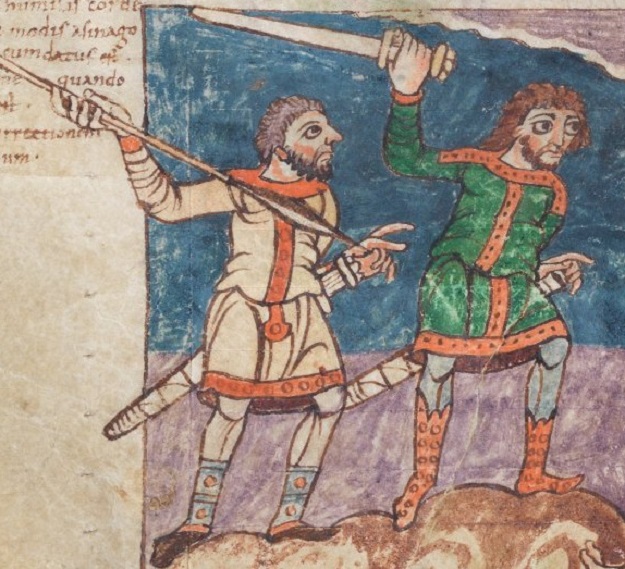
In the Danish legend of Offa of Angel, the hero was slated to fight two Saxon warriors, only for his swords to break mid-combat. So his father, aged and blind King Wermund, ordered his old sword “Skraep” dug up from the ground, where he’d buried it after he became too enfeebled to use it. Armed with his father’s sword, Offa defeats the Saxons, as his father shouts “That was Skraep that struck!” each time he father heard a strike. The story highlights the high regard Vikings had for their swords. And well they should have, as they used one of history’s more transformative blades.
The Viking Sword

The Viking sword was a double-edged and relatively light straight weapon that weighed between two to four pounds. It managed to stay light with a fuller that ran down the blade’s, which reduced weight without compromising strength. The blade measured between two and three feet, and was 1.5 to 2.3 inches wide. It was balanced by the hilt and pommel, while a slight blade taper helped bring its center of balance closer to the hilt. The grip was typically made of wood wrapped in leather.
For the elites and those who could afford it, the sword’s grip could by wrapped with gold or silver wire. By the close of the Viking era, blade lengths had increased. Some recovered samples dating back to that period had blades that measured up to three and a half feet long. The sword’s tip was not pointed, but rounded. A rounded tip is stronger than an acute one, and in that environment, before effective armor became widespread, was not significantly less effective at thrusting than a sharply pointed blade.
The Misnamed “Viking” Sword

“Viking sword” is actually a misnomer. It implies that it was developed or used more by Vikings than other peoples, when that was not so. What we know as the Viking sword was developed by Frankish swordsmiths in the Frankish Empire in the Carolignian era. It got its name because the most and best preserved samples were recovered by archaeologists from Viking burial sites. By the time the swords’ true provenance had been recognized, “Viking sword” had already stuck. “Carolignian sword” or even “Viking era sword” would have been more accurate.
Viking swords first emerged in the eighth century, having evolved from the Merovignian sword. That, in turn, had evolved from the Roman spatha. Merovignian swords were widespread in Northern and Western Europe in the early Middle Ages. Early versions of the Viking sword were made via pattern welding, with iron bars of soft and hard qualities – a combination that allowed for flexibility and strength. The bars were welded together with heat, then twisted and drawn out in a thin strip to form the blade. Pattern welding was abandoned after metallurgical advances produced quality iron that could be smelted into good steel for sword blades.
Use and Evolution of the Viking Sword

In use, the Viking sword was wielded one-handed, although some historic texts mention two-handed use. However, the sword’s ergonomics cast some doubt on that. Viking sword handles between hilt and pommel are commodious for a single handed grip. However, there is not enough space for a two-handed grip. Some speculation posits that when the texts referred to two-handed use, they did not mean two hands on the handle. Instead, they referred to one hand gripping the sword’s handle, while the other cupped the wrist of the sword hand to deliver blows with significantly more power. Viking swords gradually evolved, and led to the development of the Crusader era’s knightly sword in the eleventh century.
_________________
Some Sources & Further Reading
Art Institute Chicago – The Art of the Viking Sword
National Museum of Denmark – Viking Swords

