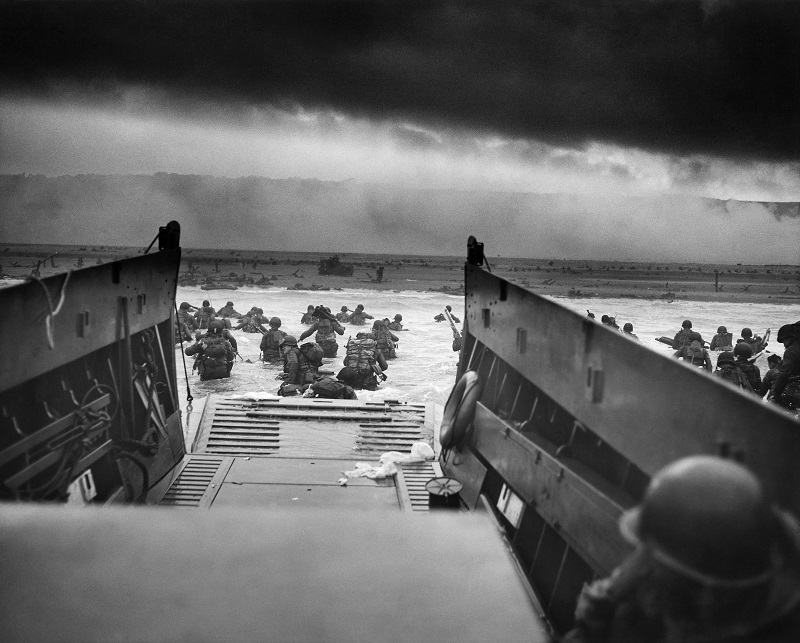
Few people exemplify the impact of ingenuity and determination quite like Andrew Jackson Higgins, the American boat designer and builder whose innovative landing craft, popularly known as the “Higgins boat”, reshaped the course of amphibious warfare in the Second World War. Dwight D. Eisenhower described him as “the man who won the war for us”. His contribution was not forged on the battlefield, although it greatly impacted battles, but in the shipyards of New Orleans. His story is a fascinating blend of entrepreneurial drive, engineering brilliance, and a stubborn refusal to accept limits.
The Civilian Boat That Started it All

Andrew Higgins was born on August 28th, 1886, in Columbus, Nebraska. He was an ambitious, restless youth, frequently at odds with authority. By the time he reached adulthood, Higgins had earned a reputation for independence, unrelenting energy, and a fiery temper. Those traits served him well as a businessman. After working in the lumber industry and developing a familiarity with logistics and shipping, Higgins moved to New Orleans. There, the expansive bayous and shallow waterways inspired him to experiment with boat design. In 1922, he had founded the Higgins Lumber and Export Company. By the late 1920s, he had shifted his focus to boat building.
The new company, Higgins Industries, specialized in shallow-draft vessels able to navigate Louisiana’s swamps and marshes. The boats, designed for logging operations and oil exploration, needed to handle both shallow waters and difficult conditions. Higgins’ first major design was the Eureka boat, a rugged and versatile craft with a shallow draft. Its propeller was recessed into a tunnel, which allowed it to move over sandbars and swampy terrain without damage. That commercial utility boat became the unlikely ancestor of one of the twentieth century’s most consequential military vessels.
Adapting a Civilian Boat Into a Military One

By the late 1930s, global tensions were escalating, and military planners were considering the enormous challenges of amphibious operations. The US Navy and Marine Corps were faced with a challenge: how to land troops, vehicles, and equipment directly onto beaches in contested areas. Existing landing craft were inadequate. They either grounded too far offshore, or forced troops to clamber over the sides into the surf. That left them and their occupants vulnerable to enemy fire. When the Marines discovered Higgins’ Eureka boat in 1938, they recognized its potential. The craft could get as close to the shoreline as possible, even deliberately run itself aground in shallow water, then reverse quickly and depart – a critical advantage for combat operations.
However, while the Marines admired the Eureka boat’s performance, they demanded a modification: a bow ramp. Instead of force troops to leap over the sides, a ramp would allow soldiers and vehicles to disembark directly onto the beach. There was a problem, however: the Navy would not pay him to make a prototype. Andrew Higgins, characteristically impatient with bureaucracy, went ahead and built the new design himself at his own expense, even though it put his then-still-small company under serious financial strain. He incorporated a steel bow ramp that could be lowered and raised via pulleys, which enabled rapid deployment. That new model became the LCVP (Landing Craft, Vehicle, Personnel), better known as the Higgins boat.
The Higgins Boat

The Higgins boat was deceptively simple, yet ingenious in design. It was 36 feet long and 10 feet wide, and could carry a platoon of 36 soldiers, a Jeep and 12 men, or 8,000 pounds of cargo. Constructed primarily of plywood to conserve steel, it was inexpensive, lightweight, and relatively easy to mass-produce. The boat’s shallow draft and flat bottom allowed it to approach shorelines that larger vessels could not. Once beached, the bow ramp dropped, and troops stormed ashore in seconds. That design revolutionized amphibious warfare. Before the Higgins boat, landing under fire was slow, chaotic, and often disastrous. With it, troops could move from sea to land in an organized, rapid assault.
The boat’s versatility also meant it could be used in rivers, swamps, and open seas. That gave Allied forces unprecedented mobility. Andrew Higgins’ design didn’t stop with the LCVP. His company developed a wide range of landing craft, including the LCM (Landing Craft, Mechanized) to ferry tanks and heavy vehicles from assault ships directly to enemy-held shores, and larger troop transports. At its wartime peak, Higgins Industries was operating seven plants in New Orleans, employing more than 20,000 workers, including women and African Americans at a time when segregation still shaped much of American industry.
The Hard Driving Andrew Higgins

Andrew Higgins was as colorful as his boats. Known for his explosive temper, salty language, and relentless demands, he was both feared and admired by his employees. He paid his employees top wages – and expected top performance in return. One of his favorite phrases was “The guy who relaxes is helping the Axis!” He had it printed on banners and displayed in his factories. He tolerated no inefficiency, yet he was fiercely loyal to his workforce. Higgins employed New Orleans’ first ever fully integrated workforce of blacks and whites, men and women. His willingness to integrate women and minorities into his factories was radical for the time, and he promoted workers based on ability rather than social standing. The workforce’s notable integration compared to many other wartime factories reflected both necessity, and Higgins’ no-nonsense attitude toward efficiency.
Higgins often clashed with military bureaucracy. Navy officials had initially resisted his designs, and preferred to develop their own. Higgins, however, was combative and persuasive. He pointed out the shortcomings of competing designs, and demonstrated the effectiveness of his boats directly to skeptical officers until he won them over. His ability to push past resistance and deliver what the troops needed – often faster than the military procurement process allowed – proved essential to the war effort. He could be acerbic, and his hard driving and often abrasive personality did not endear him to many. Columnist Drew Pearson wrote of him: “[Higgins] is very disagreeable, likes to write insulting letters to admirals, gets on almost everyone’s nerves, but is a genius when it comes to small-boat design”.
Andrew Higgins Revolutionized Amphibious Warfare

The Higgins boat became a cornerstone of Allied strategy. It saw action in nearly every amphibious landing of the war. The boats debuted in major numbers in the Pacific Theater, where island-hopping campaigns required landing troops on heavily defended beaches. The Marines who stormed Guadalcanal, Tarawa, Saipan, and countless other islands, relied on Higgins boats to carry them ashore. But it was in the European Theater that the Higgins boat gained its legendary status. On D-Day, June 6th, 1944, more than 1,500 Higgins boats ferried soldiers of the Allied Expeditionary Force onto the beaches of Normandy.
The sight of the ramps of Higgins boats dropping into the surf as troops rushed forward under fire became one of the defining images of the war. Without the Higgins boat, Eisenhower later stated, the invasion of Normandy – and by extension, the liberation of Western Europe – might have been impossible. Historian Stephen Ambrose echoed Eisenhower’s sentiment, and noted that Higgins’ craft “invented the modern amphibious assault”. Andrew Higgins headed a massive manufacturing operation in WWII, and by war’s end, more than 23,000 boats had been built by Higgins Industries and licensees. Unfortunately, he struggled to adapt after the guns fell silent and the demand for landing craft plummeted.
A Rapid Rise in Wartime, Followed by a Rapid Peacetime Decline

Higgins attempted to pivot into peacetime production. He made pleasure boats, aircraft, and even appliances, but the company never regained its wartime prominence. Higgins Industries was liquidated on November 9th, 1945. The following year, its industrial properties were transferred to a new company, Higgins Inc., focused on making pleasure watercraft. However, the market was not yet there in the immediate postwar years for such products, and by 1948, most activities had ceased. As to Andrew Higgins, he passed away in New Orleans from stomach cancer in 1952, at the age of 65, just a few years after the company closed.
Despite the decline of his business, Higgins’ legacy endures. Military historians routinely cite his contribution as pivotal to Allied victory. His boats symbolize not just engineering innovation but the marriage of civilian industry and military necessity amidst total war. Andrew Higgins was not a general or a statesman. He did not lead armies or shape grand strategy. Yet his invention, the Higgins boat, enabled those strategies to succeed. By solving the problem of how to move men and machines from sea to hostile shore, he gave the Allies a tool that allowed them to conduct amphibious operations on an unprecedented scale.
The Legacy of Andrew Higgins and the Higgins Boat

In the words of Eisenhower, “[Andrew Higgins] is the man who won the war for us. If Higgins had not designed and built those landing craft, we never would have landed over an open beach. The whole strategy of the war would have been different”. Eisenhower’s statement captures the essence of Higgins’ impact. Without his boats, victories at Normandy, in the Pacific, and across the globe would have been far more costly – if they could have been achieved at all.
Higgins’ story reminds us that wars are not only won by soldiers and generals, but also by inventors, engineers, and entrepreneurs whose vision and persistence provide the means for victory. His boats carried millions of men across perilous waters and into the crucible of combat. They changed the fate of nations, and earned Andrew Higgins an enduring place in history. Today, preserved Higgins boats can be found in museums around the world, including the National WWII Museum in New Orleans, which features a pavilion dedicated to his work. They stand as reminders of how a single inventive solution, conceived by a stubborn and visionary boat builder, could alter the outcome of a global conflict.

_________________
Some Sources & Further Reading
Herman, Arthur – Freedom’s Forge: How American Business Produced Victory in World War II (2012)
History Halls – American Tanks of World War II: The M4 Sherman Medium Tank
Smithsonian Magazine, June 3rd, 2019 – The Invention That Won World War II
Strahan, Jerry E. – Andrew Jackson Higgins and the Boats That Won World War II (1994)

