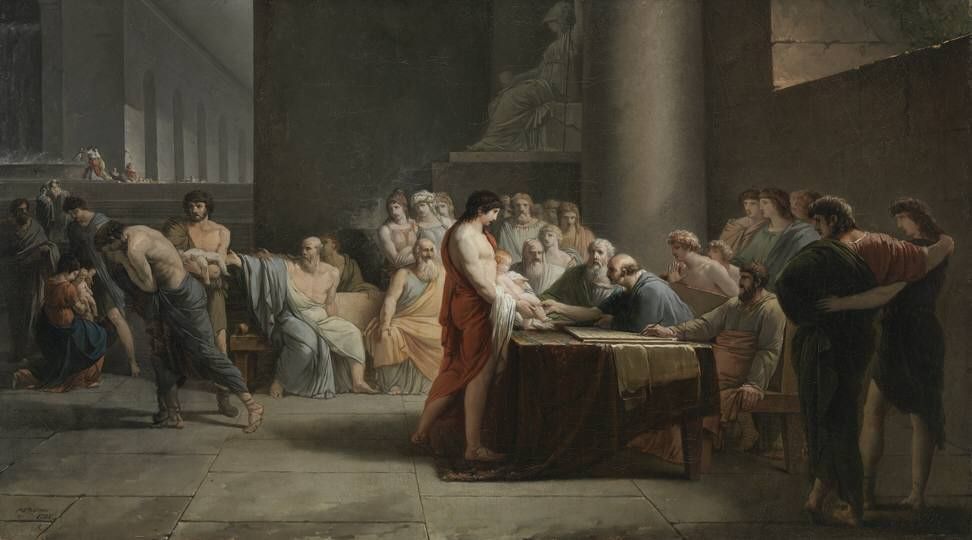
Ancient Greek author Plutarch wrote in a biography of Spartan statesman Lycurgus that newborns in Sparta used to be taken to a council of elders for inspection. Those who were healthy and hale were raised, but the weak and sickly were abandoned outdoors and left to die. For thousands of years, Plutarch’s description of Spartan eugenics was accepted at face value. How true was it, though?
Infant Exposure in Ancient Greece

For thousands of years, ever since Plutarch wrote about Sparta’s practices regarding newborn babies, his description was accepted as true. It was widely believed that the Spartans practiced eugenics as a matter of state policy, to raise strong warriors and citizens. Modern research has challenged that take. To be sure, infant exposure did happen back then, and happened all too often. For thousands of years, across many cultures, unwanted babies were often abandoned and left to their fate – which was seldom good.
Throughout most of history, life has seldom been a bed of roses. Most of our ancestors led lives that were orders of magnitude tougher than anything we experience today. Things we find shockingly cruel today, such as infanticide of unwanted children, were seen as routine by many. In ancient Greece, for example, unwanted children were often abandoned in the wilderness. There, they perished from exposure to the elements, thirst or hunger, attacks by wild animals, or, if they were lucky, were saved by a passerby.
Spartan Eugenics

The Spartan government reportedly ramped up infanticide into eugenics as a matter of state policy. In his Life of Lycurgus, a biography of the ancient Spartan statesman and lawgiver, Plutarch wrote: “Offspring was not reared at the will of the father, but was taken and carried by him to a place called Lesche, where the elders of the tribes officially examined the infant … if it was well-built and sturdy, they ordered the father to rear it, and assigned it one of the nine thousand lots of land;
but if it was ill-born and deformed, they sent it to the so‑called Apothetae, a chasm-like place at the foot of Mount Taÿgetus, in the conviction that the life of that which nature had not well equipped at the very beginning for health and strength, was of no advantage either to itself or the state”. However, Plutarch might have been mistaken. After all, he penned his Life of Lycurgus around 100 AD. That was five hundred or more years removed from Sparta’s fifth century BC heyday, and three centuries after Sparta had ceased to exist as an independent polity.
Infanticide Was Common In Much of the World and Throughout Much of History

Infanticide was widely used throughout history and across many societies to get rid of children who, for whatever reason, were unwanted. People in ancient Greece often exposed unwanted infants, and deemed it the best and most moral means to get rid of unwanted children. As they saw it, exposure was not as morally repugnant as the outright murder of an infant. From the ancient Greeks’ perspective, if they exposed a baby, then its fate was in the hands of the gods.
The gods might act directly in order to rescue the child. Or they might send a kind-hearted passerby might do so. Infant exposure often occurred in the context of hardships in difficult times that made an extra mouth to feed problematic. Some, however, took that further, and took infant exposure from cruel necessity to eugenics. For example, Aristotle advocated that deformed infants be exposed. He wrote: “As to the exposure of children, let there be a law that not deformed child shall live”.
Ancient Spartan Eugenics and the Modern Eugenics Movement

Plutarch popularized the notion of Spartan eugenics, whereby the state decided whether newborns were healthy enough to rear, or not. Throughout ancient Greece, whether to keep or expose a newborn baby was usually the father’s decision. The exception was Sparta, where a group of Spartan elders made that choice. The goal was to produce strong warriors to maintain Sparta’s military dominance. To that end, the Spartan state involved itself in the matching of couples for their physical and mental traits.
When those parents had offspring, the authorities decided which newborns to keep, and played a key role in their upbringing. Spartan children were raised in brutally tough state boarding schools, to ensure their development in accordance with Sparta’s ideals. Thousands of years later, a eugenics movement arose, and had its heyday in the late nineteenth and first half of the twentieth centuries. Its adherents admired Sparta’s child selection and rearing practices. Or at least what they thought were Sparta’s child rearing practices. As seen below, recent research has cast doubt on whether infant exposure was as common in Sparta as has long been believed.
Was Spartan Eugenics a Myth?

Modern eugenicists looked back at history, admired Spartan manliness, and figured the ancient Spartans must have been on to something. However, what if Spartan infanticide as a matter of state policy is just a myth? The only evidence for widespread Spartan infant exposure is a single passage from the Life of Lycurgus. Plutarch wrote hundreds of years after Lycurgus had died. Moreover, he was more concerned with biographical details about his subject’s life, than with details about Sparta as a whole.
Additionally, there are many examples of ancient Greeks who were reared despite birth deformities. Their numbers even include a Spartan monarch, King Agesilaus II (444 – 360 BC), who was born lame. Despite that deformity, he was not exposed, and instead grew up to become a formidable warrior. Of course, the absence of (additional) evidence of Spartan infanticide is not evidence of absence. It could well be that Sparta did practice eugenics, as described by Plutarch, but that there were some exceptions to the rule. The debate continues.

_________________
Some Sources & Further Reading
History Halls – Myths and Realities: Just How Short Was Napoleon?
Plutarch – Parallel Lives: Lycurgus

