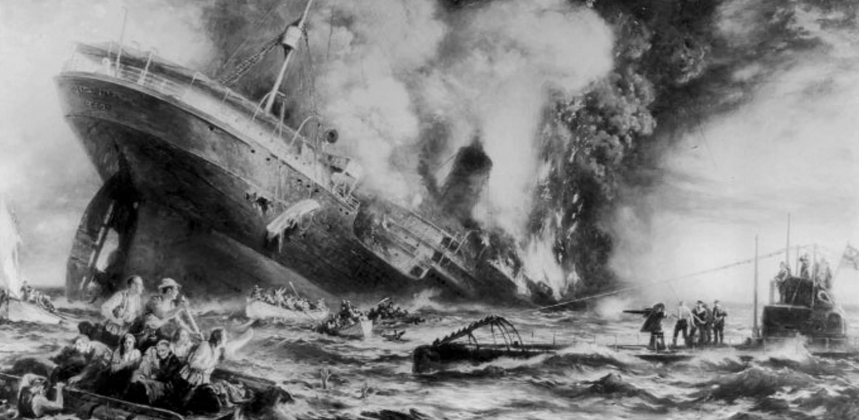
The sinking of the RMS Lusitania on May 7th, 1915, was one of the most infamous maritime tragedies of the First World War. It not only cost the lives of nearly 1,200 people, but also profoundly shaped international opinion and nudged the United States closer to involvement in the war.
Submarines vs Civilian Ships

The RMS Lusitania was a British ocean liner owned by the Cunard Line. She was launched in 1906, amid competition between British and German companies for dominance of the lucrative transatlantic passenger trade. One of the biggest and fastest ships afloat, she was designed to carry over 2,000 passengers, along with crew. The Lusitania could travel at a remarkable 25 knots, which enabled her to outrun most contemporary warships. Although primarily a luxury passenger liner, Lusitania had been built with Admiralty subsidies. In exchange, she was required to be convertible into an armed merchant cruiser during wartime. The Lusitania was never officially fitted out as a warship. However, her dual-purpose design gave her a symbolic, as well as practical, role in Britain’s naval strategy.
By 1915, World War I was in full swing. Britain’s Royal Navy had imposed a naval blockade on Germany in a bid to choke off supplies. In response, Germany declared the waters around the British Isles a war zone. German submersible U-boats prowled the Atlantic, sinking Allied merchant vessels. Unlike surface ships, German submarines could not easily enforce the traditional practice of stopping a ship, boarding, and allowing crew and passengers to evacuate before sinking it. U-boats relied on stealth and staying hidden for their survival. Surfacing to try and emulate what surface ships traditionally did left the U-boats too vulnerable. So they increasingly relied on “unrestricted submarine warfare” – attacking without warning.
Mistaken Assumptions About Safety

The German government had issued warnings that Allied ships, even passenger liners, were targets in the declared war zone around the British Isles. Warnings were published in American newspapers, including notices that appeared adjacent to Cunard’s own ads for Lusitania’s May 1st, 1915, sailing from New York. However, the warnings were dismissed by much of the public as bluster or propaganda. On May 1st, the Lusitania departed New York City for Liverpool, with about 1,959 people aboard, including passengers and crew. Among them were nearly 200 Americans, prominent businessmen, families, and notable figures.
Some passengers expressed concern over German threats, but many assumed that a fast liner like Lusitania was relatively safe. Others trusted that the presence of women, children, and neutral travelers would deter attacks. Captain William Turner, an experienced seaman, was aware of the dangers. The British Admiralty had issued warnings about submarine activity near the Irish coast. Turner was instructed to maintain course, avoid known danger zones, and employ evasive zigzag maneuvers when appropriate. Turner took certain precautions, such as closing watertight doors. However, in what was probably a grave error of judgment, he chose to maintain a steady speed rather than go full throttle through the danger zone, in order to conserve coal.
The Sinking of the Lusitania

On the afternoon of May 7th, 1915, as the Lusitania approached the southern coast of Ireland, she entered the patrol area of German submarine U-20, commanded by Captain Walther Schwieger. Around 2:10 PM, U-20 spotted the liner. Schwieger saw a large vessel flying the British flag, and gave the order to fire. A single torpedo was launched, and it struck the starboard side beneath the bridge. Passengers and crew reported hearing an initial explosion, followed by a much larger secondary blast.
Ever since, the nature of the second detonation has been controversial. Whether it was caused by coal dust, boilers, or munitions cargo aboard remains debated. Regardless, the explosions caused catastrophic damage, flooded compartments, and crippled the ship almost immediately. Within just eighteen minutes, the Lusitania listed heavily and sank beneath the waves. Panic and chaos gripped the decks as lifeboats were launched, but many failed to launch successfully due to the ship’s severe list. Some boats capsized, while others were never deployed in time. Rescue ships rushed from the Irish coast, but for many it was too late.
A Tragedy That Shocked the World

Of the 1,959 souls aboard the Lusitania, 1,198 perished, including 128 Americans. The fatalities included men, women, and children of all classes, from steerage passengers to wealthy elites. The sheer speed of the sinking and the problems with lifeboat launches made survival largely a matter of luck and location. Those who made it to lifeboats that launched successfully lived. Those who did not, did not. The tragedy shocked the world not only because of the high death toll, but also because it blurred the line between combatants and civilians.
The sinking provoked outrage in Britain, the United States, and other neutral nations. Newspapers carried harrowing accounts of drowned children and frantic survivors. British propaganda quickly painted the attack as a barbaric act of German aggression. The reaction in the US was particularly intense. President Woodrow Wilson had maintained a stance of neutrality, despite mounting pressure to aid the Allies. The deaths of American citizens on the Lusitania stirred anger and calls for war, especially from interventionists like former President Theodore Roosevelt. However, Wilson resisted immediate action, and sought instead to pressure Germany diplomatically.
The American Response

Germany defended the attack by pointing out that the Lusitania was not acting in a strictly civilian capacity: she was not just carrying passengers, but also war materiel intended for Germany’s enemies. Indeed, the ship’s cargo included rifle ammunition, shrapnel shells, and other military supplies destined for Britain. From Germany’s perspective, that made the liner a legitimate target. The Germans also argued that passengers had been warned not to sail. However, critics noted that the attack was carried out without warning, and that the overwhelming majority of those killed were civilians.
The issue of whether the presence of munitions justified the loss of civilian life became one of the tragedy’s central controversies. Despite the loss of American lives, the sinking did not immediately bring the United States into the war. However, it marked a turning point in American attitudes towards the combatants. Wilson sent a series of stern diplomatic notes demanding that Germany cease unrestricted submarine warfare. Wary of provoking American intervention, the Germans moderated their U-boat campaign for a time.
A Transformative Event

The incident also underscored the vulnerability of even the largest and fastest ships to submarine attack. The sinking had dramatically demonstrated that no passenger liner was safe, and that being a civilian did not confer immunity in wartime. Public perceptions of the war at sea were forever altered. Cunard and other lines adjusted routes, employed decoys, and coordinated more closely with naval escorts in subsequent voyages. The sinking of the Lusitania became a rallying cry for Entente propaganda, which painted it as a symbol of German ruthlessness.
When Germany resumed unrestricted submarine warfare in 1917, it helped tip American public opinion, by then already soured against the Germans, toward intervention. That April, the US declared war on Germany, and cited unrestricted submarine warfare and the sinking of the Lusitania among its grievances. The tragedy also had enduring cultural resonance. Memorials were erected, survivors gave haunting testimonies, and the disaster was retold in countless books, newspapers, and later films. As seen below, more than a century later, the debate over whether the ship carried enough contraband to justify its targeting continues.
The Ongoing Controversy Surrounding the Sinking of the Lusitania

Declassified documents and modern explorations of the wreck show that the Lusitania was, indeed, carrying munitions, although not enough to produce an explosion as big as the one observed. However, whether the explosion of the munitions aboard caused or contributed to the sinking of the Lusitania is an issue independent from whether the presence of such munitions aboard was enough justification for the Germans to target her in the first place. By launching a torpedo at the Lusitania, Captain Schwieger clearly intended to sink her. Whether it was the torpedo alone that sank her, the explosion of the explosives in the cargo hold, or a combination of both, matters less than whether carrying munitions intended for Germany’s enemies made the liner a legitimate target.
The sinking of the Lusitania was more than the loss of a single ship. It was a defining episode in the evolution of modern warfare. The the lines between combatants and civilians became increasingly blurred, as new technologies brought unseen dangers. It highlighted the deadly effectiveness of submarine warfare, tested the limits of international law, and set in motion political currents that ultimately helped draw the US into WWI. The proud liner vanished beneath the waves in just eighteen minutes, but her legacy endured for years, shaping the course of the war and the conduct of naval strategy. The Lusitania remains a potent reminder of the human cost of total war, and the fragile boundary between civilian life and military conflict.

_________________
Some Sources & Further Reading
American Historical Review, Vol. 41, No. 1 (Oct., 1935) – The Sinking of the Lusitania
History Halls – SMS Emden: World War I’s Greatest Sea Raider
Larson, Erik – Dead Weight: The Last Crossing of the Lusitania (2015)

