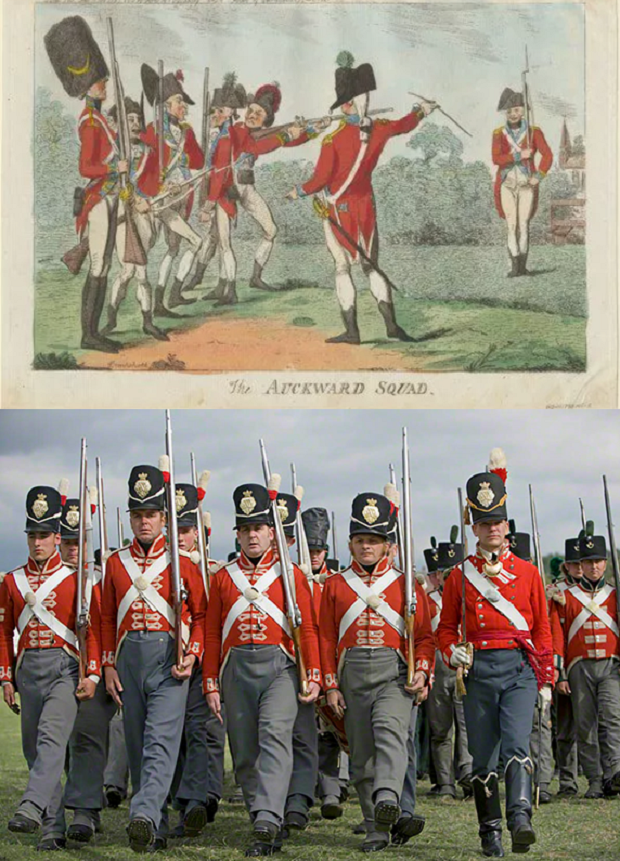
The term Redcoats has become synonymous with eighteenth and early nineteenth century British soldiers. Especially those from the Seven Years’ War, American Revolution, and Napoleonic Wars eras. Their iconic scarlet uniforms were a symbol of the British Empire’s military power. They were also a marker of professional discipline in an age when many armies still relied heavily on irregular troops or hastily assembled levies. Yet behind the image of the polished ranks and the thunderous volleys of musket fire was a long, and often brutal, process of Redcoat recruit training.
The Redcoat Recruit

It takes time, patience, and sometimes cruelty, to transform a raw, often unwilling civilian, into a disciplined infantryman. Understanding that process sheds light on how the British Army created the professional soldiers who carried its colors around the globe. Redcoat recruit training began long before a recruit ever held a musket. The eighteenth century British Army was not a conscript force. Instead, it relied on volunteers, press gangs, and bounty incentives. Recruiting parties traveled from town to town, accompanied by drums and fife music, hanging up posters promising steady pay, adventure, and the king’s shilling.
In reality, many recruits were the poor, the desperate, or even criminals given the option of military service instead of prison. Age and physical standards varied widely, but recruits were expected to be reasonably fit, and of suitable height for line infantry drill. Redcoat recruit training was not done by the British Army, but by each regiment. Back then, men were not recruited into the British Army, but into a specific regiment. Unlike today, there was no army-wide induction process and standard training program. Instead, each regiment trained its recruits in accordance with and up to its own standards.
Redcoat Recruit Training Depended on the Regiment

Because Redcoat recruit training was left to each regiment, training quality – and outcomes – varied, depending on the regiment, the competence and conscientiousness of its officers and non commissioned officers, and how much its chain of command cared about the quality of training and resultant soldiers. Once a man accepted his bounty and swore his oath, he was bound to the regiment, and began his transformation from civilian to Redcoat. New recruits were first introduced to the strict routines that defined military existence. They were taught the importance of obedience, punctuality, and cleanliness – qualities enforced through constant inspections, and the punishment of those who fell short.
Uniforms were issued, and recruits were shown how to maintain their scarlet coats, polish their brass, and keep their shoes and accoutrements in serviceable condition. Hygiene was primitive by modern standards, but it was still stressed. Even in those days, it was understood that uncleanliness could lead to outbreaks of disease that ravaged whole companies. Living arrangements in barracks or tents also introduced men to communal discipline. Sharing close quarters with dozens of others, they learned that the army was a collective endeavor, with success dependent on every soldier adhering to the same routines.
Drill, Drill, and More Drill

From the start, Redcoat recruit training exposed inductees to harsh punishments for infractions, including confinement, reduction in rations, and flogging. This instilled a fear of disobedience and underscored that the British Army prioritized discipline above all else. The most crucial aspect of Redcoat recruit training was drill. The effectiveness of eighteenth century armies relied on their ability to maneuver in large formations, and deliver coordinated volleys of musket fire. A musket was inaccurate and slow to load compared to later rifles. Because of that, battlefield success did not depend on the marksmanship of individual soldiers. Instead, victory attended the side whose soldiers were best able to stand firm in ranks, fire together, and reload under immense pressure.

Recruits spent endless hours learning to stand, march, and turn in step with their comrades. Training relentlessly drilled into the men the manual of arms – the sequence of movements used to handle and fire the musket. Each motion, from bringing the musket to the shoulder to biting open a cartridge, pouring powder, ramming the ball, and presenting to fire, was practiced until it became second nature. A trained Redcoat could fire three to four rounds per minute, a speed only achievable through repetitive drilling. Most manual of arms Redcoat recruit training ended with the men leveling their muskets and dry firing. Firing practice with live ammunition was relatively rare due to the expense of powder and shot. So most training emphasized drill over marksmanship.
Learning How to March Could be More Important Than Learning How to Shoot

The British Army believed that discipline and collective firepower mattered more than individual shooting skill. Accordingly, marching drill was just as, or even more essential than, the manual of arms and firearm training. Redcoat recruit training sought to ensure that soldiers were able to wheel, form lines, and execute complex battlefield maneuvers on command. Recruits learned to follow the steady beat of the drum, which regulated pace and kept formations intact. The synchronization of hundreds of men moving as one was impressive, both on training grounds in the field of battle. It was not natural, though, but forged through hours of daily repetition.
Alongside musket drill, recruits received training in the use of the bayonet. By the eighteenth century, the bayonet charge came to be seen as a decisive battlefield tactic. After they softened the enemy with volleys, British infantry advanced with fixed bayonets, relying on discipline and cohesion to break opposing lines. Recruits practiced thrusts, parries, and the psychological act of advancing steadily with cold steel. Some regiments also trained their men in basic sword use, especially sergeants or grenadiers. For the ordinary infantryman, though, the musket and bayonet were the only weapons of significance.
Redcoat Recruit Training Conditioned Men’s Bodies and Minds

Redcoat recruit training did include formal physical training programs as we know them today. There were no such programs in the heyday of the Redcoat. Nonetheless, the life of a Redcoat was physically demanding. Long marches while carrying muskets and full backpacks over rough terrain built endurance. Recruits were expected to adapt quickly to the rigors of campaign life, in which marches of fifteen to twenty miles a day were not uncommon. For those who fell out or fell short, punishments often included extra drill or carrying additional loads, which incidentally toughened the soldier’s body.
Beyond physical and technical training, recruits also underwent psychological conditioning. The constant drill, strict punishments, and regimentation aimed to break down individuality and foster unquestioning obedience. Soldiers learned to suppress fear, to remain in formation under fire, and to trust in their officers and comrades. The regiment became a family, bound by shared hardships and the ever-present threat of punishment or disgrace. Drinking, gambling, and carousing were common outlets and bonding experiences and rituals. However, the army also tried to instill loyalty through ceremonies, religious services, and pride in regimental colors. Loyalty was as much emotional as it was disciplinary, forged through a mixture of fear of punishment, pride in their regiment, and camaraderie with fellow soldiers.
Many Variables Determined the Quality of Training

Redcoat recruit training was mostly aimed at producing standard line infantry. However, some men were selected for specialized roles. Light infantry required more flexibility and marksmanship. So men in such units were trained to skirmish in loose order, rather than stand shoulder to shoulder. Grenadiers, traditionally the largest and strongest men, were trained to lead assaults and throw grenades – the latter a role that faded by the mid-eighteenth century, but still retained symbolic status. Cavalry recruits trained in horsemanship and saber use, while artillery recruits needed instruction in gunnery and mathematics. Each specialty demanded further training beyond the standard infantry drill.
The length and quality of recruit training varied depending on the era, the regiment, and the demands of war. In peacetime, Redcoat recruit training could extend for months, in which new soldiers were gradually integrated into their companies. In wartime, when regiments urgently needed replacements, training could be shortened drastically, and raw recruits might be sent into battle after just a few weeks of basic instruction. This variability explains why some Redcoat units were lauded for their discipline while others faltered under fire. Over time, especially during the Napoleonic Wars, training grew more systematic. The Duke of York’s reforms in the late eighteenth century emphasized improved drill manuals, better officer education, and standardized practices across regiments. These changes helped the British Army maintain a professional core, despite a rapid wartime expansion.
Redcoat Recruit Training Was Harsh, Sometimes Cruel, but It Created Superb Soldiers

Redcoat recruit was not only grueling, but often demoralizing. Harsh discipline, poor pay, and the bleak prospects of military life led to high desertion rates. Desertion was most common among recruits not yet unaccustomed to the army’s severity. To counter that, punishments were made public and brutal, serving as both deterrents and spectacles of discipline. Soldiers who endured training and remained in the ranks became some of the most disciplined troops in Europe. The training of British Redcoat recruits was far from humane by modern standards. However, it produced soldiers whose discipline and cohesion became legendary. From the fields of Europe to the forests of North America and the plains of India, the Redcoats’ ability to stand firm, deliver steady volleys, and charge with bayonets shaped the course of empire and history.
Redcoat recruit training in the eighteenth and early nineteenth centuries was less about individual skill than about transforming ordinary men into parts of a machine – one that operated with precision under the king’s colors. It molded poor and often desperate civilians into disciplined instruments of imperial warfare. Through relentless drill, harsh discipline, and the forging of collective identity, recruits learned to fight not as individuals, but as parts of a cohesive whole. Their training was grueling, sometimes cruel, and rarely glamorous. It nonetheless made the British Army one of history’s most effective fighting forces. The scarlet uniform symbolized more than just allegiance to the crown. It represented the endurance, obedience, and unity drilled into every recruit who survived the transition from civilian to Redcoat.

_________________
Some Sources & Further Reading
Cookson, J. E. – The British Armed Nation, 1793-1815 (1997)
History Halls – Powder Monkeys: The Child Sailors Who Kept the Guns Firing in Age of Sail Battles
Young, Peter, and Lawford, James Philip – History of the British Army (1970)

