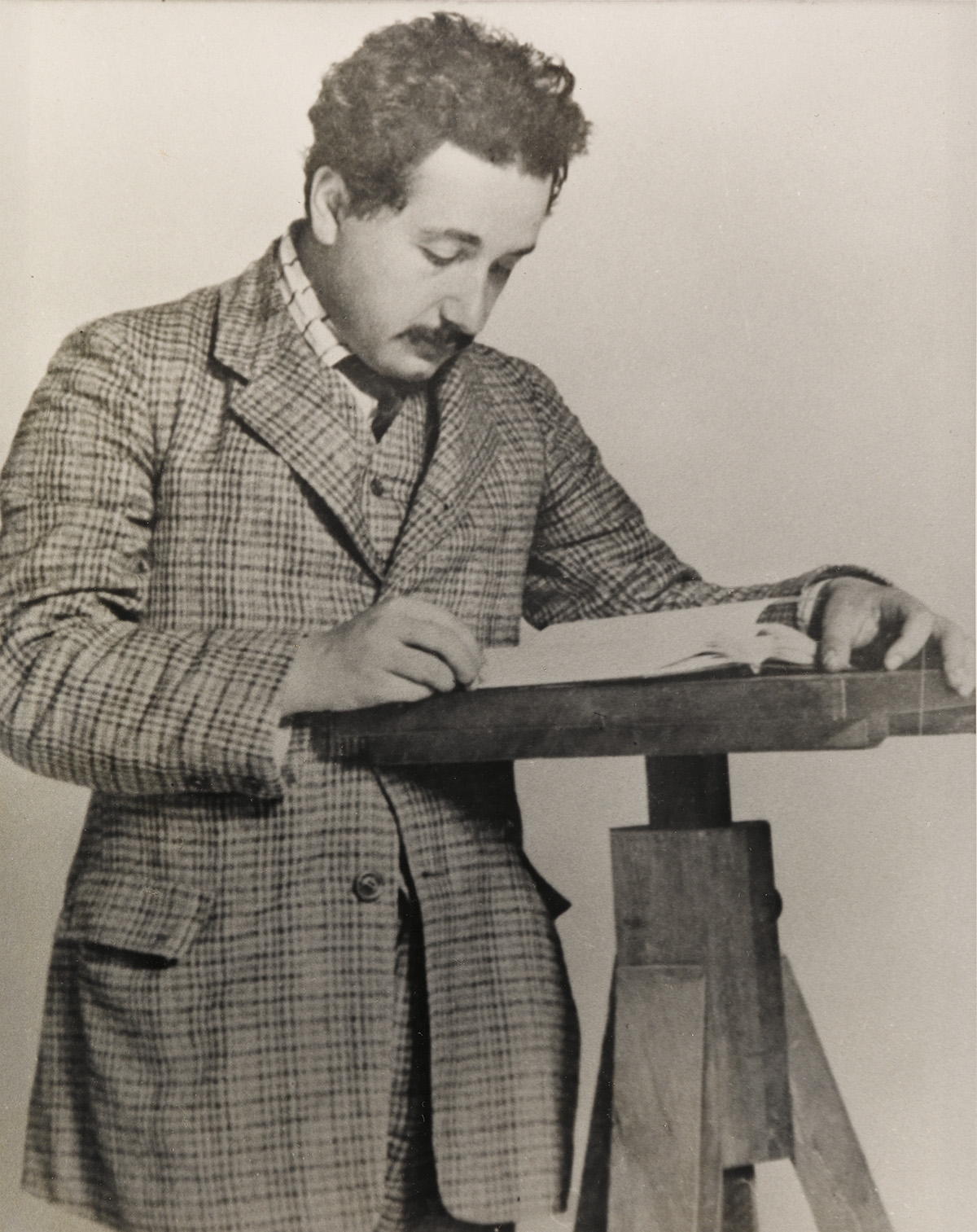
The popular image of great scientists doing great things is often of middle aged or older professors toiling away in university labs. That is what we see most often in film, TV, and other media. Albert Einstein was an exception: as seen below, he revolutionized science not as a mature professor, but when he was in his twenties, the age of your typical grad student.
Einstein Started Off as An Unassuming Patent Office Functionary

When most people picture Albert Einstein, what comes to mind is an old man with disheveled and wild white hair. It thus stands to reason to assume that Einstein’s most important work probably took place at the tail end of a long life, spent on complex physics and math research and study. In reality, Einstein made his greatest contributions to science by the time he was twenty six. The rest of his life was mostly about fine tuning what he had done in his twenties.
Albert Einstein (1879 – 1955) was born in the German Empire, and moved to Switzerland in 1895. In 1897, he enrolled in Zurich’s Federal Institute of Technology, in pursuit of a physics and mathematics teaching diploma. He graduated in 1900, and got a job as a patent examiner in the Swiss Patent Office in Bern. In his free time, he dabbled in some physics theories. As a minor functionary toiling away in the Patent Office, there was little that stood out about Einstein. Then came 1905, his annus mirabilis, or Miracle Year.
Einstein’s Miracle Year

In just a few brief months in 1905, Albert Einstein released four theories that revolutionized science and the fundamental understanding of the concepts of mass, energy, space, and time. In January and February, 1905, he revealed his theory of relativity, which demonstrated that Isaac Newton’s assumption that space and time were absolute was mistaken. In March, he again revolutionized science with his work on quantum theory. Then in April and May, he published two papers that proved the assumed but hitherto unverified existence of the atom.
Einstein did all of that by the time he was twenty six. For the rest of life, which lasted another half century until he passed away in 1955, he never came up with anything to equal what he had done in 1905. That is not to say that he coasted for the rest of his life on the accomplishments of his youth. However, even if he had done so, it would have been fine: his accomplishments in that single year were greater than the combined contributions of multiple geniuses throughout their entire lifetimes.

_________________
Some Sources & Further Reading
Encyclopedia Britannica – Albert Einstein
History Halls – Piltdown Man: One of History’s Most Devastating Science Pranks

