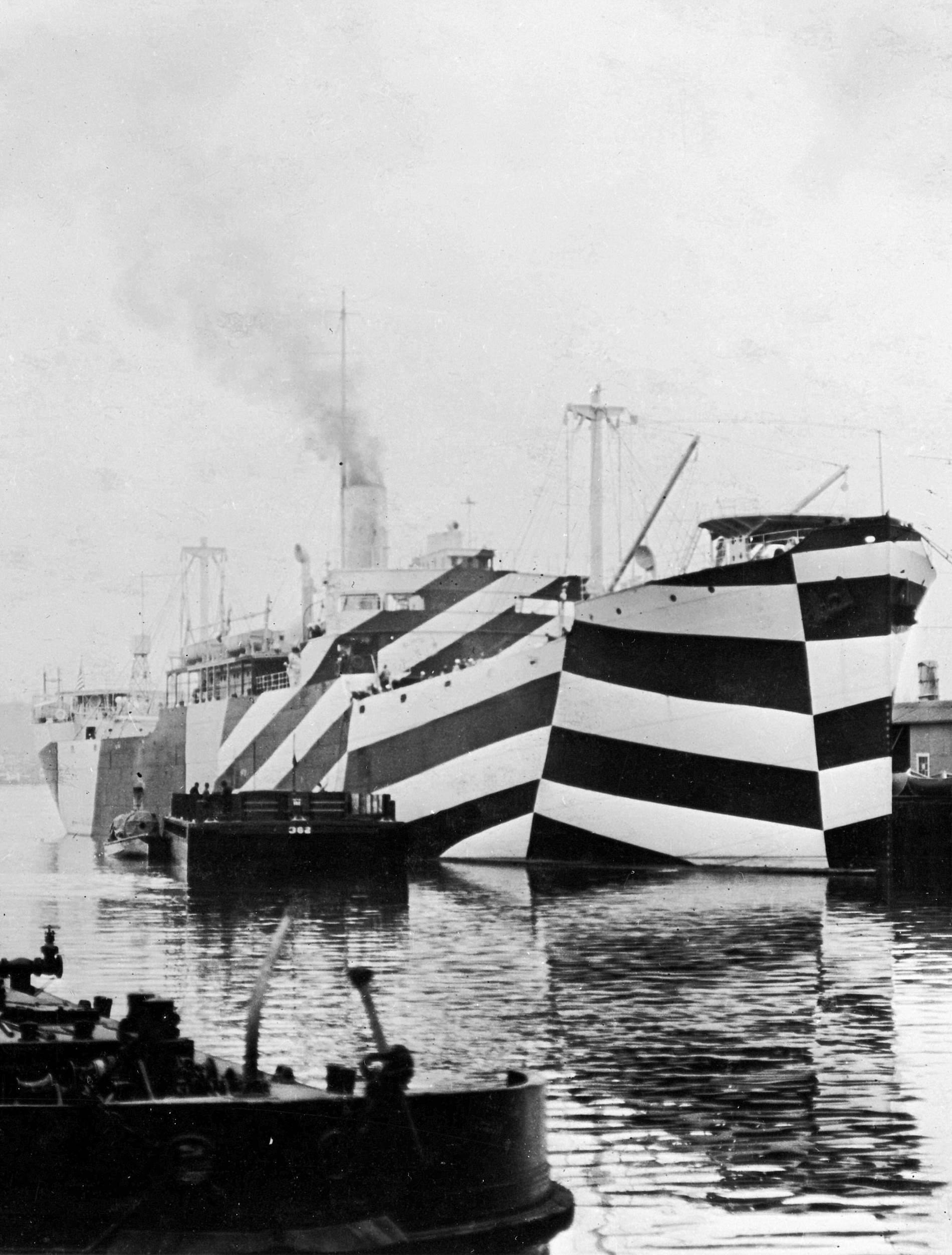
When most think of camouflage, what comes to mind are the earthy tones and patterns of modern military battle-dress uniforms. The idea is to blend soldiers, vehicles, or ships into their environment, and make them more difficult to see – and thus destroy. Ideally, camouflage should make one’s assets invisible to the enemy. In World War I, though, a radically different approach was tried: rather than hide from the enemy, confuse him. Used for ships at sea and known as dazzle camouflage, it abandoned any attempt at hiding. Instead, it put all its eggs in the basket bewildering the enemy’s perceptions. In a fascinating intersection of art and war, it employed bold, geometric patterns and stark contrasts to disrupt visual recognition.
Don’t Hide: Dazzle

Naval warfare entered a new era in WWI. Germany’s U-boat fleet proved devastatingly effective, sinking Allied merchant and military vessels with torpedoes. As an island nation whose local resources could not meet its population’s demands, Britain relied on imports brought by sea for its very survival. Regardless of what happened in the battlefields on land, the German submarine menace at sea threatened to starve Britain into submission and out of the war. Conventional naval camouflage painted ships gray, blue, or green. The hope was to blend ships against the background, but in practice, it offered little protection from submarines at sea. Whatever color they were painted, when seen through a submarine’s periscope, ships were clearly outlined against the horizon. It eventually became clear that when it came to U-boats, the key threat was not being spotted, but getting accurately targeted.
Submarines depended on visual data when preparing to launch torpedoes. A U-boat captain would peer through a periscope, and estimate a target ship’s speed, course, and distance in order to calculate a firing solution. If he got those variables wrong, the torpedo would miss. That vulnerability inspired creative solutions, most notable of which was the concept of dazzle camouflage. The man most often credited with its invention is British naval officer and marine painter Norman Wilkinson. Germany’s U-boat campaign peaked in 1917, and inflicted enormous shipping losses. Wilkinson argued that trying to hide ships at sea nearly impossible task. Instead, he proposed that they be painted in bold, disruptive patterns that made range-finding difficult.
The Intersection of Art and War to Produce Dazzle Camouflage

Wilkinson’s proposal was a radical departure from traditional camouflage, which sought to hide things. Instead, his idea was rooted in principles of optical illusion, rather than concealment. Bold stripes, zigzags, and swirling shapes would obscure a vessel’s outline. They would distort its apparent size, and even suggest a false bow or stern. From a periscope’s limited viewpoint, that could make a U-boat’s captain miscalculate his target’s speed and heading, and thus throw off torpedo aim. Higher ups at the Admiralty approved Wilkinson’s idea. Soon, soon dazzle camouflage became a full-fledged program, with hundreds of British ships painted in flamboyant designs.
The application of dazzle required an unusual partnership between the military and artists. Painters, designers, and art students were recruited to design patterns. Wilkinson himself drew upon his background as an artist to manage the project. Each ship received a unique pattern, since repetition might furnish enemy submariners with enough data to learn how to “read” the camouflage. Designs were tested with small wooden models, viewed through periscopes against moving backgrounds. The key was not uniformity but disruption with an aesthetic of deliberate chaos. The resultant ships often looked like floating works of Cubist or Futurist art, with jagged black-and-white lines, contrasting colors, and geometric distortions. To contemporary eyes, they were stunning, even beautiful. In fact, dazzle camouflage influenced the art world in return. It inspired movements like Vorticism, and later attracted the interest of modernist designers.
The Effectiveness of Dazzle Camouflage

The British success with dazzle quickly attracted American attention. By 1918, the United States Navy had adopted the Royal Navy’s system, and painted over 1,200 vessels in dazzle camouflage designs. Like Britain, the US used artists in the process, among them the notable painter Everett Warner, who helped oversee the effort. American patterns often featured brighter colors than those used by their British counterparts. They employed bold blues, greens, and yellows, in addition to black and white. The paintwork sometimes disoriented the crews. However, many sailors took pride in their ship’s unique, even flamboyant appearance.
One of the enduring questions surrounding dazzle camouflage is whether it actually worked. Unlike other forms of military technology, its impact was difficult to measure. Success depended on whether enemy submarines miscalculated their torpedo shots, which is not the kind of thing that is easily tracked or proven. Official reports during the war suggested that dazzle helped reduce losses. Later historians, however, have been more cautious. Some argue that improved convoy tactics and anti-submarine measures were more decisive. Still, anecdotal evidence from submarine captains indicates that dazzle did, indeed, cause confusion. Many U-boat commanders described difficulty in determining a targeted ships’ heading, or even mistaking its stern for the bow.
Dazzle’s Impact Beyond the War

Dazzle camouflage was a not a perfect defense, but it nonetheless provided some psychological comfort to sailors and commanders alike. At the very least, it represented a proactive step in the desperate fight against U-boats. With the end of WWI, dazzle camouflage began to fade from naval use. In the interwar years, advances in technology, particularly radar and sonar, reduced the reliance on visual targeting. In World War II, some navies revived dazzle for certain vessels. However, its overall value was diminished in the face of new detection methods.
By the late 1940s, dazzle camouflage was largely obsolete. It was replaced by more conventional gray paint schemes, designed to minimize visibility from both sea and air. Yet the legacy of dazzle endured, remembered for its striking designs and unusual blending of art and warfare. Its impact extended beyond the battlefield. Artists in the early twentieth century, particularly those involved in Cubism, Futurism, and Vorticism, saw in dazzle a practical application of their avant-garde aesthetics. The use of fragmentation, distortion, and abstraction in dazzle mirrored artistic trends of the period.

After the war, dazzle inspired fashion, graphic design, and architecture. Designers incorporated dazzle motifs into clothing, textiles, and posters. Even in the twenty first century, dazzle patterns have been revived in public art projects, such as ship installations in Liverpool and London commemorating WWI. What makes dazzle camouflage remarkable is not just its tactical purpose, but its embodiment of creativity under pressure. In a moment of crisis, military authorities turned to artists for solutions, and those artists delivered designs that blurred the line between utility and art.
The Legacy of One of History’s Most Visually Striking Camouflage Schemas

While its measurable effectiveness remains debated, dazzle camouflage succeeded in a variety of other ways. It symbolized ingenuity in wartime, offered psychological reassurance, and left behind a unique cultural and aesthetic legacy. The sight of a great battleship or merchant ship, striped and zigzagged like an abstract painting, remains one of the most striking images of the First World War. Dazzle camouflage was not about hiding ships, but about deceiving the eye – an experiment at the crossroads of art and military science.
The concept of dazzle camouflage was born from the desperate struggle against submarine warfare. It transformed ships at sea into floating illusions, and confounded observers with bold geometric patterns. Whether or not it drastically altered naval outcomes, its place in history is secure as one of the most inventive and visually arresting strategies of modern war. Today, dazzle serves as a reminder that creativity can emerge in the most unlikely of circumstances, even in the deadly arena of naval combat.

_________________
Some Sources & Further Reading
Forbes, Peter – Dazzled and Deceived: Mimicry and Camouflage (2011)
US Naval Institute News – Camouflaged Ships: An Illustrated History
Williams, David L. – Naval Camouflage: A Complete Visual Reference (2001)

