[This is the tenth in a series of articles about the Neolithic Revolution, also known as the First Agricultural Revolution, that saw humanity switch from hunter gatherers to settled farmers and agriculturalists. For the start of the series, Part I, click here]
On average, humans in 2025 enjoy more abundance, affluence, and security, than in any prior period humanity’s existence. Because our prosperity is built upon foundations created in the Neolithic Revolution, particularly our distant ancestors’ transition from hunter gatherers to farming, it is easy to assume that the transition was beneficial at the time. In reality, except for the early farmers, it was not. As seen below, the widespread transition to full time farming came with significant downsides.
Farming Meant Trading a Rich and Varied Diet for a Monotonous One

The downsides of settled farming can first be explored with an examination of humanity’s first major staple crop, wheat. It did not offer the early full time farmers a better diet. We are an omnivorous species that evolved to thrive on the wide variety of food available from nature through the hunter gatherer lifestyle. For millions of years before we switched to farming, grains had made up only a tiny fraction of the diet of Homo sapiens and that of our predecessor hominid species.
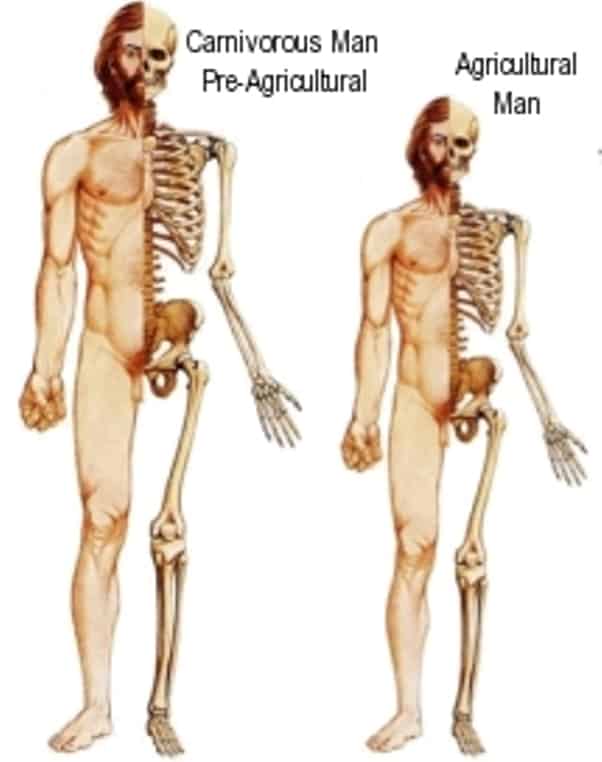
Once we became farmers, however, grains came to form almost the entirety of most humans’ caloric consumption. Moreover, throughout most of the period after we took up farming, the grains-based diet was poor in minerals and vitamins, and was hard to digest. Flour was also was not as finely ground and refined as today, so grains ground our ancestors’ teeth to nubs. The switch from a hunter gatherer diet to the grain-based diet of farmers reduced both the average life expectancy and the physical heights of farmers compared to their hunter gatherer ancestors.
Farmers Got Shorter, and Had a Lower Life Expectancy than Their Hunter Gatherer Ancestors

Farmers shrank, compared to their hunter gatherer ancestors. The average height for men fell from 5’10” during the hunter gathering period to 5’5″ after our ancestors became full time farmers. As for women, their height decreased from an average of 5’5″ for hunter gatherers to 5’1″ for females on the farm. It took about ten thousand years – until late in the twentieth century – for the average human height to return to what it had been before the Neolithic Revolution’s widespread switch from a hunter gatherer lifestyle to that of settled farmers.
The switch to full time farming was also risky. Hunter gatherers had relied on dozens of plants and animal species to survive. If times got hard and one or more of their food sources grew scarce, they could eat more of other plants or species that were still around. By contrast, farmers got most of their calories from a few staple crops, and sometimes from just a single crop, such as wheat, rice, or potatoes. If that crop failed, famine frequently followed, to claim the lives of thousands, or even millions, of farmers.
Violence and Exploitation Skyrocketed After the Switch to Farming

Increased violence was another downside of farming. Farmers relied for their survival on the crops planted in their fields. That gave them a far greater incentive to defend their territory than was the case with hunter gatherers, who often could avoid violence from interlopers by moving on. For farmers, however, to move on and abandon their fields often meant death from starvation. As a result, conflicts between settled farmers and interlopers led to greater violence than humans had ever experienced before. To assess the likely levels of violence in early farming communities, anthropologists studied primitive agricultural communities in New Guinea. They discovered than in some agricultural tribes, violence accounts for 35% of male deaths. It is even worse in some primitive agricultural tribes in South America, where half of all adults, of both sexes, meet a violent end at the hands of other humans.
Farming also eventually led to the subjugation of most farmers by emerging elites. Chiefs, priests, and warriors formed an aristocratic caste and seized the surpluses produced on the farms. They reduced the farmers to a caste of downtrodden peasants and serfs. That inequality and injustice was the foundation upon which civilization was built. To be sure, civilization is a good thing. Today, humans on average benefit more from civilization’s accumulated advances than did any prior generation. However, we should not forget that what we enjoy today was built upon the often unwilling, aching, and sometimes flogged, backs of untold generations of soil tilling ancestors. Those downtrodden farmers were the vast majority of humanity for thousands of years after the Neolithic Revolution.

[This is the tenth in a series of articles about the Neolithic Revolution, also known as the First Agricultural Revolution. It saw most of humanity switch from hunter gatherers to settled farmers and agriculturalists
I: Why Did Humans Switch From Wandering Hunter Gatherers to Settled Farmers?
II: When Humans Got Too Good at Hunting
III: When Prehistoric Hunter Gatherers Depleted the Available Resources
IV: The Domestication of Sheep and Goats
V: Newly Emergent Farmers Had to Work a Lot Harder than Hunter Gatherers
VI: Did the Discovery of Bread Cause the Shift From Hunter Gathering to Farming?
VII: Was it Actually Beer, Not Bread, that Motivated Hunter Gatherers to Become Farmers?
VIII: Was it Wheat That Domesticated Humans, Instead of the Other Way Around?
IX: Early Farmers Enjoyed a Bonanza, But it Became a Borderline Bust for Their Descendants
X: Humanity Benefited Greatly From the Switch to Farming, But it Came at a High Cost
XI: Humankind’s Greatest Revolution]]
_________________
Some Sources & Further Reading
Barker, Graeme – The Agricultural Revolution in Prehistory: Why Did Foragers Become Farmers? (2006)
Diamond, Jared – Guns, Germs, and Steel (1997)
Encyclopedia Britannica – Neolithic Revolution
Gonick, Larry – The Cartoon History of the Universe (1990)
Harari, Yuval Noah – Sapiens: A Brief History of Humankind (2014)

