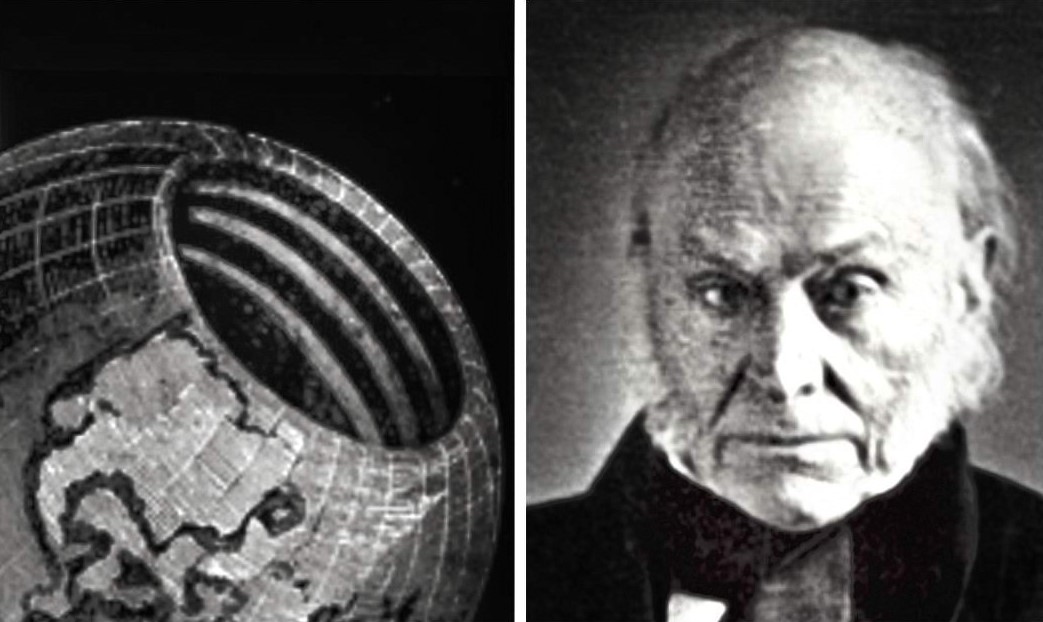
Just like his father, America’s second president John Adams, America’s sixth president John Quincy Adams was a brilliant man. As a lawyer, diplomat, politician and statesman, John Quincy was a huge success. Fortunately, one of the few things he put his mind to that didn’t pan out because Congress refused to back it, was an expedition to contact the de facto mole people of a hollow Earth.
John Quincy Adams Had Some Blind Spots

John Quincy had been an outstanding diplomat – perhaps America’s best diplomat ever – before he was elected president in 1824. He served as ambassador to Russia, and was in the delegation that negotiated an end to the War of 1812. He also served as Secretary of State, in which capacity he negotiated America’s acquisition of Florida. Adams also played a key role in drafting the Monroe Doctrine. He served in both the US House of Representatives and the US Senate, and was one of slavery’s earliest opponents. However, while clearly an intelligent man, Adams had some blind spots.
One such was his belief in the Hollow Earth Theory. That theory was considered weird to the point of ludicrousness even in his own time. It was the brainchild of a charlatan named John Cleves Symnes Jr., who kicked off what became a Hollow Earth craze. As its name indicates, Hollow Earth Theory claimed that our planet was not a solid rock. Instead, Earth is supposedly more like a ball. Inside the ball were concentric layers separated by empty spaces that were probably inhabited by people. Adams not only believed in that craziness, but actually wanted to prove it at the taxpayers’ expense.
The Hollow Earth Theory

John Cleves Symmes Jr. was a veteran of the War of 1812 who moved to the frontier after the guns fell silent. There, he reinvented himself as a scientist and became known as the “Newton of the West”. In 1818 the Newton of the West published Symmes Circular No. 1: “I declare the earth is hollow, and habitable within; containing a number of solid concentrick spheres, one within the other, and that it is open at the poles 12 or 16 degrees; I pledge my life in support of this truth, and am ready to explore the hollow, if the world will support and aid me in the undertaking”. Per the Hollow Earth Theory, each concentric circle within the hollow earth was supposed to contain its own subterranean world.
Each of those worlds was supposedly heated and illuminated by a sun-like object at Earth’s center. Symmes hit the lecture circuit to proselytize his theory. He also lobbied the US government to fund and launch an expedition to the poles, where he claimed the openings to the hollow earth’s interior were located. Educated people scoffed at the notion, but it was taken seriously enough by many, including John Quincy Adams. America’s sixth president not only saw nothing weird about the theory, he believed in it so much that he lent his support to the proposed Symmes expedition. Indeed, Adams promised to do just that during his successful 1824 presidential campaign.
John Quincy Adams Wanted to Establish Trade Relations With the Mole People

John Quincy Adams won the 1824 presidential election. Once in office, he lent his support to Symmes’ Hollow Earth theory, and the assumption that the hollow planet’s internal concentric spheres must be inhabited by humans or human-like beings: de facto mole men. Adams was interested in the natural resources beneath the Earth, and like Symmes, he wanted to establish trade with the hollow earth’s inhabitants. Backed by heavyweights whose numbers included the president, Symmes’ proposed expedition actually made it to the agenda of the US House of Representatives and came up for a vote. Fortunately, the proposal was defeated, 56 to 46.
Still – roughly 44% of the country’s congressmen wanted to spend taxpayer money to try and contact mole people. The president did not give up. He tried to get Congress to reconsider, and did all he could to gather support and resources for the expedition. However, like his father, John Quincy Adams served only one term. He lost the 1828 election to Andrew Jackson, and the newly-elected POTUS canceled the expedition and abandoned his predecessor’s attempts to reach the center of the hollow earth. Which came as no surprise, since Andrew Jackson could not have believed that the Earth was hollow: he thought it was flat.

_________________
Some Sources & Further Reading
Gizmodo – Which President Greenlit a Trip to the Center of the Earth?
History Halls – Benjamin Franklin Was a Total Babe Magnet Well Into His Old Age
Kaplan, Fred – John Quincy Adams: American Visionary (2014)

