As Europe modernized in the nineteenth century, the Russian Empire, an autocracy headed by a Tsar who wielded absolute power, was decidedly out of step with the zeitgeist. Between censorship that silenced reformers, and a secret police that locked them up since criticism of the regime was a crime anyhow, political opposition went underground and became radicalized. Below are some interesting facts about one of those radical movements, which in 1881 assassinated the Tsar in dramatic fashion.
From Naïve Students to Radical Revolutionaries

Nineteenth century revolutionaries of Narodnaya Volya, or “People’s Will”, sought to overthrow the Tsarist regime. Their means were to be acts of violent propaganda, intended to trigger a mass revolt. The movement is best known for its members’ assassination of Tsar Alexander II in 1881, and for being a forerunner of even bigger and more effective anarchist and socialist organizations in the decades that followed. It originated from radical student study circles in the 1870s, which sought to spread socialist ideas to peasants and industrial workers through public agitation out in the open. That turned out to be naïve. The kids were promptly repressed by the Tsar’s secret police, the Okhrana, who swiftly arrested and jailed the agitators.
That led to a rethink, as the activists came to realize that only an underground movement could survive in Russia’s oppressive climate. Many also came to believe that only revolutionary violence could overthrow Tsarism, and turned to more clandestine and aggressive tactics – specifically terrorism, which they termed “propaganda of the deed”. The result was Zemlya i Volya, or “Land and Liberty”, a radical organization that advocated political assassinations as self-defense and justified revenge against oppressive officials. However, although it saw terror as a justified response to bad actors, it stopped short of viewing it as an instrument for political struggle against the government.
The Birth of a Radical Organization

In 1879, Zemlya i Volya tried to assassinate Tsar Alexander II and failed. The organization was nearly wiped out by the secret police in the backlash and wave of repression and roundups of radicals that followed their attempt. Some of the more radical survivors came to see terror as a proactive tool that could be used to overthrow the regime, and not simply as a reactive means of retaliation. So they formed a new organization, Narodnaya Volya, or People’s Will, with that in mind.
From the start, the new radical movement called for violence, and announced an ambitious program of terrorism and assassination to break the government. They issued a proclamation that declared a death sentence against the Tsar, who was to be executed as an enemy of the people. They established clandestine cells in major cities and within the Russian military, and began to publish underground revolutionary newspapers and leaflets targeted at industrial workers. As seen below, they also went after the Tsar with dogged determination.
Dogged Assassins on the Tsar’s Trail

In December, 1879, People’s Will tried to assassinate Alexander II with explosives on a railway, but missed his train. They did not let that discourage them. Two months later, they tried again, this time with a bomb planted in his palace. However, the Tsar was not in the room when the explosives went off. The frightened Alexander declared a state of emergency and set up a commission to repress the terrorists. Within a week, a People’s Will assassin tried to kill the commission’s head.
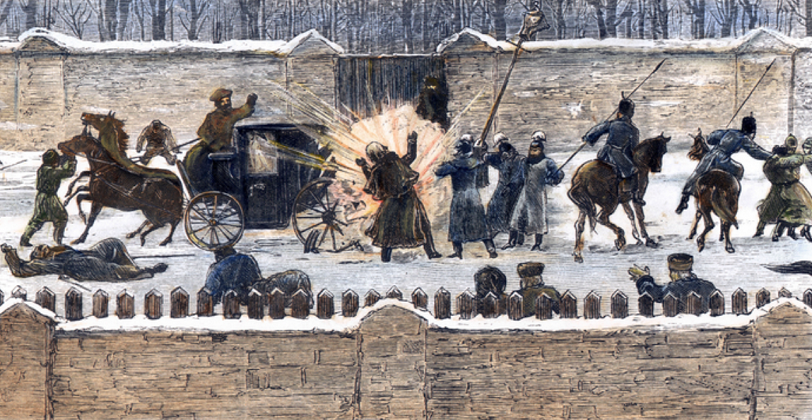
The secret police ramped up the repression. Tsarist authorities sentenced People’s Will activists caught distributing illegal leaflets to death, and quite a few were hanged. That did not daunt the radicals, who doggedly persisted with their relentless efforts to do in the Tsar. They finally succeeded on March 1st, 1881. At 2:15 that afternoon, a People’s Will assassin, Nikolai Rysakov, was waiting in ambush along a route taken by the Tsar every week. When Alexander II passed by, he threw a bomb under his carriage.
The Assassination of Tsar Alexander II

The explosion killed a guard and wounded others, but the Tsar’s carriage was armored and he was unhurt. Rysakov was immediately seized. Shaken, Alexander II stepped out of the carriage to survey the damage and see the captured culprit. A second People’s Will assassin, Ignacy Hyrniewiecki, also carrying a bomb, was concealed in the gathering crowd. He saw the Tsar cross himself as he told anxious members of his entourage “Thank God, I am untouched”. Hyrniewwiecky shouted “it is too early to thank God!” and threw his bomb.
This one landed directly beneath the Tsar’s feet and exploded, mortally injuring both Alexander II and his assassin. A third assassin was also hidden in the crowd, ready with yet another bomb in case the first two failed. His explosives were unnecessary. The Tsar was rushed to his palace, where he died of his injuries an hour later. Hyrniewiecki was taken to a military hospital, where he too died of his injuries a few hours later, having refused to divulge any information to investigators or even tell them his name.
The Legacy of People’s Will

The captured first bomb thrower, Rysakov, turned out not to be as steadfast as Hyrniewiecki had been. At the moment of truth, faced with the prospect of execution, he cooperated with investigators in a desperate bid to save himself from the noose. The information he furnished allowed the Okhrana to raid the People’s Will headquarters. Many members were arrested, and subsequently executed or jailed. Snitching did not save Rysakov, who was hanged along with others he had implicated. In the aftermath, intensified repression effectively crippled People’s Will.
Terrorism was kept in check for years, but the repression created even more enemies for the Tsarist government. It drove more opponents into underground clandestine resistance, and transformed the Russian Empire into a pressure cooker. It finally erupted into revolution in 1905, and into an even greater revolution that finally did away with Tsardom in 1917. Surviving veterans of People’s Will, who began to emerge from prisons at the turn of the twentieth century as their sentences expired, played important roles in both revolutions.

_________________
Some Sources & Further Reading
Encyclopedia Britannica – Narodnaya Volya
History Halls – The Incompetent Bodyguard Who Got Lincoln Killed
Lampert, Evgenii – Sons Against Fathers: Studies in Russian Radicalism and Revolution (1965)
Yarmolinsky, Avrahm – Road to Revolution: A Century of Russian Radicalism (1955)

