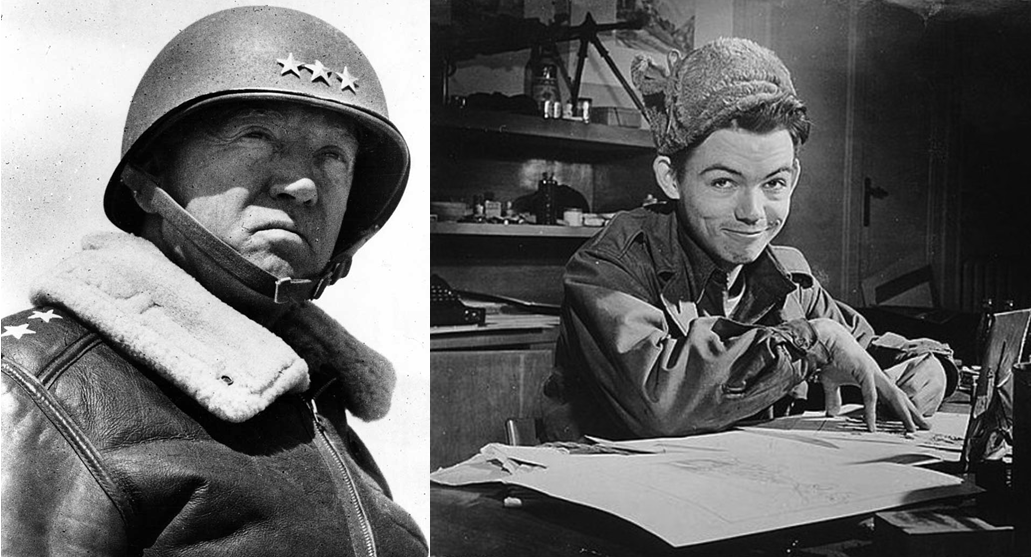
General George S. Patton was known as a stickler for good order, spit and polish, and for his hot temper. So when World War II cartoonist Bill Mauldin popularized a pair of slovenly GI cartoon characters, Patton was enraged at what he deemed an affront to discipline and an assault on morale. Below are some interesting facts about the cartoonist who got under Patton’s skin.
The Creator of Willie and Joe

The target of Patton’s wrath, William Henry “Bill” Mauldin, was born in 1921 in New Mexico. He studied at the Chicago Academy of Fine Arts, before he enlisted in in the US Army in 1940. Within a few years, he rose to fame as a cartoonist for the military newspaper Stars and Stripes. Most notably, Mauldin created a duo of disheveled cartoon GIs, Willie and Joe. Through their woes and travails, he depicted the struggles and misadventures of front line soldiers.
Early in his military career, Mauldin drew cartoons for the 45th Infantry Division’s newspaper. His work attracted the attention of Stars and Stripes, which began to publish his cartoons in 1943, before it formally added him to its staff in 1944. Mauldin was not just a cartoonist who sketched characters in the comfort of the rear. Cartooning is what he is best known for, but he spent significantly more time in the middle of the fighting as a war reporter than he did drawing cartoons. He covered combat in Sicily and Italy, and was wounded near Salerno.

After D-Day, Mauldin was sent to France, and he accompanied the advancing GIs into Germany. While working for Stars and Stripes, Mauldin created his most famous characters, Willie and Joe. A duo of front line soldiers, they often had to deal with the horrors of war, and simultaneously try and meet the oft-times ridiculous expectations and directives of their chain of command. Willie and Joe thus struggled from one cartoon to try and triumph over both the enemy and their own rear echelon officers.
The Cartoonist Who Got Under Patton’s Skin

George S. Paton was not a fan of Mauldin or his cartoon creations. Willie and Joe’s slovenly appearance was an affront to the ideal of ramrod straight and soldierly spit and polish image fetishized by the temperamental general. Mauldin’s cartoons also often made pointed jabs at the unrealistic fatuousness of the military hierarchy. For example, one cartoon ridiculed a directive from Patton that troops be clean shaven at all times. As a result, the general saw Willie and Joe as detrimental to good discipline and morale. So Mauldin was ordered to report to Patton’s headquarters, where the general assailed him, accused him trying to incite a mutiny, called him an “unpatriotic anarchist”, and threatened him with jail.
The GIs however loved Willie and Joe, and Patton’s boss, Dwight D. Eisenhower, took their side. Eisenhower correctly judged that Mauldin’s cartoons gave soldiers an outlet for frustrations that might otherwise bubble over and get expressed in more troublesome ways. So he ordered Patton to back off and leave Mauldin alone. The War Office also supported the cartoons, and helped Mauldin get them syndicated in the US. They were seen as an asset to the war effort precisely because they depicted the dark side of war. They showed the civilians back home that victory would not come easy, but would require considerable effort and sacrifice.
A Runaway Success

Willie and Joe were a runaway success. Not only with the military rank and file, but also with the civilians back home after they were syndicated, and earned Mauldin a Pulitzer Prize in 1945. As Band of Brothers author Stephen Ambrose described Willie and Joe: “More than anyone else, save only Ernie Pyle, [Mauldin] caught the trials and travails of the GI. For anyone who wants to know what it was like to be an infantryman in World War II, this is the place to start – and finish”.
Mauldin returned to civilian life after the war. He published collections of his wartime cartoons, freelanced, and was eventually hired by the St. Louis Post Dispatch as an editorial cartoonist. He won another Pulitzer Prize in 1959, this one for a cartoon that depicted the lack of civil liberties in the Soviet Union. In 1962, by which point Mauldin’s cartoons were widely syndicated, he switched to the Chicago Sun Times. His work also appeared in numerous magazines, such as Sports Illustrated and Life. After a long and productive life, Bill Mauldin passed away in 2003, aged eighty one, and was buried in Arlington National Cemetery.

_________________
Some Sources & Further Reading
History Halls – Awkward Misunderstandings: George Patton and the Honored Latrine
Library of Congress – Bill Mauldin Beyond Willie and Joe
Mauldin, Bill – Up Front (1991)

