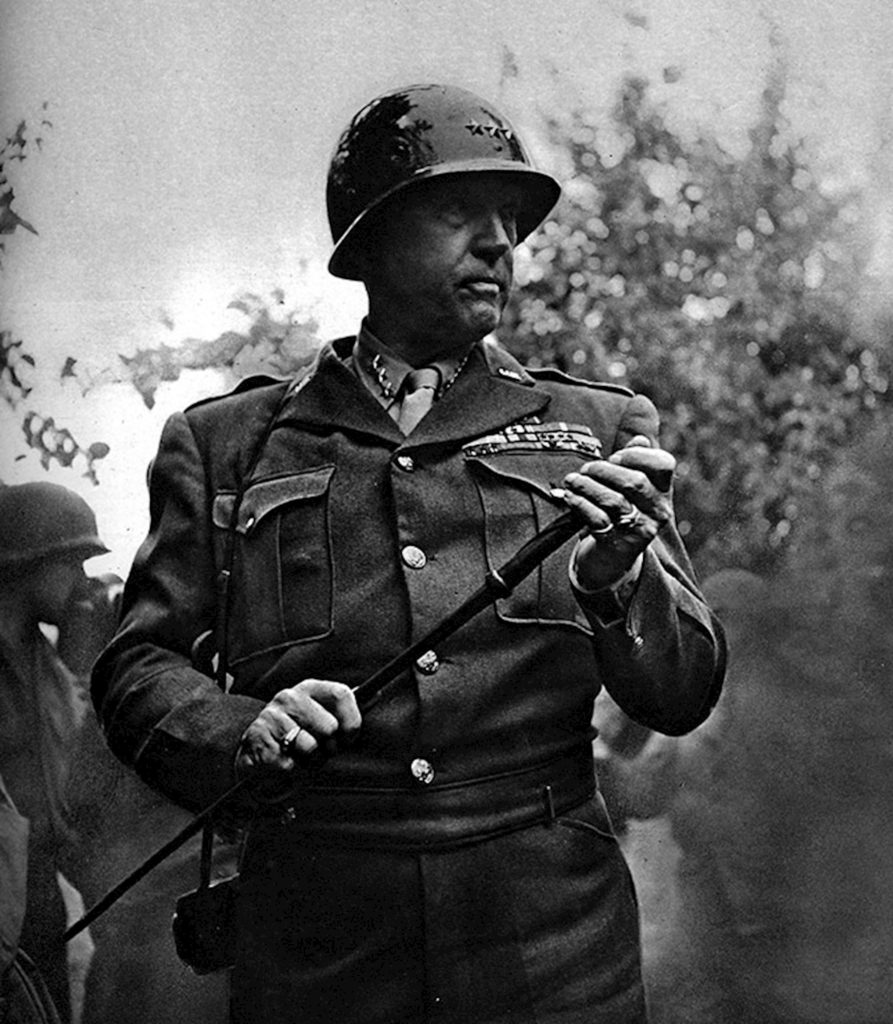
George S. Patton won great fame in World War II as America’s best known fighting general. He had also fought in First World War, in which conflict he was obligated to participate in an odd ceremony that resulted from a misunderstanding by well-meaning French locals.
Patton and the Mysterious Buried Doughboy

General George S. Patton took command of the US Third Army after D-Day in WWII. Soon thereafter in the summer of 1944, he led it in a breakout from the Normandy beachhead that liberated Paris and a huge chunk of France. It was his second go around in that country, as he had also fought there in World War I. In that earlier conflict, Patton had established a US Army Tank Corps School in 1918 in Langres, in the region between Dijon and Metz.
One day, as Patton recounted in a letter now curated in the Library of Congress, he received a visit from the distraught mayor of the nearby small town of Bourg. He tearfully asked Patton, then a colonel, why he had not been told that a Doughboy had been buried nearby, so the locals could pay him the honors due a fallen ally. As Patton recalled: “Being unaware of this sad fact and not liking to admit it to a stranger, I stalled until I found out that no one was dead. However, he insisted that we visit the ‘grave’”. So Patton went with him.
Honoring “Abandoned Rear”

Colonel Patton and his subordinate officers, who were just as curious about the mysterious buried American soldier, accompanied the mayor of Bourg. He took them to a freshly covered pit, atop which were sticks that formed a cross, and held a plaque that read “Abandoned Rear”. As became immediately apparent to Patton, there had been an awkward misunderstanding. The French mayor and the locals had mistaken the crossed sticks for the religious symbol, and “Abandoned Rear” for the deceased soldier’s name.
“Abandoned Rear” was actually a humorous designation for a covered latrine, to warn others from digging in that spot. “I never told them the truth”, wrote Patton. Decades later in WWII, Patton, now a general, passed through the region and decided to make a brief nostalgic stop at Bourg. He asked a local whom he vaguely remembered if he had been there in WWI, and the man replied that he, and that he still remembered Patton from when he had been there as a colonel. The grave was still there, meticulously kept by the townspeople with all the honors due a fallen soldiers, with a cross that said “Abandoned Rear”.

_________________
Some Sources & Further Reading
Encyclopedia Britannica – George Patton
Library of Congress – George S. Patton Papers

