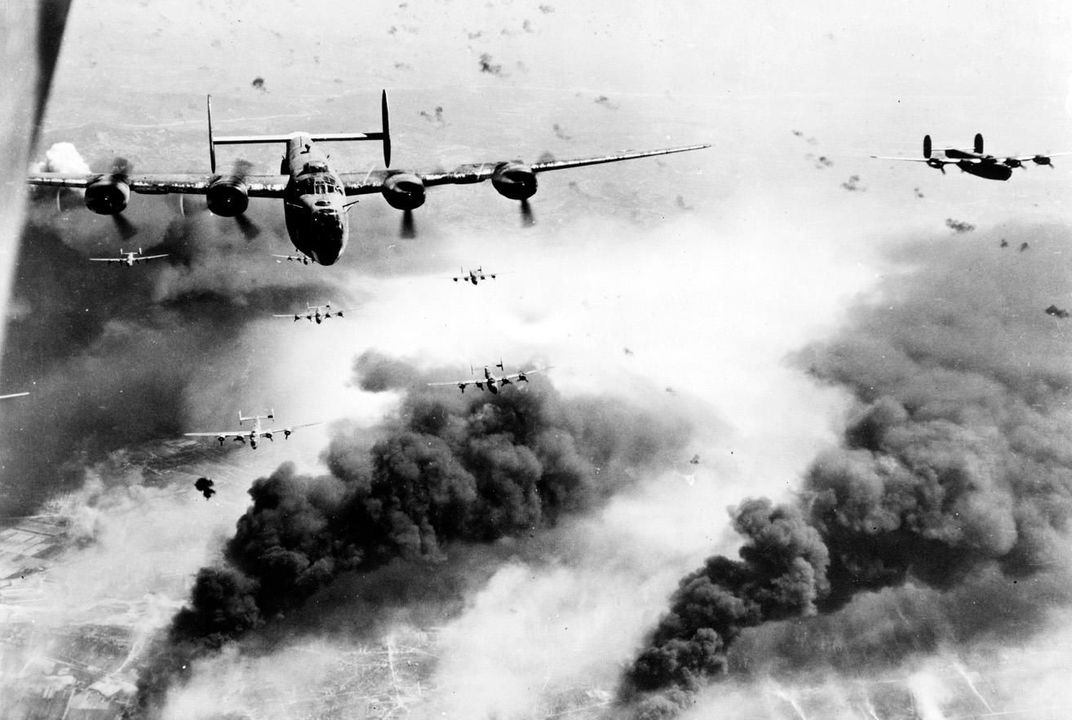
More than 19,000 Consolidated B-24 “Liberator” heavy bombers were built during World War II. Those numbers gave the B-24 the records for history’s most produced American military airplane, most produced heavy bomber, and most produced multi-engine aircraft. Below are some interesting facts about the B-24.
Birth of the B-24

In 1938, as war clouds gathered overseas, the US Army Air Corps saw a greater need for heavy bombers. So it asked the Consolidated Aircraft Corporation to manufacture the Boeing B-17 “Flying Fortress” under license. Rather than build a rival’s bomber, Consolidated decided to design its own. The result was the B-24 Liberator, a new bomber with a distinctive appearance that featured a box-like fuselage beneath a high wing, and a twin tail assembly. The B-24 first flew in 1939, and entered service in 1941.
Unlike most bombers of its era, the Liberator had a tricycle landing gear that significantly improved ground visibility for taxiing, takeoffs, and landings. B-24s, along with B-17s, became the mainstays of America’s strategic bombing campaign in Europe. Like the B-17s, Liberators carried the Norden bombsight and flew in defensive “box” formations. However, they were looser, because B-24s were tougher to handle, which made tight formations like those of B-17s inadvisable. B-24s typically flew with a 5000 pound bomb load, but for short missions could carry up to 16,000 lbs.
Pros and Cons of The B-24 vs the B-17

B-24s had a 1600 mile range for high altitude missions – which was forty percent more than the B-17s’ range. However, B-24s had a 28,000 foot service ceiling, compared to 35,000 feet for B-17s. As a result, Liberators were more exposed to flak than Flying Fortresses. Liberators were also more vulnerable to damage, and their interior spaces were more cramped. That explains why aircrews generally preferred the more robust and easier to fly B-17, despite the B-24’s longer range, higher speed, heavier bomb load, and superior landing gear.
B-24s took part in some of WWII’s toughest raids. Of those, few were tougher than that carried out against the Ploesti oilfield complex in Romania. The German military’s most important energy source, Ploesti supplied one third of the Reich’s oil and aviation fuel. The costliest of the Ploesti raids occurred on August 1st, 1943, which came to be known as “Black Sunday”. That day, 177 Liberators, unescorted by fighters, took off from North Africa and flew to their targets at low level to avoid detection. Unfortunately, as seen below, the enemy was alerted because of a cascade of mishaps.
The Liberators’ Toughest Raid

The raid against Ploesti that came to be known as “Black Sunday” started off well, but was hit with a series of misfortunes before the bombers reached their target. The B-24s crossed the Mediterranean Sea undetected, but that changed soon after they reached land. A navigation error took some bombers directly over a German position en route to Ploesti, which alerted the enemy that a raid was headed towards their vital oilfields. Another mishap was the crash of a lead navigator.
The bombers that had been following and counting on the crashed navigator to shepherd them to the target, lost cohesion, and arrived over Ploesti in staggered groups, rather than simultaneously. Eventually a group leader, seeing all formation lost, broke radio silence to order the scattered B-24s to make their individual ways to Ploesti and bomb as best they could. The Germans prepared a hot welcome: of the 177 Liberators that took off, 162 reached Ploesti, and of those, 53 B-24s and 660 crewmen were lost.
A Versatile Bomber

Of the 109 surviving B-24s that made it back to an Allied base after the August 1st, 1943, raid, 58 were damaged beyond repair. Black Sunday had been a terrible day for the Liberators, but they had better ones. B-24s were versatile, and they saw extensive use throughout the war. The Liberator’s long range made it a natural fit for the Pacific Theater’s vast expanses, and they began to replace B-17s there starting in 1942. Long range also made B-24s suitable for anti-submarine patrols.
Liberators played a vital role in defeating the U-boat menace during the Battle of the Atlantic by closing the “Mid-Atlantic Gap” – an area within which U-boats had been free to operate without fear of air attack. Their range also suited them well for flying high priority cargo and VIPs – Winston Churchill’s personal transport was a Liberator. By war’s end, however, aviation technology had progressed so much that the bombers with which America started the war were becoming obsolete towards its end. More advanced B-29 “Super Fortress” bombers and other newer designs began to replace the B-24s and B-17s, which were rapidly phased out of service. A few, adapted for maritime service, continued to operate with the US Navy until the Korean War.

_________________
Some Sources & Further Reading
Birdsall, Steve – Famous Aircraft: The B-24 Liberator (1968)
Hess, William N. – Big Bombers of World War II (1998)
History Halls – World War II Bombers: America’s Rugged B-17 ‘Flying Fortress’

