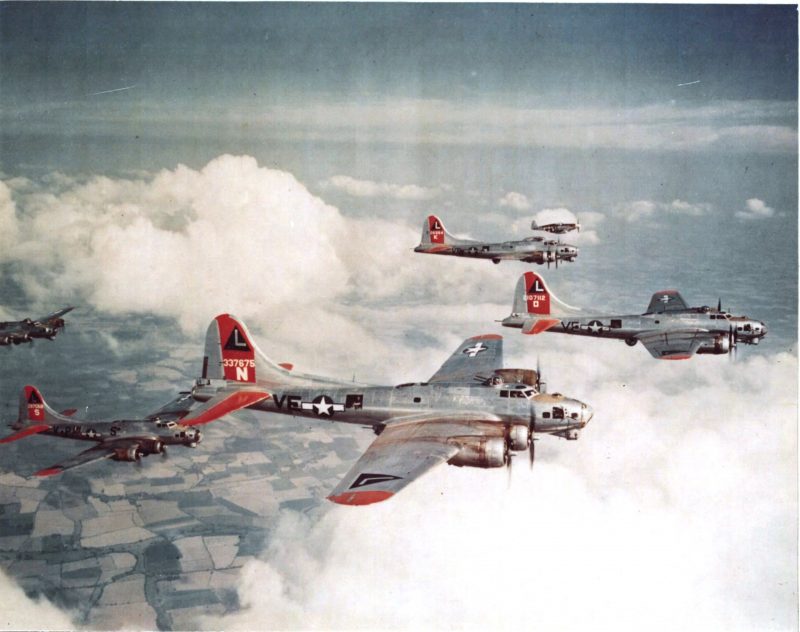
The Boeing B-17 “Flying Fortress” was probably America’s most iconic World War II airplane. First flown in 1935, it entered operational service in 1938. The B-17 was intended to be tough, as Boeing’s president had advised designers that he wanted an “aerial battleship”. When the airplane was unveiled, bristling with defensive machineguns, a reporter described it as a “Flying Fortress”, and Boeing quickly adopted and trademarked the nickname. B-17s became famous for their Eighth Air Force raids into Germany – a fame augmented by the wartime documentary Memphis Belle. As seen below, they were also legendary for their ability to survive significant punishment.
The Rugged Flying Fortress in ‘Round the Clock’ Bombing

Flying Fortresses saw most use in Europe in the strategic “Round the Clock” bombing campaign. Allied airmen divided bombing schedules so that US bombers attacked German targets during the day, and the British Royal Air Force bombed them at night. RAF Bomber Command had begun the war with daylight raids unescorted by fighters, which lacked the range to accompany the bombers deep into Germany.
However, high losses to German fighters soon forced the RAF to switch to nighttime raids. When America entered the war, daylight bombing was the only practical option: US bomber training, doctrine, and bomb aiming equipment, were all based on clear target visibility. As a result, it was either American daylight bombing or no American bombing at all.
Rethinking the Use of B-17s

US air commanders had a lot of faith in their more robust and heavily armed bombers. They believed that unescorted B-17s could fight their way to targets deep inside Germany. They would fly in tight formations, rely on their own defensive firepower for mutual protection, and bomb with acceptable losses. Unfortunately, bitter experience demonstrated that such assumptions were not based on reality.
While B-17s were exceptionally rugged, unescorted raids deep into Germany, such as those against the ball bearing and aircraft plants at Schwienfurt and Remagen in 1943, resulted in heavy and unsustainable losses to German fighters. US air commanders were forced to rethink things. American bombers were forced to pull back and limit themselves to targets closer to Britain and within fighter protection range.
The Arrival of Adequate Fighter Protection

Fortunately, the range of US escorts steadily grew, especially after the introduction of drop tanks. American P-38 and P-47 fighters began to accompany B-17s and B-24s to targets deeper within the Reich. The arrival of improved versions of the P-51 Mustang, equipped with drop tanks that gave them the range to escort bombers virtually anywhere in Europe, was a game changer that finally removed all restrictions.
From then on, steadily intensifying daylight raids by B-17s helped reduce the Third Reich to rubble. American bombing reached its high water mark in February, 1945, with a 1000 bomber raid, escorted by 400 fighters, on Berlin, followed soon thereafter by joint American-British raids on Dresden that demolished the city and killed between 25,000 to 130,000 people.

_________________
Some Sources & Further Reading
Hess, William N. – Big Bombers of World War II (1998)
History Halls – World War II Bombers: Britain’s Handley Page Halifax

