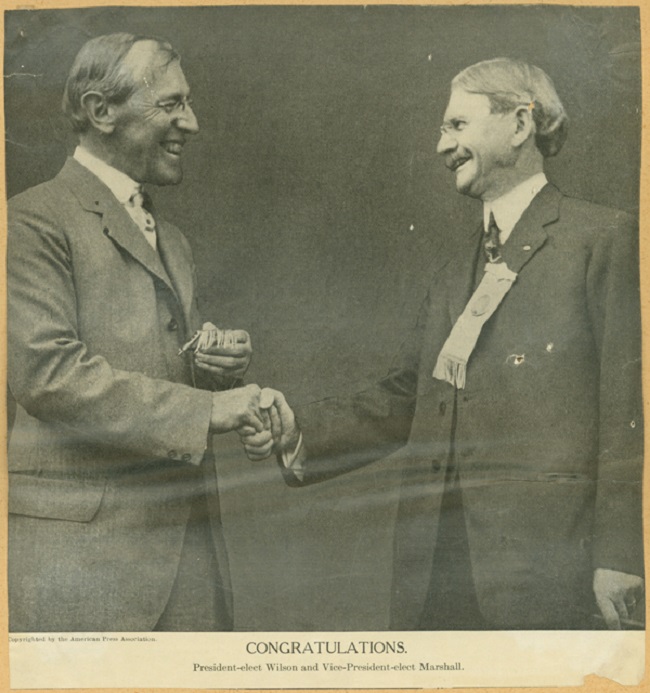
Opinions about just who was the most useless vice president in American history vary. Because of recency bias, many would probably name somebody from within their lifetime. For historians specialized in American politics, however, a prime candidate would be the now nearly forgotten Thomas Marshall. As seen below, he was well aware of his uselessness, and so feared the top job that it left him open to one of American politics’ meanest pranks.
A Vice President Who Knew He Was Useless

Woodrow Wilson’s running mate and 28th vice president of the United States, Thomas Riley Marshall (1854 – 1925), harbored no illusions that he possessed any power or influence. He won a second term by joking throughout the presidential campaign about his position’s “utter uselessness and frivolity”. He liked to tell a story about a man who had two sons, one of whom went to sea and drowned, while the other became vice president. The punch line was that “neither son was ever heard from again”.
Marshall often referred to himself as “the Wilson administration’s spare tire – to be used only in case of emergency”. So on the one hand, Marshall was not the type to take himself or his position too seriously. On the other hand, Marshall had next to no confidence in himself. Worse, he lived down to that self-assessment when the country needed him the most. When Wilson was paralyzed by a stroke in 1919, Marshall became paralyzed by fear of actually taking the reins of government.
Fear of the Top Job

Once a prominent Indiana lawyer, Marshall got started on politics by stumping and organizing rallies for Democratic Party candidates, before he was finally elected governor. He tried to make progressive changes to Indiana’s constitution, but his efforts proved controversial and were blocked by the state’s supreme court. Marshall was a well-liked man, but not a well-respected one. He did not seem to mind. Indeed, he reveled in his irrelevance, and often told those who passed by his White House office: “If you look on me as a wild animal, be kind enough to throw peanuts at me”. As a contemporary described him: “Marshall made friends, not enemies. But they looked on him as jester”. Wilson put it more succinctly, dismissing Marshall as “a very small caliber man”.
Vice President Marshall’s low stature had not mattered for years, until late September, 1919, when it suddenly became a huge problem. 1919 had been particularly hectic for President Wilson. He had traveled to Europe to negotiate the Versailles Peace Treaty, and upon his return crisscrossed the country for weeks to drum up support for America’s joining the League of Nations. Exhausted from all of his exertions, the president’s health gave out and he collapsed on September 25th. A week later, on October 2nd, things got worse and Wilson was felled by a stroke that left him partially paralyzed. It was against that backdrop, as seen below, that Marshall became vulnerable to an especially mean prank.
A Cruel Hoax

President Wilson’s wife, Edith, stepped up to the plate when her husband was incapacitated. She took the reins, and secretly ran the government until the end of his term. It was admirable on her part, but that should have been the vice president’s job. However, Marshall was incapacitated by fear of actually becoming the country’s chief executive. That left him open to a cruel hoax. On November 22nd, 1919 – almost two months after Wilson’s stroke – Marshall was delivering a speech in an Atlanta auditorium. Mid-oration, a policeman approached a man sitting onstage, and told him to interrupt the vice president and have him call Washington immediately: the president had died.
A stunned Marshall froze, then muttered: “I cannot take up the burden of the great chieftain”. As he confessed later: “I dreaded this task”. As an organist played “Nearer, My God, To Thee”, audience members sobbed, prayed, and left. However, when Marshall reached the telephone in the lobby, the line was dead. Inquiries revealed that no long distance call had come through from Washington: Marshall had been cruelly hoaxed. Relieved, he resumed his role as a nonentity, and finished his term paralyzed by fear of actually becoming president, alongside a president paralyzed by a stroke.

_________________
Some Sources & Further Reading
History Halls – The Hitler Diaries Hoax: When Respectable Publications Fell for a Forgery
Marshall, Thomas R. – Recollections of Thomas R Marshall, a Hoosier Salad (1925)

