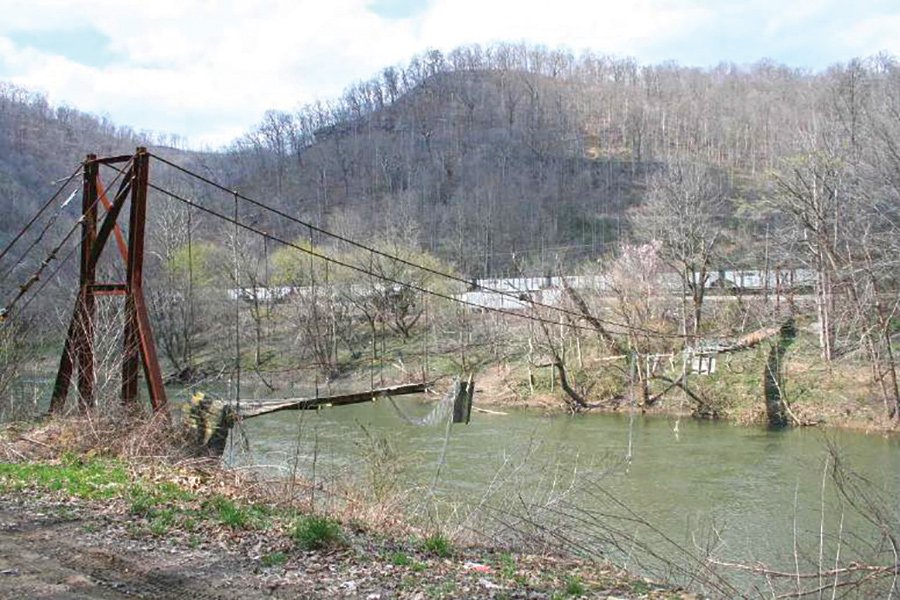
Small towns and communities are often overlooked by government layers above their own. They can get the short end of the stick when it comes to allocation of taxpayer funds and resources. Especially small communities without political clout. That prompted an overlooked West Virginia community, desperate for a bridge for years but ignored by its own government, to finally ask the Soviet Union in the 1970s for foreign aid. Below are some interesting facts about that awkward Cold War episode.
Overlooked and Ignored Vulcan

Vulcan, a tiny community in Mingo County, West Virginia, lies on the state’s southwest border with Kentucky. Surrounded by mountains on three sides, and the Tug River on the fourth, Vulcan would probably never have been inhabited if coal had not been discovered there in the early twentieth century. A coal miner camp was set up, which eventually grew into a small but thriving community. It ceased to thrive, however, when the coal ran out in the early 1960s. Soon as the coal was gone, Vulcan’s population started to shrink, until only a few dozen families – stubborn holdouts unwilling to leave the place they knew as home – were left. To the extent the outside world had ever known that Vulcan existed, it forgot about it soon as the coal dried up.
That was a problem for the locals, because they were all but cut off from the outside world. As a 1972 book described Vulcan, WV: “Their biggest problem was that the state had forgotten to build a road into the community. Although state maps showed a road into Vulcan, it was nowhere to be found. The only way people could get in and out was to drive up the Kentucky side and walk across a swinging bridge, which was too narrow for a vehicle. The bridge had been built by the coal company years before and was on the verge of collapse; although there were boards missing, the children had to walk across it to catch the school bus on the Kentucky side…”
Turning to the Reds for Help

Without a road, Vulcan’s children had to crawl under parked railroad coal cars – which often blocked the community’s sole bridge – on their way to and from school. One child lost a leg doing that. There was a side road that ran through Vulcan. However, it belonged to a railroad that placed it off limits, and vigorously prosecuted those who used it as trespassers. For years, Vulcan’s residents begged county, state, and federal officials to fix their rickety bridge, but were ignored.
In the meantime, the bridge continued to deteriorate and become an ever greater hazard to life and limb. Forsaken by their own government, the Vulcanites opted for a radical alternative. In 1977, their mayor wrote the Soviet embassy in Washington, DC, as well as officials in communist East Germany. He described Vulcan’s plight, and requested foreign aid to build a bridge. The Soviets jumped on the opportunity to embarrass their Cold War rival, and sent journalists to Vulcan. Their interviews and broadcasts of the locals’ woes finally brought attention to the overlooked community.
Vulcan Finally Got its New Bridge

From ignored, Vulcan suddenly became the center of national and international attention. Newspapers across the country and around the world finally took notice. For example, The Spokane Daily Chronicle wrote: “Soviet officials were amused today by reports that the small town of Vulcan, W.Va. has appealed to the Kremlin for foreign aid… The town, with a population of 200, asked the Soviet government for financial help to build a bridge after the town was turned down by the U.S. and West Virginia governments”. Many anticommunist types did not see the humor and were not amused. Radio stations and local newspapers received a flood of threats to blow up any bridge built with Red foreign aid.
On December 17th, 1977, the Soviet embassy sent a senior journalist to meet Vulcan’s mayor and survey the problem. He was authorized to promise the locals that his government would keep an eye on the situation, and that if their own government did not build them a bridge soon, the Soviets would pay to build them one. Within an hour of that visit, word filtered down to reporters milling about Vulcan that West Virginia’s government had agreed to build a bridge. The state legislature authorized $1.3 million for the task. Today, a single lane, graffiti-covered bridge connects the people of Vulcan to the outside world.

_________________
Some Sources & Further Reading
History Halls – When America Wanted to Nuke the Moon
Ocala Star Banner, January 2nd, 1980 – West Virginia Bridge Being Built Without Russian Aid

