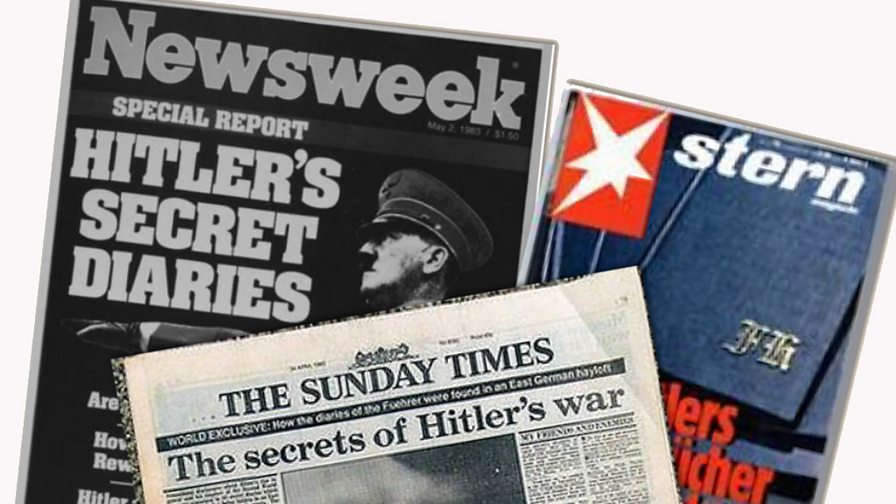
Given the right – or wrong – circumstances, anybody can fall for a hoax. Still, it is reasonable to assume that investigative journalists, those most skeptical of professionals, ought be the least likely to get hoaxed. However, they are not immune to getting gulled. One of history’s most remarkable hoaxes, the 1983 publication of the Hitler Diary, had as it key marks prominent investigative journalists and editors from respectable publications. Below are some fascinating facts about that embarrassing episode of shoddy journalism.
Finding the Fuhrer’s Diaries

In 1983, a conman convinced the editors of the respectable British Sunday Times newspaper, and the equally respectable German Stern and American Newsweek magazines, that Hitler had kept a secret diary. To great fanfare, the newspaper and magazines published the Hitler Diary. They ended up with egg on their faces when their scoop turned out to be a forger’s crude concoction. The debacle began in April, 1983, when Stern magazine held a press conference to announce that their star reporter, Gerd Heidemann, had discovered the erstwhile Fuhrer’s diaries. They had been recovered in 1945 from the wreckage of a plane crash. They then languished in obscurity for years, until Heidemann tracked them down.
Juicy tidbits littered the documents. They ranged from Hitler’s sensitivity about his bad breath, to his astonishing ignorance about the Holocaust and what his underlings had been doing to the Jews. The editors of Stern were jubilant. They declared that their scoop, which revealed the Fuhrer’s innermost thoughts, would lead to a major rewrite of World War II’s history and Hitler’s biography. The magazine, which had paid $6 million for the documents, sent them to three handwriting experts. All of them declared the diary authentic. Prominent British historian Hugh-Trevor Roper, who reviewed the diaries on behalf of the Sunday Times, also declared them legit.
The Respectable Publications That Missed Obvious Signs of Forgery

Stern’s editors had feared a leak. So they refused to allow any German WWII experts to examine the diary before it was published. That turned out to have been a major blunder. Once the diary was published, German scholars and researchers finally got to examine the documents. They easily detected the telltale signs of forgery. For one thing, both the paper and ink supposedly used by Hitler were modern, and had not existed during the Fuhrer’s lifetime. For another, the diaries were riddled with obvious inaccuracies about events and dates that Hitler could not have possibly gotten wrong.
There were even dated entries in which the Fuhrer described events before they had actually happened in real life – an impossibility, unless Hitler was a time traveler. An investigation revealed that the diary was the creation of a notorious German forger named Konrad Kujau. He had conspired with Stern reporter Gerd Heidemann to rip off the magazine. In the fallout, historian Hugh-Trevor Roper’s reputation was ruined, and editors at Stern, the Sunday Times, and Newsweek, were fired. As to Kujau and Heidemanna, they were tried and convicted of forgery and embezzlement, and sentenced to three and a half years behind bars.

_________________
Some Sources & Further Reading
History Halls – The Tasaday Hoax: The Isolated Stone Age Tribe That Wasn’t
New German Critique, No. 90 (Autumn, 2003) – The Fascination of a Fake: The Hitler Diaries
New Yorker, The, April 25th, 2013 – Diary of the Hitler Diary Hoax

