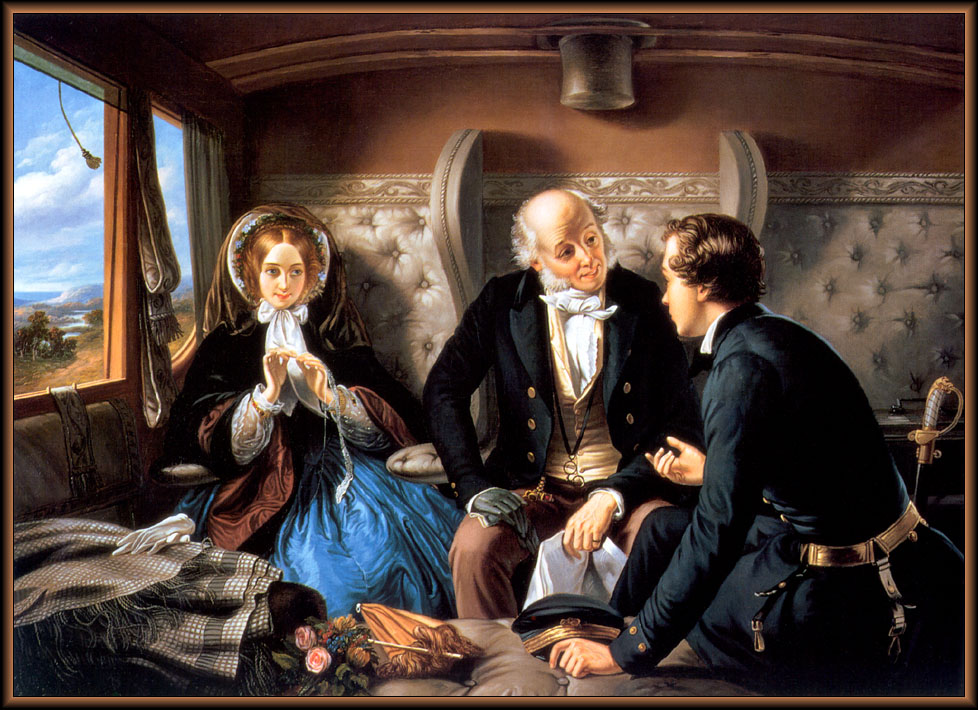
The unknown frightens many people, and new technologies are no exception. We are an imaginative species, so we tend to let our fancies run wild to come up with all kinds of terrible possible consequences of new inventions. Some of those fears might be valid, but quite a few turn out to be ludicrous. Take trains, for example. When first introduced, there was widespread optimism about the new technology, but also many irrational fears.
Victorians Feared that Human Bodies Could Not Handle Train Speeds

When steam locomotive passenger trains entered service in the first half of the nineteenth century, many feared that their high speeds – at least high by the standards of their era – would prove lethal to passengers. Not lethal in the way most people today might picture, however, such as via train wrecks. New locomotives, such as the Rocket, built by Robert Stephenson in 1829, maxed out at twenty eight miles per hour. Quite slow, by today’s standards, but not by those of 1829. Until then, it is unlikely that any humans had ever experienced such speeds unless falling off a cliff.
So a myth cropped up that the unprecedented velocity of trains was dangerous in of itself. In the nineteenth century, the perceived risk of the velocities afforded by trains was not limited to the consequences of a crash or derailment. Naysayers theorized that human bodies were simply not adapted to or able to withstand travel at any speed faster than that of a galloping horse. In a precursor to concerns about G forces in the era of powered flight, train skeptics invented tall tales about the impact of speed on humans.
The Fear That Train Speeds Would Make Women’s Uteruses Fly Out of Their Bodies

Train alarmists invented and accepted a myth that the high speed of trains would compress passengers’ organs against their backs. Such compression would damage human constitutions, and could prove fatal. The fear was greatest when it came to female passengers. It was believed that between motion and speed of trains, women’s uteruses might get dislodged, and exit their bodies. Such ludicrous fears eventually waned as train travel became common, and nobody got their hearts or lungs flattened against their backs, and no women had their uteruses fly out of their bodies.
So train alarmists shifted their paranoia from dangers to passengers’ bodies, to dangers posed to their minds. By the 1850s, many Victorians developed other worries about the steady increase in train speeds. Combined with the rattle of railway cars, they feared injuries to passenger brains that could drive them insane. Just like today, the nineteenth century had no shortage of sensationalist media. It did its best to whip up the myth about the risks to sanity posed by train travel. An illustrative example, as seen below, was a widely reported story in 1865 about a lunatic on a train bound for Liverpool, England.
The Fear That Trains Made Passengers Crazy

One day in 1865, an armed and deranged passenger on a train from Carnforth to Liverpool began to attack windows to get at passengers in other compartments. When the train slowed down and stopped at its next station, the madman calmed down. When the train got underway again, he went crazy, only to calm down again when the train stopped at the next station. The pattern of frenzied rage while the train was in motion, followed by calmness when it slowed down and stopped, continued until the train reached Liverpool. Contemporary newspapers and mental health professionals linked the bouts of violent insanity to train travel.
However, rather than reason that the passenger was a mentally disturbed individual for whom a train’s motion was a trigger, they concluded that train travel was the cause of his mental illness. The myth persisted, well into the twentieth century, that the speed or motion of trains drove people insane. The pattern of flawed analysis that confused causation with correlation went on for years. Somebody would do something crazy or act in a socially unacceptable way in a train, and the train’s speed or motion would be blamed.

_________________
Some Sources & Further Reading
Atlas Obscura – The Victorian Belief That a Train Ride Could Cause Instant Insanity
History Halls – Moral Panics: When Coffee Was Controversial

