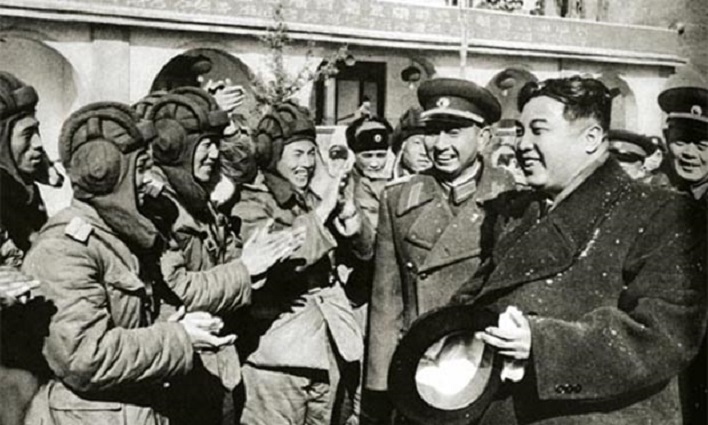
China’s desire to regain Taiwan – by force, if necessary – has long been a powder keg awaiting a spark. It is the greatest single potential trigger for direct war between the US and China. Ironically, Taiwan was pretty much communist Beijing’s for the taking at one point. As seen below, the island would probably have been absorbed into China decades ago. Until North Korea’s communist dictator, Kim Il Sung unintentionally saved it.
The Other Island Held by Mao’s Enemies

China’s current tense relationship with Taiwan began in the closing stages of the Chinese Civil War. Mao Zedong’s communists finally secured victory over the Nationalist forces of Chiang Kai-shek, and he declared the establishment of the People Republic of China (PRC) on November 1st, 1949. The defeated Republic of China’s (ROC) president and his surviving followers fled from mainland China to the nearby island of Taiwan. There, they continued on as the Republic of China – now significantly reduced in size. However, Taiwan was not the only island to which the Nationalists had retreated in 1949.
Defeated ROC forces also fled to Hainan, another sizeable island off the coast of China, similar in size to Taiwan. Mao and his followers were not about to let the defeated Nationalists be, however. They immediately began planning to pursue their remnants to their offshore island havens. They started off with Hainan. On April 16th, 1950, less than six months after they had secured mainland China, the communists conducted an amphibious invasion of the island. 100,000 People’s Republic of China soldiers landed on Hainan, where they were assisted by about 15,000 local communist militiamen. They faced somewhere between 140,000 to 200,000 ROC soldiers and militiamen. Although outnumbered, the communists were relatively confident of victory.
The Communist Invasion of Hainan

Mao’s greatest worry had not been Hainan’s Nationalist defenders. He knew his forces could defeat them, having already done so many times on the mainland. His biggest fear was that the US, whose navy could easily sink a communist seaborne invasion, would intervene. The US did nothing, and the communists cruised to an easy victory within two weeks. At the cost of roughly 4,000 PRC casualties, Mao’s forces inflicted an estimated 33,000 casualties on the ROC forces, forced the survivors to evacuate Hainan, and secured the island by May 1st. Mao took America’s non-intervention as a sign that the US had written off the Republic of China. That was supported by an American declaration a few months earlier that had defined the parts of East Asia vital to US interests: Hainan and Taiwan were conspicuously absent from that list.
Emboldened by their easy success in Hainan, and convinced that the US would once again decline to intervene if they invaded Taiwan, the communists began to plan for an invasion of the island. Mao expected another easy victory, a repeat of the communist seizure of Hainan, and gave orders for an amphibious assault on Taiwan to take place in July, 1950. Realistically, there was little reason to expect that the Nationalists would do any better defending Taiwan than they had done in their defense of Hainan. The writing was on the wall, and the Republic of China’s last bastion seemed doomed. Then fate intervened. Or to be more precise, as seen below, North Korea’s Kim Il Sung intervened.
The Communist Dictator Who Inadvertently Saved Taiwan

On June 25th, 1950, just as Mao’s forces were making their final preparations to invade Taiwan, North Korea’s communist dictator sent his forces to invade South Korea. Like Mao, he believed that the US would not intervene – South Korea also having been conspicuously absent from the parts of East Asia recently declared by American officials to be vital to the US. Unfortunately for Kim – and for Mao – the US did intervene. Washington had not cared much if the communists seized Hainan, and until Kim invaded South Korea, did not seem to care much if they seized Taiwan as well. There was little near either island that mattered to America.
South Korea was a different story: it lay close to Japan, and Japan mattered a lot. The idea of the entirety of Korea in communist hands, to be used as a potential springboard from which to invade Japan someday, spurred the US into action. The American forces were rushed to defend South Korea, and while at it, with America’s blood already up, the US Seventh Fleet was also rushed to the Taiwan Strait to make sure that Mao’s forces did not cross over to seize that island as they had recently done with Hainan. With Taiwan now under the protection of America’s defensive umbrella, all hopes for a successful communist invasion were gone. Thus, the Nationalists and the Republic of China in Taiwan were spared at the last moment, thanks to the decision of a dictator in distant North Korea to invade his southern neighbor.

_________________
Some Sources & Further Reading
History Halls – The Great Leap Forward That Set China Back
Short, Philip – Mao: A Life (2001)
Van de Van, Hans – China at War: Triumph and Tragedy in the Emergence of the New China (2017)
Westad, Odd Arne – Decisive Encounters: The Chinese Civil War, 1946-1950 (2003)

