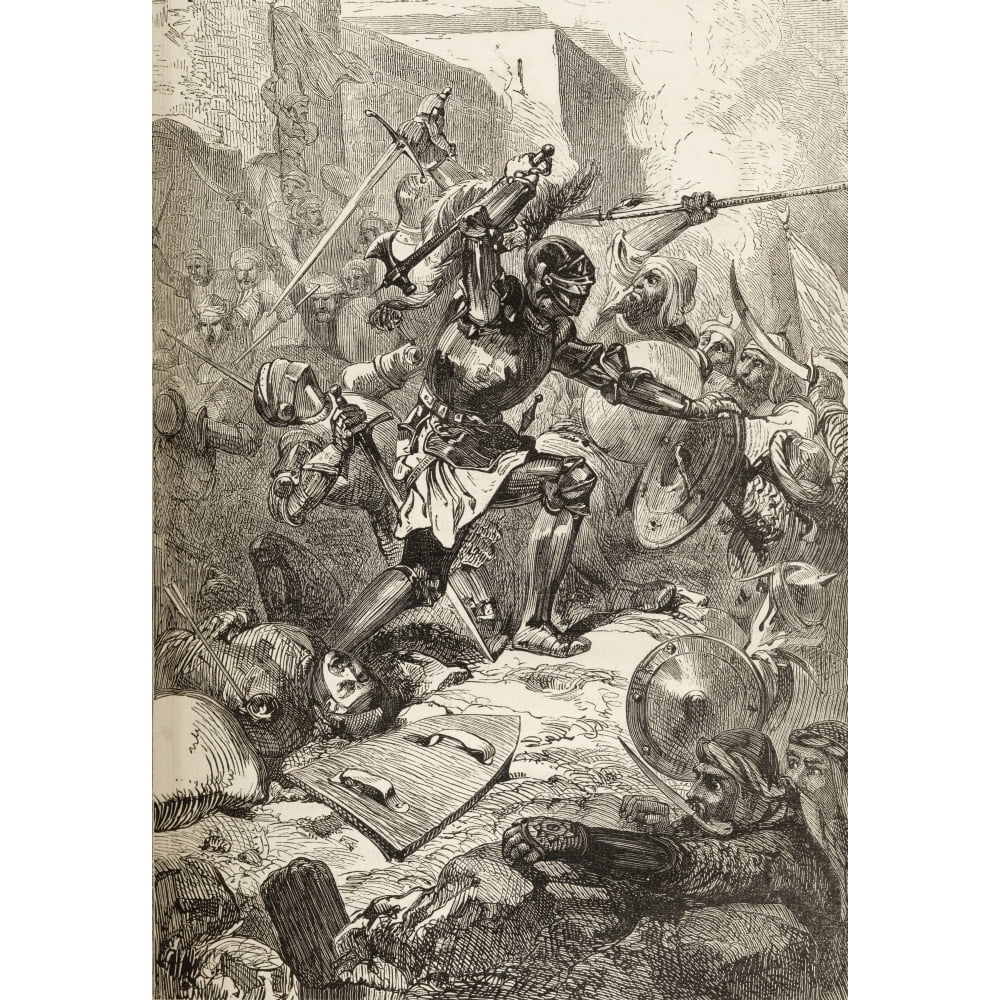
When did Muslim armies come closest to conquering Europe? It was not in 732, when the Franks under Charles Martel defeated an Umayyad army at the Battle of Poitiers. That had been a raid, not an attempted conquest. Nor was it in 1683, when a coalition army led by Polish King John Sobieski broke a Turkish siege of Vienna with a dramatic charge. By then, thanks to the Military Revolution, European armies had already gained a qualitative edge over the Ottomans that made their attempts to conquer Europe unrealistic. As seen below, the closest that Islamic armies ever came to conquering Europe was in 1529.
Suleiman the Magnificent’s Plans for Vienna

The Ottoman Turks crushed the Hungarians at the Battle of Mohacs in 1526, then annexed Hungary to their growing empire. It was the latest episode in nearly a century of Turkish conquests in eastern and central Europe. It brought the confident and expansionist Ottomans into direct contact with the Hapsburg Empire along the Hungarian border. In 1529, Ottoman Sultan Suleiman the Magnificent assembled his forces for an invasion of Hapsburg territory. The campaign aimed to seize Vienna, a gateway to Central Europe for forces advancing from the direction of the Balkans.
Once seized, the city was to be used as a base of operations for further advances into Europe. Accordingly, Suleiman set out with his army from the Black Sea, headed towards Vienna with an army of about 120,000 combatants. However, things began to sour for the Turks from early on. Unusually heavy rains turned the roads into seas of mud, in which the Ottomans’ heavy siege artillery was mired and had to be abandoned. The bad weather also wreaked havoc on the soaked troops’ health. As seen below, that was just the start of the Ottomans’ woes.
Bad Weather, and Vigorous Defenders

By the time it arrived before Vienna and besieged it in September, the Ottoman army had been significantly weakened. The city’s roughly 20,000 defenders were greatly outnumbered by the Turks. However, the defenders were relatively dry, and sheltered behind strong walls and fortifications that were able to withstand bombardment by the Turks’ light field pieces. The heavy siege guns that had been abandoned in the mud en route were sorely missed by the besiegers. The Ottomans tried to collapse Vienna’s walls by mining, but were foiled by the defenders’ effective counter-mining.
The Turks made numerous attempts to storm Vienna’s walls, but were beaten back each time. The city’s defenders shot down the attackers with arquebuses, and used long pikes to push back scaling ladders and the attackers who made it to the top of the walls. The Ottomans’ woes were worsened by more heavy rains in October, which fouled much of their gunpowder. Suleiman ordered a final all-out assault in late October, but it was beaten back. So the siege was lifted, and the Turks withdrew.
1529 Turned Out to be the Ottoman Turks’ High Water Mark

The retreat became a disaster when winter snows arrived early that year, and caught the Ottomans out in the open. Many perished, and all the remaining artillery had to be abandoned. Another attempt to seize Vienna was made in 1532, but it proved abortive. After that second failure, Suleiman gave up on his dream to conquer Europe. Thereafter, Turkish efforts were diverted to Asia and the Mediterranean. At the time, the Turks’ failure before the gates of Vienna in 1529 did not appear decisive. With the hindsight of history, however, we now know that it was pivotal moment in history: 1529 was the best chance that the Ottomans ever had to conquer Europe or a significant part thereof.
Europe in 1529 was politically divided, and rent by bitter wars of religion between Catholics and Protestants. Moreover, European armies had not yet undergone the Military Revolution, with its innovations in tactics and strategy that would give European armies a qualitative edge over non-European forces for centuries to come. The Ottomans made another unsuccessful – and better known – attempt to seize Vienna in 1683. By 1683, however, even if they had managed to seize the city, it is unlikely that they could have advanced much further into Europe, or even held on to Vienna for long. 1529 turned out to be Ottoman Turks’ high water mark in Europe.

________________
Some Sources & Further Reading
Kinross, Lord – The Ottoman Centuries: The Rise and Fall of the Turkish Empire (1977)
Wheatcroft, Andrew – The Enemy at the Gate: Habsburgs, Ottoman and the Battle for Europe (2009)

