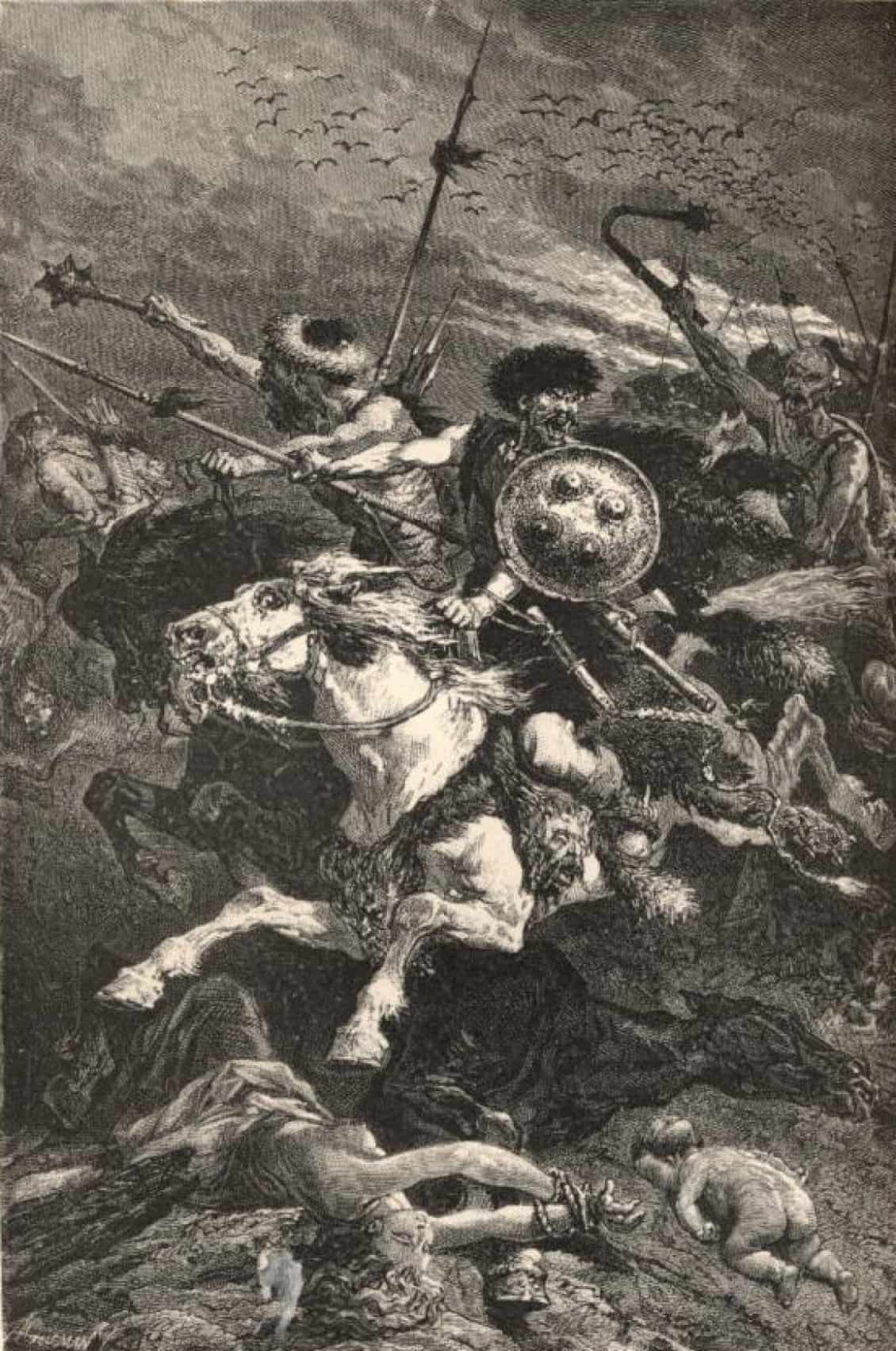
Attila the Hun (reigned 434 – 453) ruled a multi-tribal empire that stretched from the Russian Steppe into Central Europe. He terrorized the civilized world, and earned the moniker “The Scourge of God”. Attila invaded Persia and both the Eastern and Western Roman Empires, devastated the Balkans, and extorted literal tons of gold from the Romans to let them be. He always came back for more, however. In 450, the Western Roman Emperor’s sister sought Attila’s help to escape an unwanted betrothal. Attila interpreted that as a marriage proposal, accepted, and asked for half of the Western Roman Empire as dowry. The Romans refused, so Attila invaded, began plundering Gaul, and a Roman general named Aetius was tasked with organizing the resistance. It all came to a head at the Battle of the Catalaunian Fields in 451 – a battle that not only halted the Huns, but shaped Europe forever after.
Meeting at the Catalaunian Fields

Aetius allied with the barbarian Visigoths, promising them a homeland of their own in southwestern France in exchange for their military aid. An allied Roman-Visigoth army of about 50,000-80,000 men set out to confront Attila, who led a similar-sized army. They reached him as he was besieging Aurelianum – today’s Orleans, France. Attila broke off the siege and retreated to find favorable ground to give battle. He found it at the Catalaunian Fields northeast of Orleans, and there, he turned to face his foes.
On June 20th, 451, Attila’s army met the allied army commanded by Aetius and the Visigoth King Theodoric I, at the Battle of the Catalaunian Fields. The battlefield was dominated by a ridge, whose right side the Huns seized, while the Romano-Visigoths seized the left. The ridge’s crest in the center was unoccupied, and it became the battle’s focus, as whoever controlled that high ground would have a significant advantage.
A Decisive Battle That Shaped Europe

Combat commenced when the Huns advanced to seize the crest, but Aetius’ men got there first. The Romans repulsed the Huns, who reeled back in disarray, and Theodoric’s Visigoths attacked them as they retreated. Attila plunged into the fight to reorganize his men, but was forced to retreat back to his fortified camp. King Theodoric was killed during this fighting, and his son Thorismund took his place.
Fighting finally petered out and ceased at nightfall. The next day, Attila awaited an attack, but it never came. Aetius realized that Attila had already been defeated, and began to calculate the political ramifications of what would happen if his barbarian enemy was utterly destroyed. If the Hun threat was completely removed, the Visigoths would have no more need of the Romans, and would likely turn on them.

As a result, even though the Visigoths urged Aetius to resume the battle, he refused. Instead, Aetius convinced Thorismund to return to the Visigoth capital and secure the throne, before one of his brothers seized it. Attila survived, but the battle had reshaped the Roman province of Gaul. It set it on a new trajectory that would eventually transform it into modern day France.
The Romano-Gauls, a blend of the Celtic Gauls and the Latin Romans, were replaced as a ruling class by new Germanic overlords. The Goths went on to form an independent kingdom in southwestern Gaul, while in northern Gaul, Roman influence was weakened, while that of the Franks and Burgundians increased. Today’s France would eventually emerge from that new blend.

_________________
Some Sources & Further Reading
Hildinger, Erik – Warriors of the Steppe: Military History of Central Asia, 500 BC to 1700 AD (1997)
History Halls – The Men Who Made and Unmade the Roman Republic: The Selfless Cincinnatus
Kim, Hyun Jin – The Huns, Rome, and the Birth of Europe (2013)
Maenken-Helfin, Otto – The World of the Huns: Studies in Their History and Culture (1973)
MacDowell, Simon – Catalaunian Fields 451: Rome’s Last Great Battle (2015)
Man, John – Attila: The Barbarian King Who Challenged Rome (2009)

