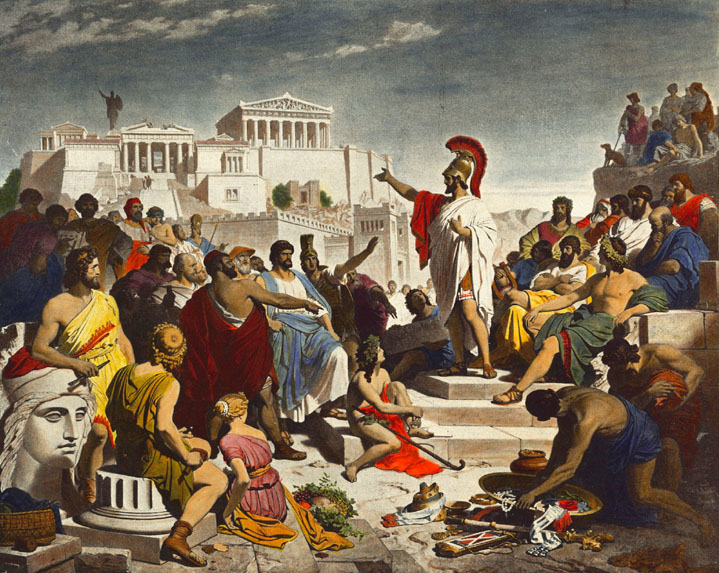
Ancient Athenian statesman Pericles (495 – 429 BC) was his city’s dominant political figure in the mid-fifth century BC. The Athenian Golden Age, during which the city attained the apogee of its power and its empire reached its greatest extent, is also known as the “Age of Pericles”. Below are some interesting facts about that towering ancient statesman.
A Patron of the Arts, and a Proponent of Expanding Athenian Power

Pericles was born to a populist general, Xanthippus, who was ostracized and exiled by his fellow Athenians in 484 BC. He was recalled four years later during the crisis of the Persian invasion, and led the Athenians at the Battle of Mycale. Pericles grew up wealthy, and was a patron of culture and the arts since his youth – Aeschylus’ oldest surviving play, The Persians, was paid for by Pericles in 472 BC. Pericles was also a friend and patron of Phidias, Ancient Greece’s greatest sculptor. In the Periclean Age, Athens flowered into a center of culture, art, education, and democracy.
Pericles inherited his father’s democratic leanings, and by the 460s BC he had become the deputy and right hand man of Ephialtes, Athens’ radical democratic leader. When Ephialtes was assassinated in 461 BC, Pericles stepped into his shoes. He completed his predecessor’s reform agenda, and dominated Athens until his death in 429 BC. A hawk, Pericles was a proponent of increasing Athens’ power abroad. Throughout his years in power, he aggressively advocated the expansion of Athenian dominance in the Aegean and Eastern Mediterranean.
Pericles Transformed an Alliance Into an Athenian Empire

Pericles successfully transformed the Delian League, which had started off as an anti-Persian defensive alliance headquartered in the island of Delos, into a de facto Athenian empire. Delian League members were not permitted to leave, and were compelled to pay annual taxes and other contributions into a treasury controlled by Athens. By the 440s BC, any remaining pretense was abandoned, and the Delian League’s treasury was transferred from Delos to Athens. There, it was used it to pay for a magnificent public works program. Athens’ grandest monuments, such as the Acropolis and the Parthenon, were paid for by that act of brazen embezzlement.
In 431 BC, the drawn out Peloponnesian War (431 – 404 BC) between Athens and Sparta began. Pericles ably led his city in the first two years. His strategy successfully neutralized Sparta’s advantages as the Greek world’s most formidable land power, and exploited Athens’ sea power to take the war to Sparta and her allies. However, a plague struck Athens in 429 BC, and Pericles was one of its victims. Athens failed to produce another leader of Pericles’ caliber. Led by a series of lesser men during the prolonged conflict, Athens lurched from mistake to mistake, until the war ended in catastrophic defeat and collapse in 404 BC.

_________________
Some Sources & Further Reading
Arid, Hamis – Pericles: The Rise and Fall of Athenian Democracy (2004)

