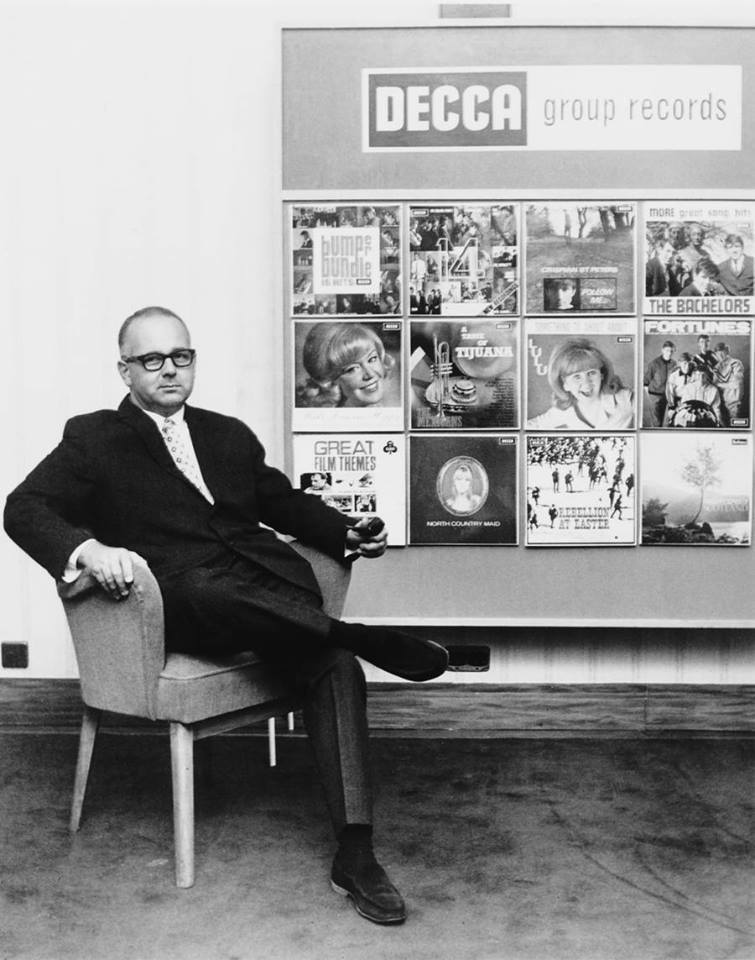
We all have causes for regret, and things we can look back on and wish we had handled differently. Few of us, though, have greater cause for regret than Dick Rowe, the record label executive who passed on signing what turned out to be the biggest ever music group. Below are some fascinating facts about that fail.
A British Music Industry Giant

Few wielded more influence in Britain’s music industry back in the 1950s and 1960s than Richard “Dick” Rowe. Decca Records’ A&R (artists and repertoire) head, Rowe was responsible for finding new artists who showed promise. He became infamous for an epically poor decision, but to be fair, Rowe was actually not bad at his job. His successful signings include The Rolling Stones, Tom Jones, Cat Stevens, The Animals, and Them, the band that launched Van Morrison. However, his name and reputation became forever tied with his biggest miss.
Brian Epstein, the manager of an unheralded musical group, took his young talents to audition with Decca Records on January 1st, 1962, at their studios in West Hampstead, North London. Epstein’s charges had been invited by one of Rowe’s A&R subordinates, Mike Smith, who had heard the band play a few weeks earlier. He liked what he heard enough to ask them to do a session at Decca’s studio. The group drove all the way from Liverpool to London on New Year’s Day, in the middle of a snowstorm, and made it just on time for their 11 AM audition.
An Awkward Audition

Brian Epstein’s charges were understandably annoyed after having driven through a snowstorm just to make it to Decca Records on time, only for man who had invited them, Mike Smith, to show up late. Smith, who had apparently partied hard the night before, unnerved the young musicians even more when he refused to let the group use their own amplifiers. Instead, he demanded that they use the record label’s amplifiers, which he deemed to be superior to ones used by Epstein’s group.
The kids set up, tuned and strung their guitars and cleared their throats, then performed about fifteen songs before Smith and his boss Dick Rowe. What with the drive through a snow storm, the late arrival of their host, and the use of different amplifiers, they were nervous and not at their best. Still, they thought they had done well enough to secure a contract. After the audition, however, Rowe decided to pass on the group and declined to sign them, with the airy remark that “guitar groups are on the way out, Mister Epstein”. That might have been the worst decision in the music business.
The Man Who Passed on Pop Music’s Greatest Band

Downhearted that their New Year had started with a rejection, Epstein and his group left Decca’s studios. Dick Rowe, on the other hand, thought that 1962 had started well for him and Decca Records. The same day he passed on Epstein’s group, Rowe had listened to another band that came in for an audition, liked what he heard, and signed up Brian Poole and the Tremeloes. He had told his A&R subordinate Mike Smith to decide between Epstein’s group and Brian Poole and the Tremeloes: As Rowe recalled later: “He said, ‘They’re both good, but one’s a local group, the other comes from Liverpool.’ We decided it was better to take the local group. We could work with them more easily and stay closer in touch as they came from Dagenham.”
That was not a bad decision in of itself, as Brian Poole and the Tremeloes had some success in the United Kingdom. In 1963, they entered the UK charts with a cover of the Isley Brothers’ Twist and Shout, and followed it up with a UK chart-topping cover of the Contours’ Do You Love Me. A year later, their cover of Roy Orbison’s Candy Man pleased the Brits, and a cover of the Crickets’ Someone, Someone, reached number 2 on the UK charts. Rowe’s epic fail was his failure to sign the other band that had auditioned the same day as the Tremoloes: The Silver Beatles, who soon shortened their name to The Beatles.

_________________
Some Sources & Further Reading
Beatles Bible – The Beatles Audition for Decca Records
Independent, The, February 12th, 2012 – The Man Who Rejected The Beatles

