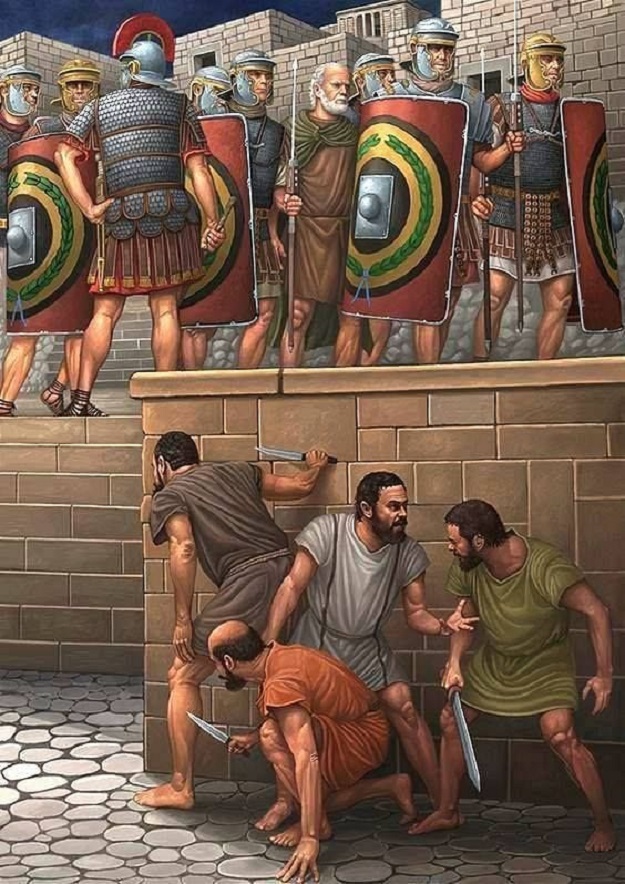
In the first century AD the Zealots, a radical Jewish sect, agitated to spark a rebellion to free Judea from the Roman yoke. They were not radical enough for some members, however, who splintered off to form an even more militant faction, the Sicarii. While the Zealots were radical, their Sicarii splinter went to extremes that made them history’s earliest identifiable terrorists, with methods that meet modern definitions of the term. Below are some fascinating facts about those radical ancient terrorists.
The ‘Dagger Men’ of Ancient Judea

The Sicarii, a word that means “dagger men” in Latin, earned their name from the knives known as sicae, with which they slew their victims. Their goal was to cleanse the Holy Lands of Romans and their Jewish collaborators. Their standard procedure was to blend into crowds at public gatherings, stalk their target, and wait for an opportune moment. When it presented itself, they would suddenly charge their target, stab him, and escape in the resultant confusion and panic by blending back into the crowd.
The Sicarii primarily targeted the pro-Roman Jewish aristocracy. They slew them, burned their estates, and eventually turned to kidnapping and holding them hostage for ransom. One of their most prominent early targets was a High Priest of the Jewish Temple, whom they slew before they went on an assassination spree that terrorized Judea’s upper strata of Jews and Romans. Their victims, particularly Imperial officials, were frequently targeted in a deliberate attempt to provoke the Romans. They succeeded, as the Romans seldom needed much provocation before they resorted to massacres and collective punishment of the Jewish population.
‘The Worse, The Better’ – The Ancient Origins of a Modern Terrorist Strategy

The brutal Roman retaliation for Sicarii provocations kept the embers of discontent smoldering. Collective repression lit new flames of resentment, and provided a steady and steadily growing stream of new recruits and sympathizers from the families and friends of the Romans’ victims. The ancient Sicarii adopted a strategy common among modern terrorists, that can be distilled into a simple term: “the worse, the better”. Sicarii engaged in targeted sabotage, with the intent to worsen the populace’s living conditions and keep them disgruntled.
Faced with an occupier ready to resort to indiscriminate violence, the Sicarii deliberately provoked the Romans. They committed atrocities that all but guaranteed massive Roman retaliation and collective punishment of their Jewish subjects. That forced the hands of many fence sitters by presenting them with terrible choices. They could do nothing, and likely ending up massacred or enslaved by angry Romans in no mood to distinguish “good” Jews from bad. Or they could join the resistance and hope to gain their freedom – or at least the dignity of dying while fighting.
The Sicarii Slaughtered Hundreds of Roman Women and Children

The Sicarii strategy of “the worse, the better” and forcing fence sitters to choose was evident early in the Great Jewish Revolt. It began in 66 AD, when Judea’s Roman governor responded to tax protests by arresting prominent Jews and looting Jerusalem’s Temple. The protests escalated into a massive uprising that forced the Romans and their pet king to flee Judea. The Sicarii attacked and seized the fortress of Masada near the Dead Sea, then descended upon nearby settlements to massacre any Romans they could find. They ended up slaughtering more than seven hundred Roman women and children. That atrocity ensured that there could be no turning back.
Rome, never known for its gentleness when dealing with turbulent conquered subjects, was bound to respond with overwhelming violence to the cold-blooded massacre of hundreds of Romans. That served Sicarii purposes – or at least they thought at the time that that it served their purposes. The certainty of massive Roman retaliation solidified the Sicarii’s own ranks. Simultaneously, it confronted other Jews with the prospect of indiscriminate collective punishment of the innocent and guilty alike should the Romans win. Having ensured with their massacre of Roman civilians that there could be no turning back, the Sicarii then joined the Zealots and other rebels to attack Jerusalem, which they liberated in 66 AD.
The Dramatic End of the Sicarii

Once they established themselves in Jerusalem, the Sicarii began to slaughter known and suspected Roman collaborators en masse. They also slew any opponents, suspected opponents, and eventually, even those who simply failed to express the requisite enthusiasm for the Sicarii cause. Their extremism led to a backlash and an uprising by the city’s population, and a falling out with the other rebels. It ended in Sicarii defeat, the capture, torture, and execution of their leader, and the group’s expulsion from Jerusalem.
The survivors retreated to the fortress of Masada, and contented themselves with plundering the surrounding countryside. In the meantime, the Zealots and other radicals managed to crush the popular backlash. They retained control of Jerusalem until it was besieged, conquered, and razed by the Romans in 70 AD. The Romans then began mopping up operations, and eventually reached the final holdouts, the Sicarii in the Masada, whom they besieged. Aware that all was lost and that their fate would be unenviable if they were captured, the Sicarii resorted to mass suicide: they slew their families, and then themselves.

_________________
Some Sources & Further Reading
Ben-Yehuda, Nachman – Masada Myth: Collective Memory and Mythmaking in Israel (1996)
Encyclopedia Britannica – Sicarii
Pearlman, Yoshe – The Zealots of Masada: Story of a Dig (1967)
Smallwood, Edith Mary – The Jews Under Roman Rule: From Pompey to Diocletian (1976)

