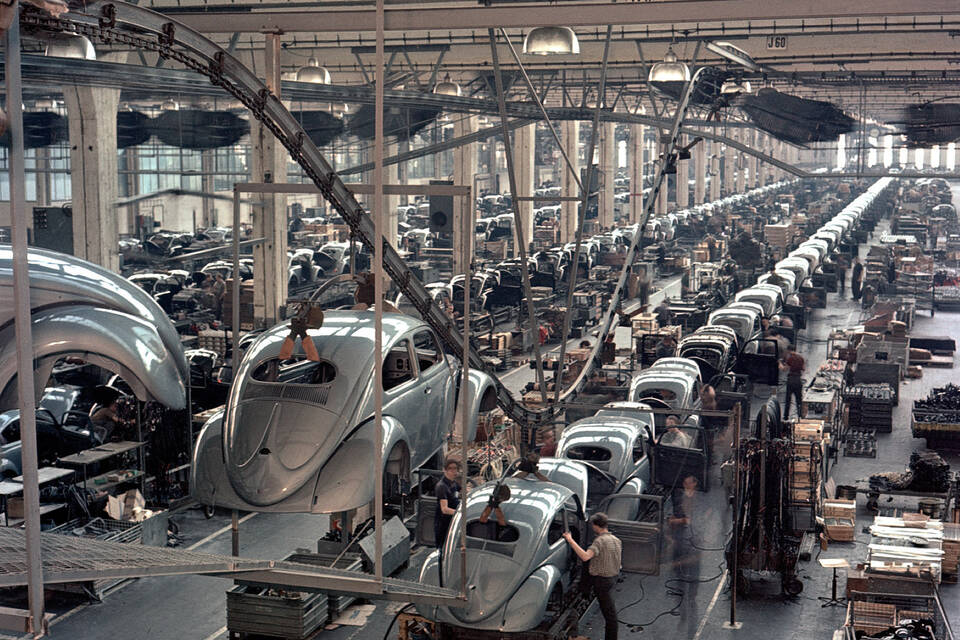
In World War II’s aftermath, Germany was a disaster zone, and its economy a wreck. Food production in 1947 was barely half what it had been in 1938. That was better than industrial production, which in 1947 was only a third of its 1938 level. Millions sheltered in bombed out ruins, because a fifth of all housing had been destroyed in the war. Many more were malnourished and hungry, because official food rations provided little more than half the calories necessary to keep body and soul together. Millions of working age men had perished in WWII. Millions more were held by the victors in prisoner of war camps. A decade after the war, however, things had turned around and people were marveling at a “German Economic Miracle”. Two decades after WWII, Germany’s economy was envied by most of the world. How did that come about?
WWII Devastated Germany’s Labor Pool, but Postwar Politics Replenished It

A variety of factors came together and contributed to Germany’s – or at least West Germany’s – rapid reconstruction and development. Key among them were the availability of adequate labor, and a timely lowering of taxes. That freed up capital and boosted disposable consumer income, and the economic management of a visionary coordinator. Combined with strong unions that ensured workers a fair deal, the result was a rapid expansion of the middle class. That boosted consumer demand, which in turn fueled a consumer-driven market in a virtuous feedback loop. The spectacular results became known as the German Economic Miracle (Wirtschaftswunder in German), or the “Miracle on the Rhine”, after the river that ran through West Germany’s economic heartland.
WWII had devastated Germany’s prime labor pool: working age men. More than five million of them never returned, killed in the war or reported missing and presumed dead. Another five million were injured, many of them disabled for the rest of their lives. Nonetheless, despite the losses, Germany’s rapid recovery was helped by the ready availability of skilled workers. The war had depleted the numbers of prime German-born workers, but postwar politics made up for much of the shortfall. Germany’s labor pool was swollen by the influx of millions of ethnic Germans who had been expelled from various European countries, and deported to West and East Germany. The skilled German labor pool was further reinforced by a steady stream of Gastarbeiter (“guest workers”) from poorer European countries. They performed manual and lower skilled labor in economic sectors that required fewer qualifications.
Tax Reforms, and Visionary Economic Stewardship

Another key factor that contributed to the rapid recovery was a slashing of taxes. They dropped from a high of up to 95% in the top brackets, to a more manageable 18% for most Germans. The top tax bracket subject to the highest taxation was pushed from those with incomes of 6000 Deutsche Marks, to those who made more than 250,000 DM. The tax reform released capital for investment in the private sector. It also increased the amount of disposable income available to middle class Germans, which in turn boosted consumer demand and fueled a consumer-driven economic boom. Even with such advantages, West Germany might have still bungled its recovery, or enjoyed a less spectacular one if it did not have the right economic stewardship.
Fortunately for the Germans, they lucked into far sighted economic stewards in the persons of West Germany’s first Chancellor, Konrad Adenauer, and more importantly, his Minister of Economics, Ludwig Erhard. As early as 1947, Erhard began to steer the economy while working for the Western Allies in a consultative capacity. He formally took charge of the economy as West Germany’s Minister of Economics from 1949 through 1963, followed by an additional three years as West Germany’s Chancellor from 1963 to 1966. Erhard’s period of economic stewardship, during which he introduced and implemented his concept of soziale Marktwertschaft (“social market economy”), covered the bulk of the Wirtschaftswunder. It is still the foundation upon which German economic policy is based in the twenty first century.

_________________
Some Sources & Further Reading
Library of Economics and Liberty – German Economic Miracle

