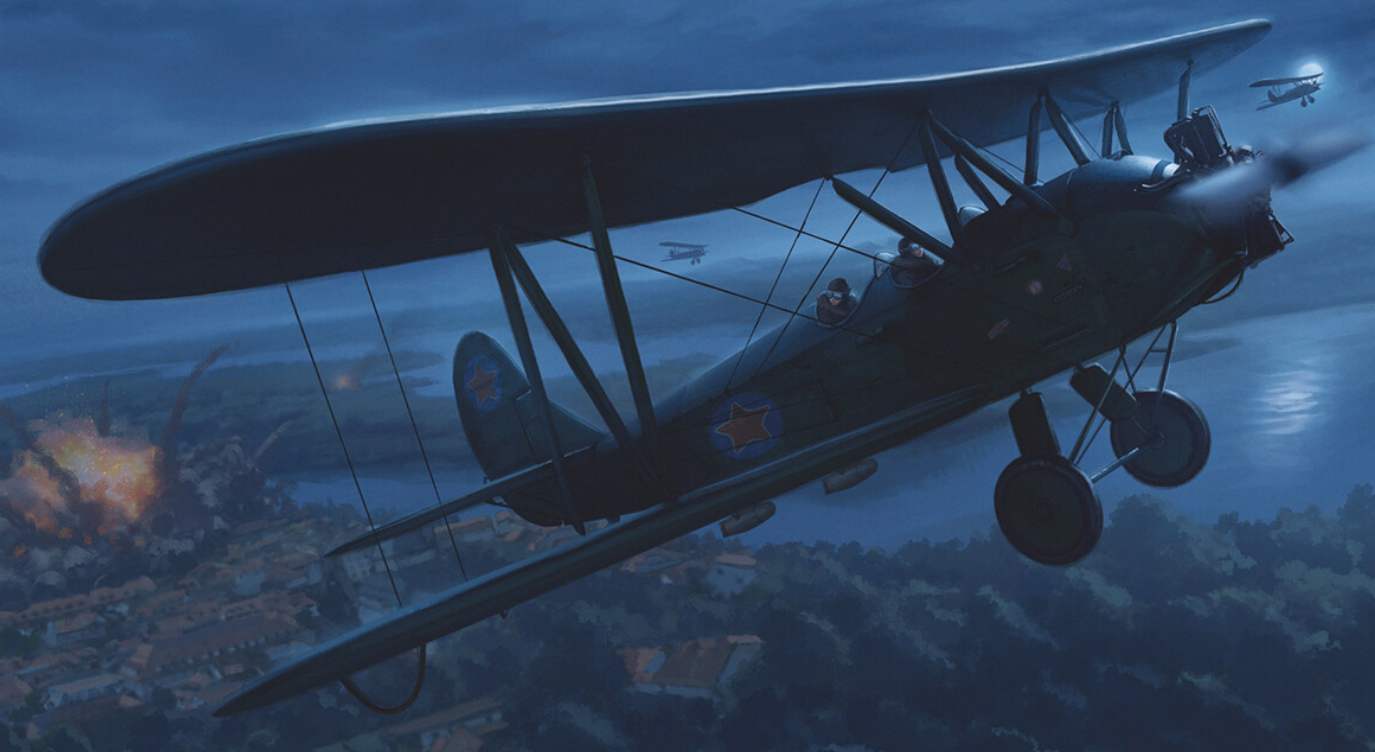
The USSR in World War II made more extensive use of women in the war effort than any other combatant. Not only as workers in factories, but as soldiers in uniform. And not just in support roles, but as warriors in front line combat. It took some heavy lifting though on the women’s part to convince the authorities to let them fight. When they finally did, though, they proved their worth. A great example of that are the Soviet female pilots who flew night combat missions to bomb the Nazis. Below are some fascinating facts about those women aviatrixes whom the Germans dubbed “The Night Witches”.
The Struggle for the Right to Fight

Things got rough in the Soviet Union in the days and months after the start of Operation Barbarossa. The sudden German onslaught in the summer of 1941 came within a hair’s breadth of crushing the communist state. The Soviets threw all they could lay their hands on against the invaders, in a desperate attempt to stop or at least slow down the Nazis.
However, even in those dire times when things were extremely desperate, some counterproductive traditional attitudes persisted. Soviet authorities were reluctant to use females in the front line, and women were initially barred from combat. After repeated appeals, most notably from Major Marina Raskova, who made the case directly to Stalin, permission was granted to form female combat units.
Establishing All-Female Aviation Units

On October 8th, 1941, three female aviation units were formed: a fighter regiment, a dive bomber regiment, and a night bomber regiment. The 586th Fighter Aviation Regiment was commanded by Tamara Kazarinova. Raskova was put in charge of the 587th Bomber Aviation Regiment. After her death in a flying accident in 1943, the 587th was renamed the 125th Raskova Borisov Guards Dive Bomber Regiment in her honor.
The most famous of the trio of female aviation units formed in the fall of 1941 was the 588th Night Bomber Aviation Regiment, led by the experienced aviatrix Yevdokiya Bershanskaya. The 588th was later renamed the 46th Taman Guards Night Bomber Aviation Red Banner and Order of Suvorov Regiment, and is more commonly known by the nickname they gained during the war: The Night Witches.
Joining the Night Witches

Ignoring and overcoming the skepticism of naysayers, enthusiastic young Soviet women flocked to the 588th Night Bomber Aviation Regiment. Many had lost family and loved ones to the Nazi invaders, and were eager for an opportunity to dish out some payback. Until then, they had only been allowed to contribute to the war effort in support roles. However, many female volunteers had wanted to be – and knew they could be if given the chance – pilots and gunners.
The volunteer female pilots were mostly in their early twenties, but some were as young as seventeen. Not only were the pilots in these all female squadrons women, but so were the ground staff and ground crews. They were determined to demonstrate that female pilots and female aerial squadrons could make a valuable contribution to the defense of the Motherland.

Female Pilots in Antiquated Planes

Training and organization were completed by June, 1942, and the aviatrixes were ready for combat. The 588th female pilots flew in slow – and by WWII standards, antiquated – plywood and canvass Polikarpov Po-2 biplanes, originally designed in the 1920s to dust crops and train flyers. To use such old and unmilitary machines in daytime combat was suicidal. However, if flown at night under the cover of darkness, the outdated Po-2s could damage the Nazis and survive.
The 588th flew its first combat sortie, a strike against a German headquarters facility, on the night of June 28th, 1942. The flimsy Po-2s could not carry much – only two light bombs, over a short distance. However, their airfields were close to the front lines, so there was enough time to fly, bomb, return to base, reload, and repeat. Sometimes, pilots of the 588th flew up to eighteen bombing missions during a single night.
When Slow Became an Advantage

The Polikarpov Po-2 was slow and obsolete, but that very obsolescence came with silver linings. For one, it was highly maneuverable. In the hands of a capable pilot, a Po-2 could perform extreme jinks and dips and turns within a small radius. That could save them from the faster and more modern German airplanes sent to shoot them down – assuming the enemy could find them in the first place at night – but that simply could not match the Po-2’s agility.
The Po-2’s slow speed also had its advantages: its maximum speed was less than the stall speed of the Messerschmitt Me Bf 109 and Focke-Wulf FW 190 fighters. Between that, the dark cloak of night, and the aforementioned maneuverability, German fighters did not find it easy to shoot down the women of the 588th.

The Scary Night Witches

The Polikarpov Po-2 biplanes could only carry a light bombload – only two bombs, one under each wing. As a result, the only way for the female flyers of the 588th to do serious damage was to fly in thick formations. Their nighttime raids often included as many as forty Po-2 airplanes, each with a pilot in front and a navigator in the back.
They seldom had any ammunition with which to defend themselves if attacked: it was decided that every available gram was better used hauling bombs to drop on the Nazis, than to carry ammunition. Because of their wood and canvass construction, the Po-2s did not show up on radar, and the distinctive sound of their engines was often the first warning Germans had that the raiders were near. The first planes usually went in as bait to attract the attention of German spotlights, whose illumination helped the raiders.
Giving the Nazis Nightmares and Keeping Them Awake at Night

588th raiders released flares to further illuminate the target, and dropped their bombs. The then made the short flight back to base to refuel, rearm, and fly another sortie. The female flyers’ bomb raids might have inflicted more psychological damage than physical harm. The frequent nighttime raids kept exhausted Germans from getting adequate rest. Fear of death by a random bomb at any moment further frayed already taut nerves.
Nazi soldiers thought that the whooshing noise of the wooden planes – whose pilots sometimes cut off the engines and glided to their targets in order to increase the chances of surprise – sounded like a sweeping broom. So they nicknamed the women pilots Nachtexen, or “Night Witches”. The Night Witches were so hated and feared, that any German who downed one was automatically awarded an Iron Cross.

Battling Bullets and Flak Up in the Air, and Sexism on the Ground

Braving bullets and frostbite up in the air was not all that the female flyers of the 588th had to face. They also had to deal with sexual harassment and skepticism down on the ground. For all its claims of progress, the Soviet Union’s fighting forces were still plagued by the era’s traditional macho attitudes.
Marina Raskova, kept up her pilots’ morale with the Twelve Commandments of the Night Witches. First of them was: “Be proud you are a woman”. Killing Nazis was the primary goal of the unit. In their free time, however, the women pilots did needlework, patchwork, decorated their airplanes, and danced.

The 588th flew up to eighteen bombing missions a night. One of the regiment’s pilots, Irina Sebrova, flew more than a thousand sorties. The Night Witches carried out more than 30,000 combat sorties. During those missions, they dropped over 3000 tons of bombs, and 26,000 incendiary munitions.
The 588th Night Bomber Aviation Regiment, by then renamed the 46th Taman Guards Night Bomber Aviation Red Banner and Order of Suvorov Regiment, flew their last mission on May 4th, 1945, about forty miles from Berlin. Although they were one of the most highly decorated Soviet Air Force units, they did not get to participate in the Victory Day Parade at war’s end: their obsolescent Polikarpov Po-2 airplanes were too slow and looked too antiquated.

_________________
Some Sources & Further Reading
Atlantic, The, July 15th, 2013 – Night Witches: The Female Fighter Pilots of World War II
History Halls – Fighting Women: The Trung Sisters
Myles, Bruce – Night Witches: The Untold Story of Soviet Women in Combat (1981)
Pennington, Reina – Wings, Women, and War: Soviet Airwomen in World War II Combat (2002)

