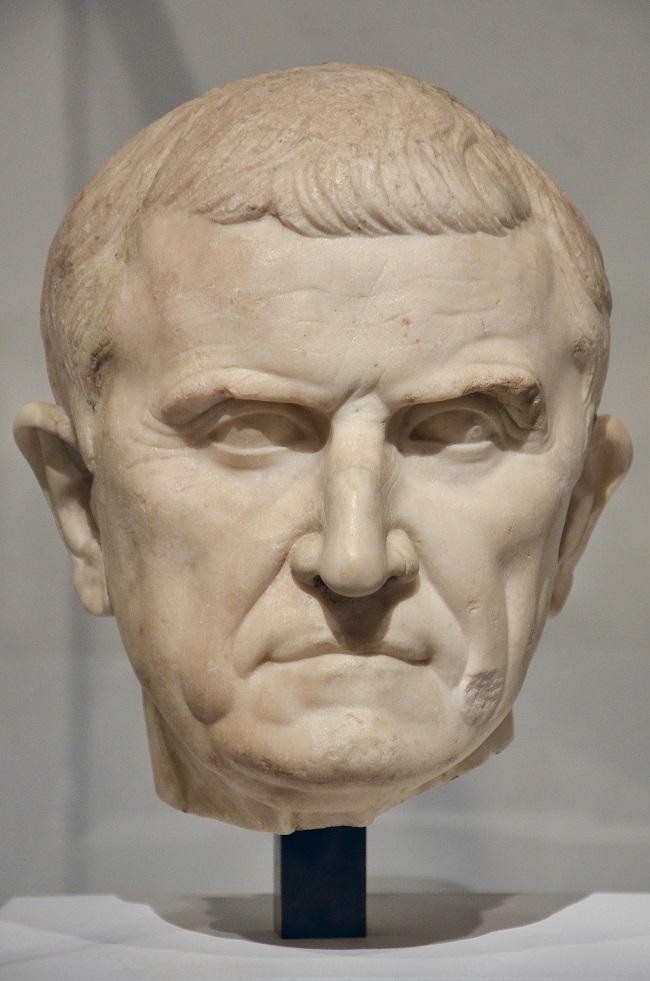
Marcus Licinius Crassus (115 – 53 BC) was a towering figure in the late Roman Republic’s final years. He formed a triumvirate with Pompey the Great and Julius Caesar, that effectively challenged the Senate and ran the state. An avaricious figure, Crassus amassed enough wealth through morally dubious means to become the Republic’s richest man. As seen below, it all came crashing down when his lust for military glory brought him to an ignoble end.
Amassing Wealth Through Dubious Means

Crassus started on the road to riches by exploiting his proximity to the dictator Sulla when the later seized control of the Roman Republic after winning a civil war. He bought the confiscated properties of executed enemies of the state in rigged auctions, for a fraction of their value. He even had the names of those whose property he coveted added to the lists of those slated for execution and confiscation of property. He continued to amass wealth and property after Sulla’s death.
One scheme, which made Crassus Rome’s biggest real estate mogul, revolved around a private firefighter company that he set up. Rome’s at the time were notoriously prone to fires. When a fire erupted, he would rush in and offer to buy the burning property from its distressed owner then and there at a knockdown price – a literal fire sale. Soon as an agreement was reached, Crassus’ firefighters would spring into action to control the fire and rescue the property for its new owner.
The Roman Republic’s Richest Man

By the 70s BC, Crassus had become Rome’s richest man. He leveraged his wealth into political power by sponsoring politicians such as Julius Caesar, whose political rise and election campaigns he financed. Eventually, Crassus entered into a power sharing agreement with Caesar and Pompey. Known as “The First Triumvirate”, the agreement divided the Republic between the trio. However, the one thing Crassus wanted that his fellow Triumvirs had but he did not was military glory. Unlike Pompey’s and Caesar’s brilliant military records, Crassus’ only military accomplishment had been to crush Spartacus’ slave uprising, and defeating slaves did not count for much in Roman eyes.
Crassus’ quest for military glory led him to an ignominious end. To get himself some martial luster and shine, he led an army of fifty thousand men to invade Parthia, a wealthy kingdom whose territory spanned modern Iran and Iraq. He trusted a local chieftain to guide him, but the guide was in Parthian pay. He led the Romans along an arid route until, hot and thirsty, the Romans reached Carrhae in modern Turkey. There, Crassus and his army were confronted by a Parthian force of nine thousand horse archers, and a thousand armored cataphract heavy cavalry.
Lust for Military Glory Ends in Disaster

Although they outnumbered the Parthians five to one, the Romans were demoralized by the rigors of the march, and by Crassus’ insipid leadership. The mounted Parthian archers shot up the Romans from a distance, and retreated whenever they advanced. As casualties mounted, morale plummeted. Crassus, unable to think of a plan, rested his hopes on the Parthians running out of arrows. The Parthians however had a supply train of thousands of camels loaded with arrows. Finally, Crassus ordered his son to take the Roman cavalry and some infantry, and drive off the horse archers. The Parthians feigned retreat, the general’s son rashly pursued, and was slaughtered with all his men. The Parthians rode back to Roman army, and taunted the father with his son’s head mounted on a spear.
A shaken Crassus abandoned thousands of his wounded and retreated to Carrhae. The Parthians invited him to negotiate, and offered to let his army go in exchange for Roman territorial concessions. Crassus was reluctant, but his men threatened to mutiny if he did not go, so he went. It turned out to be his ultimate mistake. Things went bad at the meeting, violence broke out, and it ended with the Roman negotiators slain. To mock his notorious greed, the Parthians poured molten gold down Crassus’ throat. The surviving Romans fled, but most were hunted down and killed or captured. Of fifty thousand Romans, only ten thousand survivors made it back to Roman territory.

_________________
Some Sources & Further Reading
Head Stuff – Crassus, the Richest Man in Rome
Plutarch – Parallel Lives: Life of Crassus

