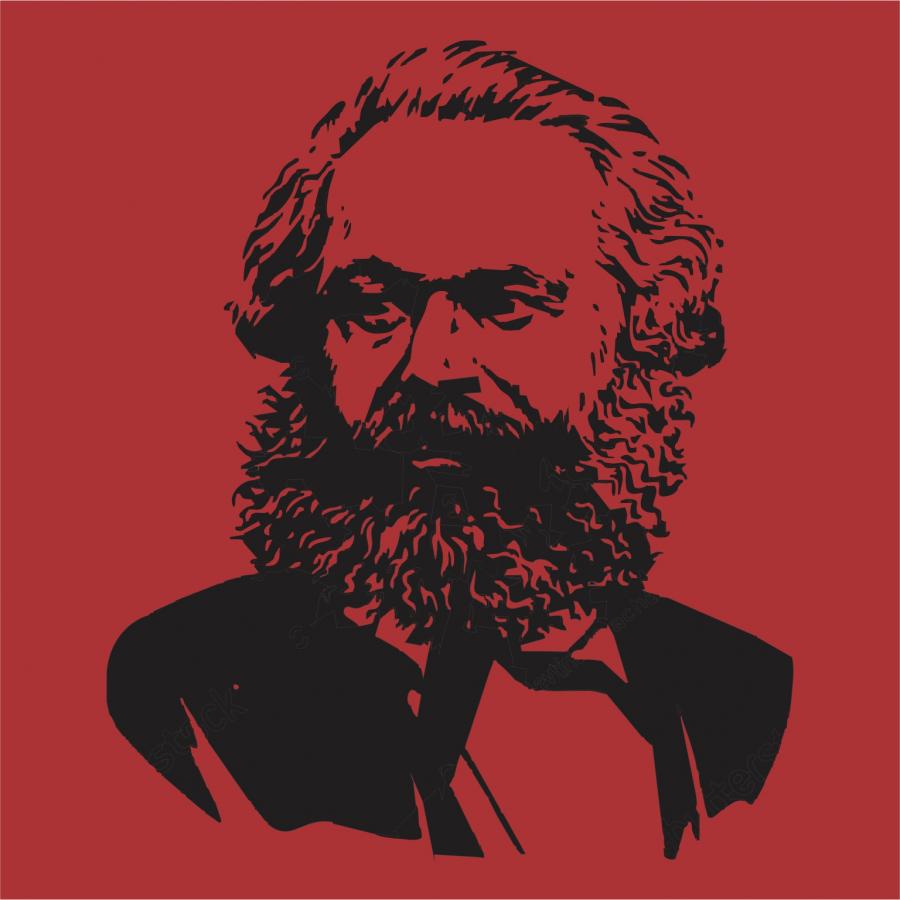
German philosopher and radical socialist Karl Marx (1818 – 1883) penned the Communist Manifesto and Das Kapital. They formed the basis of Marxism and revolutionized the world, for better and for worse. Born in Prussia, he experimented with sociopolitical theories in university. By the 1840s, he had become a radical journalist. His writings were viewed as dangerous by the authorities. So in the span of a few years he was expelled from Germany, France, Belgium, then Germany again. He finally found refuge in London, where he settled and lived for the remainder of his life. Below are some interesting facts about Marx, and his last words.
The Young Marx Was a Hell Raiser

Karl Marx’s father was a successful lawyer, a man of the Enlightenment, and a passionate advocate for Prussian reform. He had converted from Judaism to Lutheranism to avoid legal restrictions that barred Jews from high society. Marx received a liberal education in a school whose enlightened leanings made it suspect in the eyes of Prussia’s reactionary authority figures. Officials raided the institution in the 1830s, confiscated writings that were deemed subversive from its library, and forced changes in the teaching staff.
The popular image of Marx as a person is of an overly serious figure, single mindedly focused on his theories – kind of a buzz kill and killjoy. The young Marx was quite different. His early years of higher education were marked by poor grades, imprisonment for drunkenness, riotous behavior, and general rowdiness. He eventually buckled down to serious study of the law and philosophy. He was strongly influenced by Hegel, and joined a radical student group known as the Young Hegelians.
Marx Could Have Become an Established University Professor Instead of a Refugee Intellectual

The young Karl Marx’s involvement with the Young Hegelians marked the start of his transformation into a radical, and eventually revolutionary, thinker. He received a doctorate in 1841, but his radical politics kept him from getting a teaching job – which offers quite an interesting “what if?” If Marx had become a university professor in Prussia, with all the strictures that went with that, rather than a freer wandering intellectual, would he have become so influential? In real life, he turned to journalism after the doors of academia were slammed shut in his face.
Within a year, however, Marx’s newspaper was suppressed, and he was forced to move to Paris and the relatively freer French environment. In the French capital, he met Friedrich Engels, and the two developed a friendship and began a collaboration that would revolutionize the world. In 1845, the Prussians pressured the French to expel Marx, so he moved to Belgium. There, he founded a correspondence committee to link European socialists – the nineteenth century equivalent of a Facebook group, communicating at the speed of snail mail.
Karl Marx’s Last Words

Marx’s socialist correspondence committee inspired socialists in England to form the Communist League. They asked Marx and Engels, who by then were well known in socialist circles, to write a platform for their party. The result was the Communist Manifesto, published in 1848. Shortly thereafter, Marx was expelled from Belgium. He went to France, which also expelled him. He returned to Prussia, but by then he had been stripped of his citizenship, and the authorities refused to re-naturalize him, so he ended up in London in 1849.
Marx spent the rest of his life developing his theory and writing about it. In 1867, he published Das Kapital, which, when twinned with the earlier Communist Manifesto, became the philosophical bedrock of Marxism and communist theory. On his deathbed in 1883, as he lay expiring from pleurisy, Karl Marx was solicited for final words, to which he replied just before he breathed his last: “Go on! Get Out! Last words are for fools who haven’t said enough!”

_________________
Some Sources & Further Reading
Berlin, Isaiah – Karl Marx: His Life and Environment (1963)
History Halls – Benjamin Franklin Was a Total Babe Magnet Well Into His Old Age
Sperber, Jonathan – Karl Marx: A Nineteenth-Century Life (2013)

