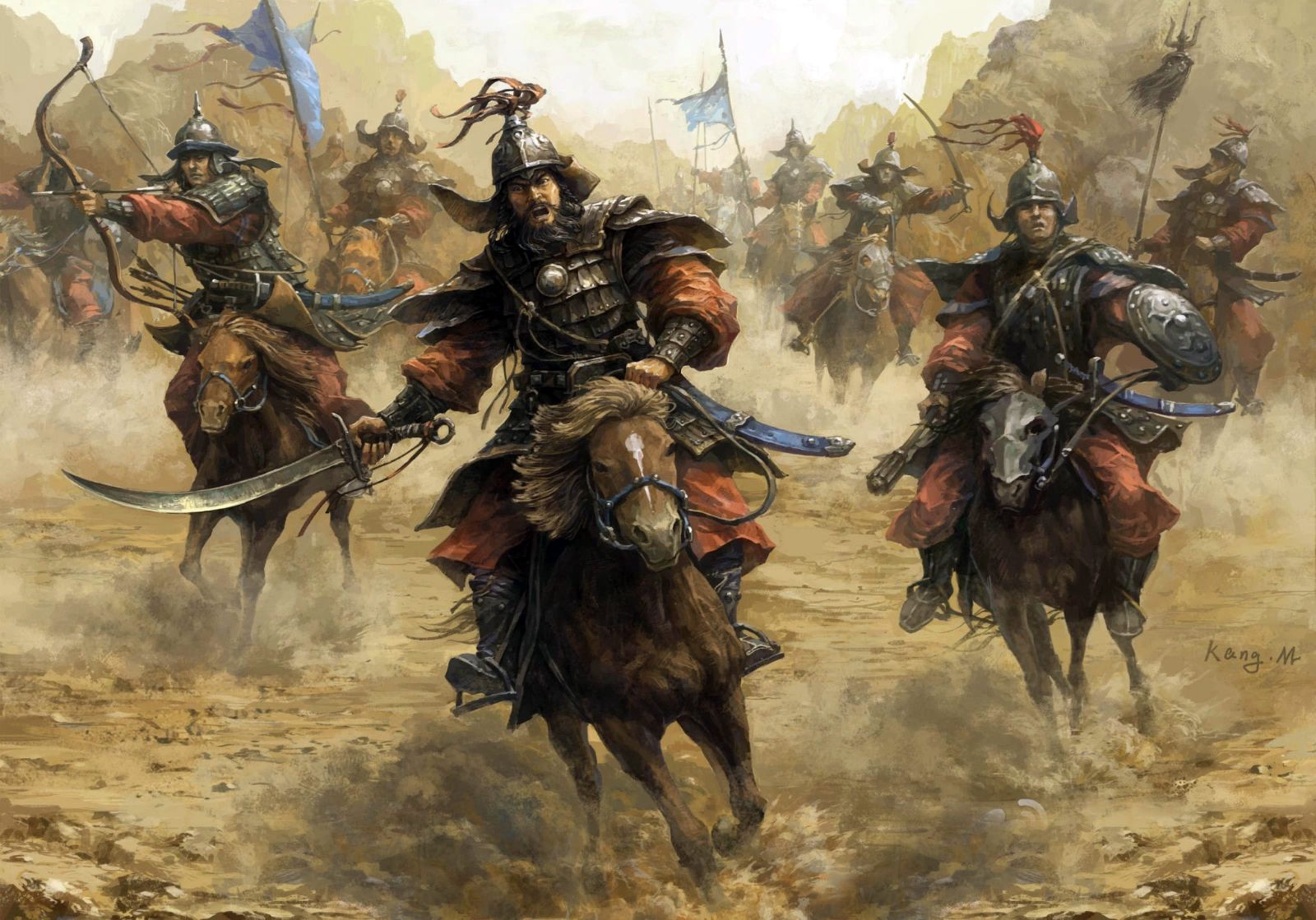
Genghis Khan once said that “Life’s greatest joy is to rout and scatter your enemies, and drive them before you. To see their cities reduced to ashes. To see their loved ones shrouded and in tears, and to gather to your bosom their wives and daughters”. The kind of person who drops that kind of quote is not somebody a wise ruler would go out of his way to insult. Yet that is what Shah Muhammad II, ruler of the Khwarazmian Empire from 1200 to 1220, did. Not only that, but as if to double down on the stupid, Shah Muhammad then dared Genghis Khan to do something about it. As seen below, that turned out be a massive mistake.
Deliberately Provoking Genghis Khan

Genghis Khan (1162 – 1227), founder of the Mongol Empire, was one of history’s scariest figures. His conquests were often accompanied by widespread massacres, even genocide. As a percentage of global population, the estimated 40 million people who perished in the Mongol conquests initiated by him would be equivalent to 278 million deaths in the twentieth century. In 1218, Genghis Khan was busy fighting the Chinese, when he sent an embassy and trade mission to Muhammad II.
In addition to diplomatic emissaries, the trade mission included numerous merchants with valuable trade wares. Genghis had hoped to establish diplomatic and trade relations with the Khwarazmian Empire, which encompassed most of Central Asia, and stretched from today’s Afghanistan to Georgia. The Khwarazmian ruler, however, was suspicious of Genghis’ intentions. So he had one of his governors halt the Mongol embassy at the border, accuse it of spying, arrest its members, and seize its goods.

Despite the insult, Genghis tried to keep things diplomatic. He sent three envoys to Shah Muhammad II, requesting that he disavow the governor’s actions, and hand him over to the Mongols for punishment. The Khwarazmian ruler executed the envoys, and followed that up with an order to execute all members of the earlier Mongol embassy and trade mission. Those turned out to be bad decisions.
Finally provoked into action, Genghis interrupted his campaigning in China, and concentrated an army of over 100,000 against the Khwarazmian Empire. It was smaller than Muhammad II’s forces, but the Mongols struck in 1218 with a whirlwind campaign that caught the Khwarazmian ruler off balance. He was never given an opportunity to recover. Genghis Khan’s invasion was a military masterpiece that overwhelmed Muhammad’s empire, and extinguished it by 1221.

It Was at This Point That Muhammad II Realized He Had Screwed Up

As to the unfortunate Shah Muhammad II, he was forced to flee for his life. However, the Mongols never gave him a chance to find sanctuary and recover for a comeback. Genghis ordered two of his best generals, Subutai and Jebe, to hunt down the Khwarazmian ruler. Shah Muhammad was chased and hounded across his domain to his death, abandoned and exhausted, on a small Caspian island as his relentless pursuers closed in.
It was in this invasion that the Mongols gained their terrible reputation for savagery. Millions perished, as Genghis Khan ordered his men to massacre entire cities that offered the least resistance. He also sent thousands of captives ahead of his armies as human shields. The consequences were catastrophic for Shah Muhammad II’s subjects and realm.

By the time Genghis Khan was done, the Khwarazmian Empire had been reduced from a thriving and wealthy realm to an impoverished and depopulated wasteland. At the grand mosque in the once thriving but now smoldering city of Bukhara, Genghis told the survivors that he was the Flail of God, and that: “If you had not committed great sins, God would not have sent a punishment like me upon you”.
Shah Muhammad II had brought catastrophe upon himself and upon his empire when he deliberately insulted somebody he assumed was just another upstart barbarian nomad chieftain from the Steppe. He discovered, too late, that he had challenged history’s greatest conqueror. Muhammad’s subsequent flight, as he was pursued hither and yon across his ever shrinking domain by relentless Mongol pursuers, could probably have been set to chase scene music from Benny Hill.

_________________
Some Sources & Further Reading
Hildinger, Erik – Warriors of the Steppe: Military History of Central Asia, 500 BC to 1700 AD (1997)
Military History, May 2006 – Facing the Wrath of Khan
Ratchnevsky, Paul – Genghis Khan: His Life and Legacy (1994)

