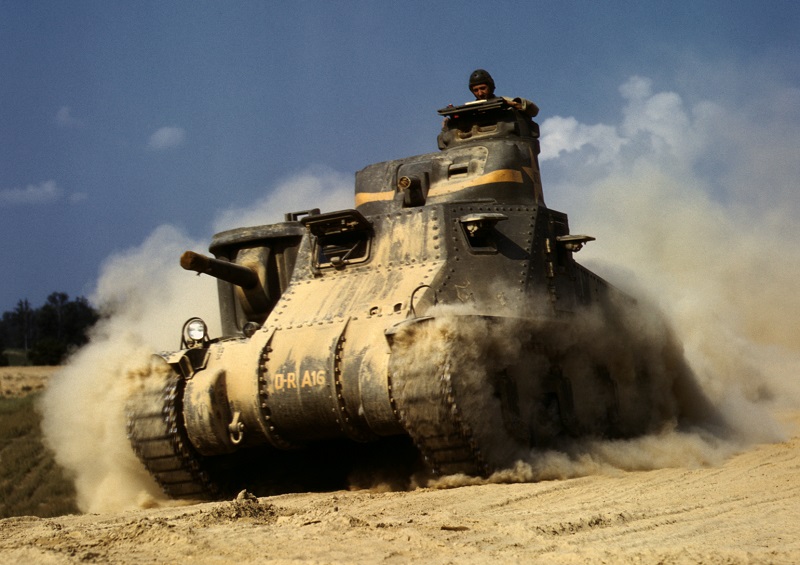
The M3 Grant was an American medium tank used in World War II’s early years. Designed in 1940 and entering service in 1941, it represented an urgent attempt by the United States to field a modern armored vehicle at a time when American tank development lagged behind that of European powers. Understood from the start to be a stopgap, the M3 Grant was quickly replaced by more advanced designs. However, it played a crucial transitional role until more modern designs appeared, and saw significant combat, especially in North Africa.
A Stopgap Design

The M3 Grant, and its earlier version the M3 Lee, were designation used only by the British. The US military officially used “Medium Tank, M3”. The Grant was developed at a moment of crisis in armored warfare, after the stunning successes of German blitzkrieg tactics. Panzer exploits demonstrated the effectiveness of fast, heavily armed tanks supported by mechanized infantry and air power. The US Army realized that its existing tanks were inadequate for modern warfare. American engineers were already working on what would eventually become the M4 Sherman. However, that design was not yet ready for mass production.
To bridge the gap, the US used a preexisting tank, the M2, and modified it to make the M3. The result was a workable, if unconventional, design. One of the most distinctive features of the M3 was its unusual armament layout. M2 upon which was based had a 37 mm gun. Developments in Europe, however, had demonstrated that was inadequate. So a bigger gun, a more powerful 75 mm gun, was added. It was placed in a sponson on the right side of the hull, rather than in a fully rotating turret. Above the hull sat a smaller turret equipped with a 37 mm gun. On top of that was a small cupola, sometimes fitted with a machine gun.
The M3 Grant Was an Unusual Tank Born of Necessity

The stacked configuration of the M3 Grant gave the tank a tall silhouette. However, it allowed it to mount a larger gun than many contemporary designs. The side-mounted 75 mm gun could fire armor-piercing rounds capable of damaging enemy tanks. It could also fire high-explosive shells useful against fortifications and infantry. The reason for the odd gun arrangement was largely practical. At the time, American engineers did not yet have a turret design capable of mounting the large 75 mm gun.
Installing the gun in the hull allowed the tank to be produced quickly, while work continued on a better turreted design. The compromise meant that the gun had limited horizontal movement, requiring the driver to rotate the entire tank to aim in many situations. While far from ideal, the solution allowed American industry to field a tank with a powerful main weapon sooner than otherwise possible. The tank’s design flaws were understood. However, a flawed tank with a 75 mm gun was better than no tank with a 75mm gun. Thus, the M3 went into production.
The M3 Lee and M3 Grant Designations

The tank’s name differed depending on who used it. The British, who received large numbers through the Lend-Lease program, called it the original M3 the “Lee” after the American Civil War general Robert E. Lee. However, they wanted improvements to the original design. Of those, the most visible was a bigger rotating turret to accommodate a radio. The improved tanks with the bigger tanks were designated “Grant”, named after Union general Ulysses S. Grant. The original design continued to be referred to as Lees.
In American service the vehicle was generally referred to simply as the M3 medium tank. After the war, however, the names Lee and Grant became widely used in historical discussions. The M3 saw its most important combat service during the North African Campaign. In 1942 British forces facing German and Italian armies urgently needed tanks capable of countering German armor. The arrival of the M3 was therefore a major boost to Allied strength. At the time, many British tanks were armed with guns that lacked effective high-explosive shells, making them less versatile on the battlefield. The M3’s 75 mm gun provided a much-needed capability for engaging both enemy tanks and defensive positions.
A Mixed Bag of Results

In combat, the M3 Grant proved to be a mixed but generally valuable asset. Its armor was thicker than many earlier Allied tanks, which gave it reasonable protection against some enemy weapons. Its 75 mm gun outmatched the German tanks it faced, such as the Panzer III and the Panzer IV. Especially at typical desert combat ranges. However, the vehicle also had significant drawbacks. Its tall profile made it an easy target, and the limited traverse of the hull-mounted gun reduced tactical flexibility.
Despite its limitations, however, the M3 was mechanically reliable, and had a big gun. That allowed it to play an important role during several major engagements. Chief among those were the Battle of Gazala, where M3s performed well, even though the battle ended in British defeat. M3s also saw combat in the early phases of the fighting around El Alamein. British and Commonwealth forces used the tank to strengthen their armored formations during a critical period when more advanced vehicles were not yet available in large numbers.
Significance and Legacy of the M3 Grant

American forces also used the M3 Grant in combat, especially during the early stages of US involvement in North Africa. In Operation Torch, for example, American armored units employed the tank alongside other early-war vehicles. It also served in training and combat roles until the newer M4 Sherman medium became widely available. Production of the M3 was extensive for a tank with such a short front-line career. Between 1941 and 1943, more than 6,000 units were built in American factories.
In addition to the British, the M3 Grant was also supplied to other Allied nations, including the Soviet Union. It was used on the Eastern Front, although though Soviet crews were generally less enthusiastic about its performance. By 1943, the M3 medium tank was rapidly disappearing from front-line service. The M4 Sherman offered a fully rotating turret with a 75 mm gun, improved ergonomics, and better overall battlefield performance. Once Shermans became available in large numbers, the M3 was gradually relegated to secondary roles. It continued to serve as a trainer, and as recovery vehicles or specialized conversions.
The M3 medium tank is often remembered as an awkward or outdated design. However, it played a crucial role at a critical moment in the war. It provided Allied forces with a tank that could stand up to Axis armor when few alternatives existed. Just as importantly, its production helped American industry gain experience in mass-producing armored vehicles. That industrial and technical momentum contributed directly to the later success of the M4 Sherman and other Allied armored vehicles. In that sense, the M3 was a transitional but vital step in American armored warfare’s rapid evolution during WWII.

_________________
Some Sources & Further Reading
History Halls – American Tanks of World War II: The M4 Sherman Medium Tanks
Stout, Wesley Winans – Tanks Are Mighty Fine Things (1946)
Zaloga, Steven – Armored Champion: The Top Tanks of World War II (2015)
Newest Articles
- The Johnstown Flood – Thousands Perished When A Dam Collapsed After Gilded Age Tycoons Modified it for their Private Resort
- The Jacquerie: The Medieval Peasant Uprising That Terrified France’s Aristocrats
- Things That Weren’t Thought Through: WWII’s Sticky Bomb Stuck to Users’ Hands Once Activated
- German Tanks of World War II – The Panzer 38(t), a Czech Tank in German Service
- Nicholas Alkemade: The WWII Airman Who Survived an 18,000 Foot Fall From a Bomber Without a Parachute

