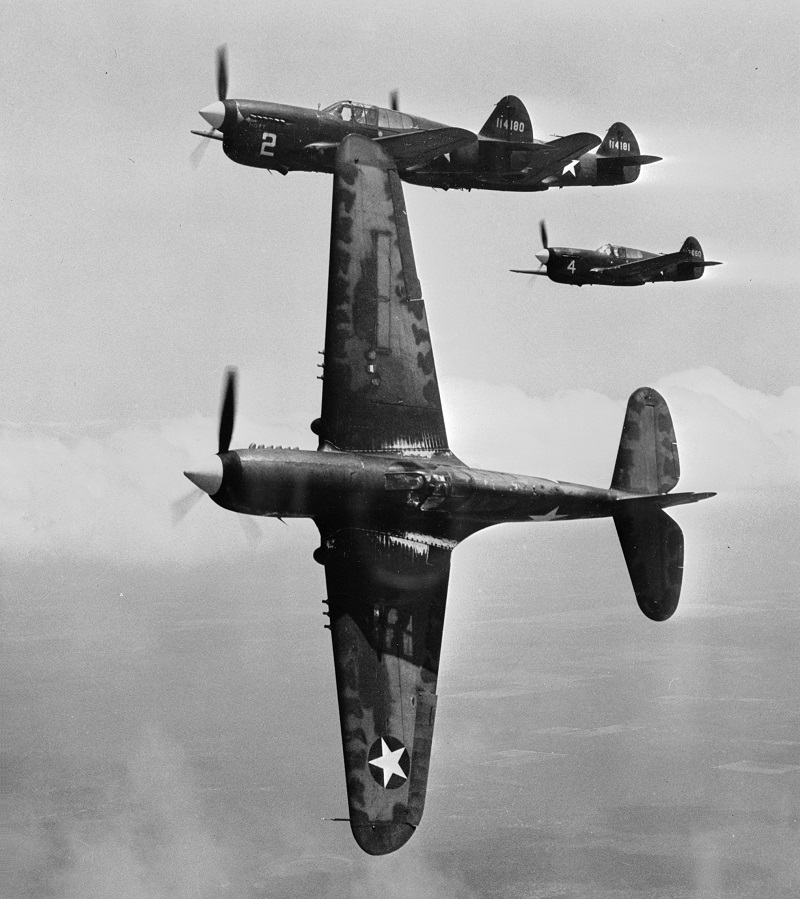
The Curtiss P-40 Warhawk was one of World War II’s most recognizable and widely used American fighters. Though often overshadowed in popular memory by later and more advanced fighters such as the P-51 Mustang or the P-47 Thunderbolt, the P-40 was a workhorse. It carried the burden of combat during the war’s darkest early years, and served across nearly every major theater. P-40s flew with dozens of air forces, and became iconic through units such as the Flying Tigers. The Warhawk’s reputation has long been debated, but its historical importance is undeniable.
Origins of the Curtiss P-40 Warhawk

The Curtiss Aeroplane and Motor Company P-40 was officially designated the Warhawk in US service. In British Commonwealth and Soviet service, models up to the P-40C were known as the Tomahawk, while P-40 and newer models were known as Kittyhawks. Its origins lie in the late 1930s, when Curtiss sought to improve upon its earlier P-36 Hawk fighter. The P-36 was a capable aircraft, but it was powered by an air-cooled radial engine. At the time, liquid-cooled inline engines were increasingly seen as the future of high-performance fighters. So Curtiss engineers adapted the P-36 airframe to accept the Allison V-1710 liquid-cooled V-12 engine. The result was the XP-40 prototype, which first flew in October, 1938.
It was an improvement over the P-36, but it was not a revolutionary leap in performance. However, it offered a straightforward way to field modern monoplane fighters in large numbers without waiting for entirely new designs. That met the US Army Air Corps’ needs at the time. The Allison engine defined much of the P-40’s character. It was reliable, rugged, and well suited to mass production. However, it lacked a two-stage supercharger, which limited the aircraft’s performance at high altitudes. As a result, the P-40 excelled at low to medium altitudes but struggled above roughly 15,000 feet, where European air combat increasingly took place. That limitation would later shape both the aircraft’s tactical employment and its reputation.
The Warhawk First Went to War in North Africa

In the early war years, America and its allies urgently needed fighters in quantity. In such desperate circumstances, the shortcomings of the Curtiss P-40 Warhawk were considered acceptable trade-offs. Early production models, designated P-40, P-40B, and P-40C, featured relatively light armament by later standards. Two .50 caliber machine guns in the nose fired through the propeller, supplemented by smaller caliber guns in the wings. Combat experience quickly demonstrated the need for heavier firepower and improved protection. Subsequent variants, beginning with the P-40D and culminating in the P-40E, introduced a redesigned nose, and stronger structure.
Additional improvements included improved armor for the pilot, self-sealing fuel tanks, and six .50 caliber machine guns in the wings. Those changes made the Warhawk more survivable and far more lethal, though they also increased weight and reduced climb performance. The P-40 entered service with the US Army Air Corps in 1940. However, it first saw combat not in American service, but in June 1941 with the RAF North Africa. There, No. 112 Squadron of the Desert Air Force became the first to feature the “shark mouth” on its P-40s. When the US joined WWII, Warhawks were the most numerous fighters flown by American pilots in the war’s early stages.
The Pacific Theater’s Most Important Allied Fighter at War’s Start

When Japan attacked Pearl Harbor in December, 1941, P-40s defended US possessions in the Pacific. Many were destroyed on the ground, but others managed to get airborne and engage Japanese attackers. In the desperate early months of the Pacific War, Warhawks were among the few modern fighters available to Allied forces. They bore the brunt of combat against highly maneuverable Japanese aircraft such as the Mitsubishi A6M Zero and Nakajima Ki-43. It was in China, however, that the P-40 achieved its most enduring fame with the American Volunteer Group.
Better known as the Flying Tigers, they flew P-40B and P-40C export versions against Japanese forces beginning in late 1941. Led by Claire Lee Chennault, the Flying Tigers developed tactics that exploited the P-40’s strengths while minimizing its weaknesses. The Warhawk was fast in a dive, structurally robust, and heavily armed. However, it could not out-turn or out-climb Japanese fighters. Chennault emphasized “boom and zoom” tactics that used altitude and dive speed to make high-speed attacks before disengaging. That approach proved highly effective, and the Flying Tigers achieved an impressive kill ratio that cemented the P-40’s legend.
The Flying Tigers Made the Curtiss P-40 Warhawk Iconic

The iconic shark mouth nose art associated with the Flying Tigers further elevated the status of the Curtiss P-40 Warhawk. Inspired by markings first seen on German fighters then copied by the British in North Africa, the snarling teeth painted on the Warhawk’s nose became one of the war’s most recognizable images. Such aggressive imagery contributed to the aircraft’s psychological impact and enduring popularity in aviation lore. Beyond China and Burma, the P-40 saw extensive service in North Africa, the Mediterranean, and the Middle East.
British Commonwealth forces referred to the P-40 aircraft as the Tomahawk and later the Kittyhawk depending on the variant. The P-40 lacked a two speed supercharger for its engine. That made it inferior to German fighters such as Bf 109s and Fw 190s in aerial combat. Especially at high altitudes. However, skilled pilots and effective tactics allowed it to remain competitive. The British employed P-40s widely in the desert war against Axis forces, where aerial combat often occurred at lower altitudes. In that environment, the aircraft’s strengths were well suited to conditions. Its rugged construction tolerated harsh desert operations. Its range and firepower made it effective for ground attack and close air support.
P-40s in the Soviet Union

The Curtiss P-40 Warhawk also played a crucial role in the Soviet Union, which received large numbers through Lend-Lease. Soviet pilots had mixed opinions of the aircraft. They appreciated its durability, heavy armament, and ability to absorb damage. However, they criticized its poor climb rate and high-altitude performance. On the Eastern Front, where much combat took place at relatively low altitudes and where ruggedness was highly valued, the P-40 found a niche. Though it was never as beloved as some other Lend-Lease aircraft, it nonetheless contributed meaningfully to Soviet air operations.
As the war progressed and lessons were learned, the P-40 continued to evolve through numerous variants. They included the P-40F and P-40L powered by Packard-built Rolls-Royce Merlin engines. Those versions offered improved high-altitude performance compared to Allison-powered models. However, they were produced in relatively limited numbers, and were quickly overshadowed by newer designs. Later variants such as the P-40N attempted to reduce weight and extend service life. That allowed the aircraft to remain useful even as more advanced fighters entered production.
The Warhawk Was a Rugged Warplane

Despite improvements, the Curtiss P-40 Warhawk gradually lost its frontline air superiority role, and was largely dispalced by 1943. Aircraft like the P-38 Lightning, P-47 Thunderbolt, and especially the P-51 Mustang, offered superior speed, climb, range, and high-altitude performance. So Warhawks were increasingly relegated to secondary theaters, ground attack missions, training, and service with smaller air forces. However, that transition should not be mistaken for obsolescence. In many parts of the world, the P-40 remained a valuable and effective combat aircraft until the end of the war.
One of the defining characteristics of the P-40 was its toughness. Pilots who flew the airplane frequently remarked on its ability to absorb significant punishment, and still bring them home. Its sturdy construction and relatively simple systems made it forgiving of battle damage and maintenance challenges alike. That ruggedness, combined with its wide availability, explains why the Curtiss P-40 Warhawk served with over two dozen air forces, including those of Britain, Australia, New Zealand, China, the Soviet Union, Brazil, and several smaller nations.
Significance and Legacy of the Curtiss P-40 Warhawk

The Warhawk’s mixed reputation largely stems from comparisons with aircraft that entered service later in the war or were designed for different operational contexts. When judged against early-war contemporaries, the P-40 was generally competitive. Its shortcomings became more apparent as air combat shifted toward higher altitudes and as enemy fighters improved. Nonetheless, it is important to remember that the P-40 was never intended to be the war’s ultimate fighter. It was an interim design intended for quick production in large numbers. The aim was to meet urgent needs at a time when the US was frantically gearing up for global conflict. The third most-produced American WWII fighter after the P-51 and P-47, nearly 14,000 P-40s were built. All of them rolled out the doors of Curtiss’ production facilities in Buffalo, New York.
The P-40 had a long service life, from the late 1930s into the postwar years in some countries. That speaks to the fundamental soundness of its design. It held the line during WWII’s critical early phases until more advanced aircraft could be fielded in sufficient numbers. The Curtiss P-40 Warhawk may not have been the fastest, highest-flying, or most elegant fighter of its generation. However, it was reliable, adaptable, and available when it was most needed. It fought on every major front, and trained thousands of pilots. It became a symbol of Allied resistance during a period when victory was far from assured. In that sense, the P-40’s legacy is not defined by technical perfection, but by endurance and service. Those qualities made it one of WWII’s most significance warplanes.

_________________
Some Sources & Further Reading
Christy, Joe, and Ethell, Jeffrey L. – P-40 Hawks at War (1979)
Shamburger, Page – The Curtiss Hawks (1972)
Newest Articles
- The Johnstown Flood – Thousands Perished When A Dam Collapsed After Gilded Age Tycoons Modified it for their Private Resort
- The Jacquerie: The Medieval Peasant Uprising That Terrified France’s Aristocrats
- Things That Weren’t Thought Through: WWII’s Sticky Bomb Stuck to Users’ Hands Once Activated
- German Tanks of World War II – The Panzer 38(t), a Czech Tank in German Service
- Nicholas Alkemade: The WWII Airman Who Survived an 18,000 Foot Fall From a Bomber Without a Parachute

