
The Flying Tigers were American World War II flyers whose story began before the United States formally entered the war. They had secretly volunteered to fight alongside China against Japanese aggression in the American Volunteer Group (AVG). Better known as the Flying Tigers, they achieved international fame under the command of Claire Lee Chennault. Their daring missions, shark-mouthed fighters, and remarkable combat record made them legendary.
10. Founder of the Flying Tigers

The American Volunteer Group, more commonly known as the Flying Tigers, were born from political necessity and strategic foresight. By 1940, Japan’s war in China had devastated Chinese defenses and cities, while Western powers hesitated to intervene. US President Franklin D. Roosevelt wanted to support China, without directly getting involved in a war with Japan. Enter Claire Lee Chennault, a retired US Army Air Corps officer and advisor to China’s leader, Chiang Kai-shek. He proposed recruiting experienced American pilots to bolster China’s air capabilities, and convinced Roosevelt to approve a covert operation.
100 pilots, released from US service, would fight Japan under civilian cover. They would be financed through a contract with the Central Aircraft Manufacturing Company (CAMCO). The unit was to fly Curtiss P-40 fighters and protect China’s lifeline, the Burma Road, from Japanese attack. Thus, in 1941, before Pearl Harbor, the American Volunteer Group, AVG, was formed. Volunteers united by a cause larger than nationality, they soon became one of the most storied groups in aviation history. Operating from remote airfields in Burma and China under the looming shadow of Japan’s rising empire, they became legends.
9. The American Volunteer Group’s Visionary Leader

At the heart of the Flying Tigers was Claire Lee Chennault. A former US Army Air Corps captain, he was known for his unorthodox tactics and outspoken criticism of official doctrine. Born in Louisiana in 1893, Chennault believed air power could decisively win wars if used aggressively and defensively with precision. After health issues forced his early retirement, he went to China as an aviation advisor to Chiang Kai-shek. Chennault observed the Japanese Air Force firsthand, and devised tactics suited to China’s limited resources. Rather than confront the Japanese head on, China’s aerial defenders were to rely on hit-and-run attacks, ambushes, and altitude advantage. When the AVG was formed, he became its commander.
Chennault’s leadership style was intense and demanding, but also inspirational. He enforced strict discipline where it mattered, and simultaneously fostered independence among his pilots. Chennault’s deep knowledge of Japanese aerial tactics and his emphasis on teamwork gave the Flying Tigers their edge. He personally directed early missions, and often took to the skies himself. His strategy, training, and intelligence gathering methods would later influence the entire US air campaign in the China-Burma-India (CBI) Theater. His inspired leadership made the Flying Tigers became a symbol of resistance against overwhelming odds.
8. Pilot Recruitment

The American Volunteer Group’s formation in 1941 was a unique mixture of patriotism, adventure, and secrecy. Recruitment took place quietly through the Central Aircraft Manufacturing Company. Headed by William Pawley, CAMCO disguised the mission as a civilian contract. Chennault sought skilled pilots from the US Navy, Marine Corps, and Army Air Corps. Around 300 men – pilots, mechanics, and support staff – volunteered. They were drawn by both ideals and high pay: $600–$750 per month plus bonuses for every Japanese aircraft destroyed. The group ultimately included about 100 pilots, most of them military veterans.
The pilots were organized into three squadrons: the “Adam and Eves”, “Panda Bears”, and “Hell’s Angels”. Their ground crews, equally vital, kept the aircraft flying in primitive conditions with limited tools and spare parts. Training took place in Burma, where pilots adapted to monsoon weather, jungle terrain, and logistical hardships. Despite their irregular status, the AVG developed into an elite force. Their unique blend of experience, improvisation, and camaraderie made them formidable adversaries in the skies of Asia. When they faced the vast Japanese air armada over China and Burma, courage and tactical brilliance would prove their salvation.
7. The Shark Mouth on a P-40: The Flying Tigers’ Iconic Image

The Flying Tigers flew the Curtiss P-40 Warhawk, a fighter that was neither WWII’s fastest nor most agile. In the right hands, though, it was quite deadly. Rugged, heavily armed, and suited for low-to-medium altitude combat, the P-40 could dive faster than most Japanese aircraft. So Chennault exploited that by training his pilots to focus on “zoom and boom” attacks by diving on opponents from on high to make a firing pass, then climb back up to repeat the process. He taught his pilots to avoid getting into dogfights with the more nimble and maneuverable Japanese airplanes. The AVG’s P-40Bs were shipped to Burma in crates, assembled under harsh tropical conditions, and often modified for combat readiness.
To intimidate enemies and boost morale, the pilots painted fierce shark mouths on their planes’ noses. The design was inspired by British Royal Air Force Tomahawks in North Africa. That ferocious image soon became the Flying Tigers’ iconic symbol. The planes bore Chinese Air Force markings – a blue sky with a white sun – reflecting their service under Chiang Kai-shek’s command. Though the P-40 lacked maneuverability against Japan’s agile Mitsubishi A6M Zeros and Ki-43 Oscars, the Tigers relied on superior tactics: diving attacks, teamwork, and disciplined gunnery. Their planes became icons of defiance, immortalized in wartime propaganda and enduring as one of aviation’s most recognizable emblems.
6. The American Volunteer Group Goes Into Action

The Flying Tigers entered combat on December 20th, 1941, just weeks after Japan’s attack on Pearl Harbor. Their first engagement near Kunming resulted in four Japanese bombers destroyed without a loss. It was a stunning debut. As Japanese forces swept across Southeast Asia, the AVG became critical in defending Burma’s skies and the Burma Road, China’s last significant supply route. From bases in Rangoon and later Toungoo and Magwe, the Tigers intercepted Japanese bombers and fighters in daily dogfights. Often outnumbered, they relied on Chennault’s tactics: attack from above, dive through the enemy formation, and avoid turning battles.
In the Defense of Rangoon from December, 1941, to February, 1942, the Tigers shot down dozens of enemy planes. That slowed down the Japanese advance, and earned the American flyers international fame. Despite constant air raids, shortages, and exhaustion, their performance astonished both allies and enemies. Despite their best efforts, the AVG could not prevent the Allied collapse in Burma. When Burma finally fell to the Japanese, the AVG retreated into China, where it continued the fight from remote bases. The American flyers’ skill and determination provided China with crucial air protection, and boosted Allied morale during the bleak early phases of the Pacific War.
5. A Rough Life

Flying for the AVG was as much about endurance as combat. Their airfields in Burma and China were rough clearings surrounded by dense jungle, mud, and heat. Conditions were primitive: the pilots lived in tents or bamboo huts, received minimal medical care, and often faced food shortages. The Flying Tigers faced tropical diseases, insects, and constant Japanese bombing raids. Mechanics often rebuilt aircraft from salvaged parts, and worked long hours with improvised tools. Spare parts came by truck or mule over the treacherous Burma Road. When that was severed by the Japanese, supplies had to come by air over the Himalayas.
Despite hardship, camaraderie flourished and the men survived on humor, liquor, and deep bonds of friendship. The local Chinese population revered the American pilots, and offered them food and protection. Many Flying Tigers formed close ties with their hosts, and Chinese ground crews risked their lives to rescue downed pilots. The Tigers were also defined by a sense of independence, as they were technically civilians, not bound by military hierarchy. Their legendary “Flying Tiger” mascot symbolized their free-spirited defiance. Life at the jungle outposts combined hardship, heroism, and improvisation. Against all odds, the Flying Tigers created a disciplined fighting force that ferociously contested the skies against Japanese aviators.
4. Flying Tiger Tactics and Successes

The Flying Tigers owed their remarkable success to superior tactics rather than technology. Chennault drilled his pilots to exploit the P-40’s strengths and avoid its weaknesses. They were to rely on the P-40’s speed in a dive, firepower, and rugged construction. They were to avoid getting into turning battles that more agile Japanese airplanes were bound to win. Chennault’s methods were based on energy fighting: attack swiftly from altitude, strike hard, and escape before the enemy could react. He also taught his pilots to use tight, defensive formations where mutual support prevented Japanese fighters from isolating individual P-40s. Communication, discipline, and teamwork were paramount.
Japanese pilots, used to facing less coordinated opponents, were surprised and outmaneuvered by the American volunteer pilots. The results were spectacular. In roughly seven months of combat, the Flying Tigers claimed nearly three hundred Japanese aircraft destroyed. In exchange, they lost fewer than thirty of their own in air combat. Their official kill ratio of better than 10-to-1 was among the highest in the war. Beyond numbers, they disrupted Japan’s air superiority over China and protected key supply routes. The Flying Tigers demonstrated that intelligent tactics could offset numerical inferiority. They set a model later adopted by the US Army Air Forces across the Pacific.
3. Astute Public Relations and Propaganda Transformed the AVG Into Global Superstars
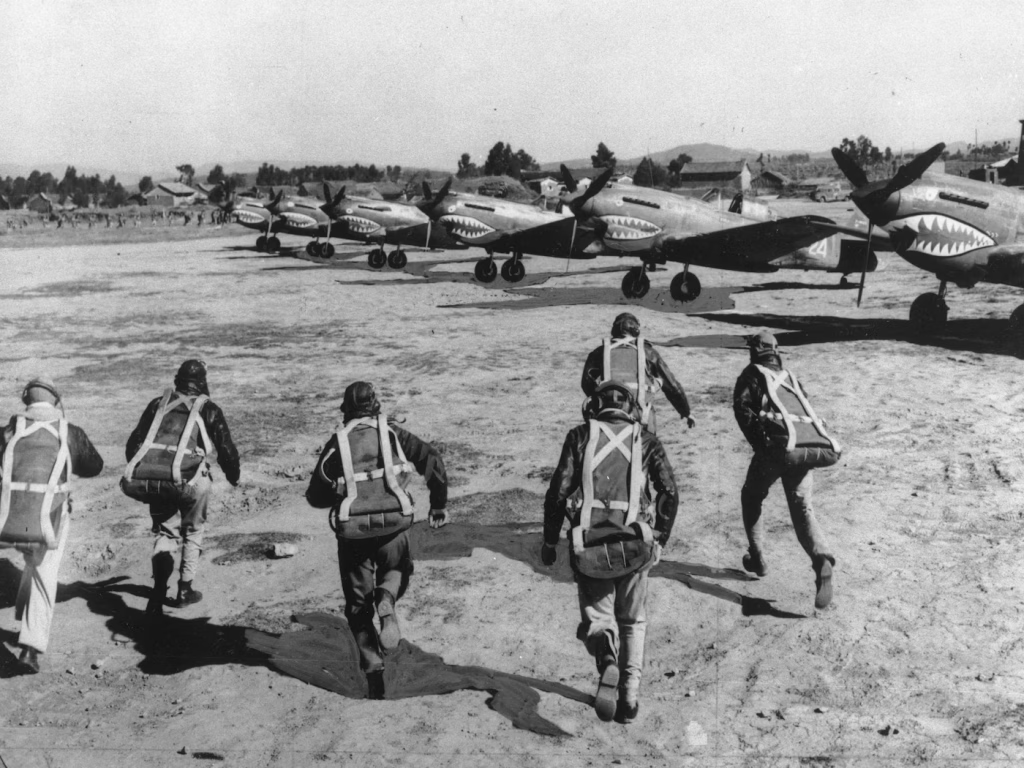
The Flying Tigers’ early victories captured global imagination, and their continued successes kept it. American newspapers, eager for good news after Pearl Harbor, hailed them as heroes. Magazines published dramatic accounts of their exploits that exaggerated the numbers, but boosted morale. Posters and films depicted their shark-mouthed planes diving on Japanese bombers. They became symbols of defiance at a time when the Allies faced just about everywhere else. In China, they became national icons, their image painted on walls and celebrated in songs. Chiang Kai-shek awarded Chennault and his men medals for bravery, while Madame Chiang became their public champion.
The American flyers even made it to the silver screen. Hollywood jumped on the bandwagon, and in 1942 the Flying Tigers was released. Starring John Wayne, the movie further embedded the AVG mythology into popular culture. Though propaganda distorted facts, the legend served a vital purpose: it showed that Japan could be beaten in the air. The Tigers’ example raised American spirits and underscored the potential of air power. Their story transcended national boundaries, and united Americans and Chinese in a shared narrative of courage and cooperation during one of humanity’s darkest hours.
2. Transition to the US Army Air Forces

By mid-1942, the US had fully entered the war, and the days of the AVG as a volunteer unit were numbered. The Flying Tigers were officially disbanded on July 4th, 1942, replaced by the US Army Air Forces’ 23rd Fighter Group. Chennault led the 23rd, but relatively few Flying Tigers signed up. In trying to get the AVG pilots to make the switch, the USAAF had used unfortunate methods that proved counterproductive and soured most of them against joining. Many AVG veterans chose not to reenlist, exhausted or disillusioned by bureaucratic disputes over pay and recognition. Only a fraction stayed on to join the new group.
The transition marked the end of the Flying Tigers as a distinct entity, but their spirit endured. The 23rd Fighter Group, later part of the Fourteenth Air Force, carried on Chennault’s tactics with great success. They flew updated P-40s, and as the war progressed, they got P-51 Mustangs and other aircraft. Chennault was promoted to major general, and commanded Allied air operations across China. Though brief, the AVG’s existence had a significant impact. It demonstrated the value of air support, and laid the foundation for sustained cooperation between the US and China. The Flying Tigers’ disbandment closed a remarkable chapter of volunteer heroism, but their legend continued to inspire aviators for generations.
1. Legacy and Historical Significance of the Flying Tigers

The Flying Tigers are not as well known today as they used to be. This writer grew up at a time when most American boys knew at least somewhat of them. We might not have known the details, but we knew their airplanes had cool shark mouths painted on their noses. My first model airplane was a P-40 with that iconic design. Their legacy is both military and moral. Militarily, their tactics, intelligence work, and combat discipline influenced US air doctrine. Chennault’s emphasis on flexibility and aggression became a model for later American fighter groups. Politically, the Tigers symbolized early US–Chinese cooperation – a relationship that persisted despite later tensions.
Beyond their victories, the Flying Tigers represented volunteerism at its finest. The American pilots signed up to risk their lives for a cause that was not yet officially their country’s war. Postwar recognition was slow, but in 1992, the group was awarded a Presidential Unit Citation, finally honoring its members’ service. Memorials and museums in China and the US preserve their story, and descendants of the Tigers continue to visit former airfields. Their legend, although dimmed, still endures. A small band of volunteers, through courage and innovation, became a beacon of hope during the darkest days of WWII.

_________________
Some Sources & Further Reading
Chennault, Claire Lee – Way of a Fighter: The Memoirs of Claire Lee Chennault (1949)
Ford, Daniel – Flying Tigers: Claire Chennault and His American Volunteers, 1941-1942 (2010)
History Halls – 20 Greatest Fighters of World War II
Schultz, Duane P. – The Maverick War: Chennault and the Flying Tigers (1987)

