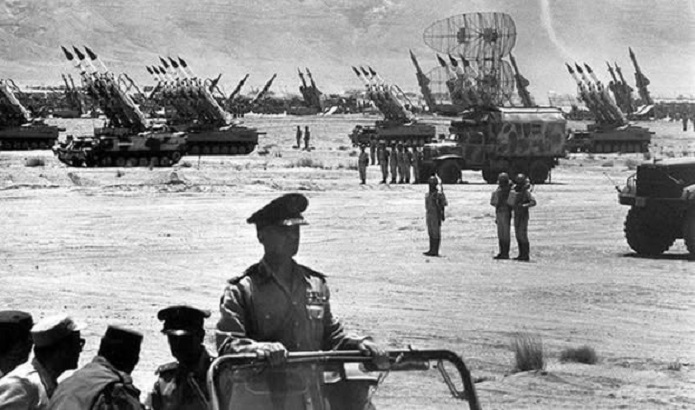
In July, 1977, the Egyptian-Libyan War, also called the “Four Day War”, pitted Egypt against Libya. It was a brief but revealing conflict between two Arab states that only recently had been close allies. Fought along the desolate border between western Egypt and eastern Libya, the war exposed deep ideological rifts in the Arab world after the October 1973 war. It highlighted how personal rivalries, incompatible political visions, and regional realignments could turn former partners into open enemies.
Relations Between Egypt and Libya Used to be Quite Warm

Relations between Egypt and Libya had initially been quite warm after the overthrow of their respective monarchies. Libya’s 1969 coup brought Muammar Gaddafi to power. A young, fiery officer, Gaddafi idolized Egypt’s Gamal Abdel Nasser and embraced pan-Arabism with revolutionary zeal. Egypt, under Nasser and later Anwar Sadat, was the leading Arab military and political power. In the early 1970s, Libya provided Egypt with substantial financial aid, oil revenues, and weapons purchases. It significantly ramped up the support as Egypt prepared for confrontation with Israel.
The alliance began to fracture after Nasser’s death in 1970. Sadat, who succeeded him, proved far more pragmatic and less ideologically rigid than Gaddafi. The breaking point came after the 1973 October War. Sadat viewed the war as a means to break the diplomatic stalemate and open the door to negotiations with Israel and the United States. Gaddafi believed the conflict should have been pursued as an unlimited war of liberation. He bitterly opposed Sadat’s ceasefire and subsequent diplomatic initiatives, especially Egypt’s gradual shift toward Washington and away from the USSR.
The Road to the Four Day War

In the mid-1970s, Gaddafi denounced Sadat as a traitor to Arab unity, and accused him of abandoning the Palestinian cause. Sadat, in turn, regarded Gaddafi as reckless, destabilizing, and dangerous – not only to Libya, but to Egypt’s western frontier. The ideological gulf between revolutionary pan-Arabism and pragmatic state-centered nationalism became unbridgeable. Tensions escalated steadily in 1976 and early 1977. Egypt expelled thousands of Libyans, while Libya harassed Egyptian expatriates and fomented unrest along the border. Both sides accused the other of sponsoring subversion.
Gaddafi began to openly call for Sadat’s overthrow. He encouraged Egyptian opposition groups, including leftists and Islamist dissidents, and offered them support and training camps in Libya. The Egyptian–Libyan border, stretching hundreds of kilometers across sparsely populated desert, became increasingly militarized. Skirmishes between border patrols were reported, and artillery exchanges occurred intermittently. Libya, flush with oil money, had purchased large quantities of modern Soviet weaponry, including MiG-23 fighters and advanced surface-to-air missiles. However, the Libyan armed forces were poorly trained, and suffered from political interference and weak command structures. Egypt, by contrast, possessed one of the most experienced armies in the Arab world.
Border Clashes Commence

Though strained by years of conflict and economic hardship, the Egyptian military had demonstrated competence in 1973. Its military had put on a creditable performance, and Egyptian forces retained strong command cohesion. Sadat also believed that a limited show of force against Libya would send a message to Gaddafi. He reasoned that it would deter further interference, without drawing Egypt into a prolonged war. Open fighting began on July 21st, 1977 after a series of border incidents culminated in clashes near the Egyptian town of Sallum.
Egyptian and Libyan units exchanged artillery fire, and Libyan forces crossed into Egyptian territory in several places. Cairo treated the incursions as a deliberate provocation rather than a spontaneous skirmish. Egypt had been massing troops and building up infrastructure along its western border for months. In response to the Libyan incursions, Sadat authorized a swift and limited military response. The Egyptian objective was not to conquer Libyan territory or overthrow Gaddafi. The goal was to punish Libyan forces, destroy forward military assets, and demonstrate Egypt’s superiority. Egyptian planners emphasized speed, surprise, and concentration of force. On July 22nd, the Egyptians struck in earnest.
Things Went Bad for Gaddafi’s Forces

Egyptian ground forces advanced across the border into Libya in several columns, supported by armor and mechanized infantry. Egyptian units encountered uneven resistance, and quickly overran Libyan border outposts. In many cases, Libyan troops withdrew hastily or surrendered – a reflection of poor morale and confusion. Simultaneously, the Egyptian Air Force struck air bases and radar installations in eastern Libya, including targets near Tobruk and Jaghbub. Egyptian pilots, veterans of earlier wars, exploited Libyan air defense weaknesses and inflicted significant damage.
Things quickly took a turn for the worse for Gaddafi’s forces. Several Libyan aircraft were destroyed on the ground, while Egyptian losses were minimal. The Egyptian navy also played a role, imposed pressure along the Mediterranean coast, and threatened Libyan supply routes. The coordinated operations underscored Egypt’s ability to conduct joint military actions – something Libya struggled to match. The Libyans attempted to respond with air strikes and counterattacks, but their efforts were largely ineffective. Although Libya possessed modern aircraft, its pilots lacked training and operational experience.
End of the Four Day War

As the Egyptians advanced into Libya, Libyan command and control proved inadequate, as political oversight often interfered in military decision-making. Contemporary reports indicate Libyan confusion at multiple levels, as units acted independently or awaited contradictory orders. Gaddafi, known for his erratic leadership style, issued fiery public statements calling for resistance and pan-Arab mobilization. However, his words had little effect, and no Arab state rushed to Libya’s defense, reflecting Gaddafi’s growing isolation. Even countries sympathetic to Libya’s anti-Sadat rhetoric were reluctant to be drawn into an inter-Arab war.
By July 24th, the Egyptian forces had achieved their objectives. They had pushed Libyan units back, destroyed significant military infrastructure, and demonstrated clear battlefield superiority. Sadat, wary of international backlash and eager to avoid escalation, ordered a halt to offensive operations. Diplomatic efforts moved quickly. Algeria and the Palestine Liberation Organization, particularly Yasser Arafat, played key mediating roles. On July 25th, a ceasefire was agreed upon. That effectively brought the conflict, named the Four Day War because of its duration, to an end.
A Turning Point and Prelude to Middle Eastern Diplomatic Realignment

Egyptian forces withdrew to their side of the border, and Libya ceased military operations. While sporadic incidents continued for some time, large-scale hostilities did not resume. Precise casualty figures for the Four Day War vary. Estimates suggest Libya suffered several hundred killed and wounded, along with substantial equipment losses, particularly aircraft and armored vehicles. Egyptian casualties were considerably lower. The conflict reinforced Egypt’s status as a professional and capable armed force, even in the post-1973 era. Libya’s weaknesses were starkly exposed, revealing that expensive weapons purchases could not compensate for poor training, discipline, and leadership.
Politically, the Four Day War deepened the schism between Egypt and radical Arab states. Gaddafi intensified his denunciations of Sadat, while Egypt moved decisively toward the diplomatic path that would culminate in Sadat’s 1977 visit to Jerusalem and the Camp David Accords of 1978. In that sense, the conflict was both a symptom and a prelude to Egypt’s dramatic realignment in Middle Eastern politics. For Libya, the war was a humiliation. Gaddafi survived politically, but his credibility suffered, particularly among Arab military elites. The conflict reinforced his suspicion of neighboring regimes and contributed to Libya’s confrontational foreign policy in the years that followed. That included support for insurgent movements and involvement in distant conflicts.
Significance and Legacy of the Four Day War

Regionally, the Four Day War underscored the fragmentation of the Arab world after 1973. The era of unified Arab military action against Israel had given way to internecine disputes. The new Arab-vs-Arab conflicts were shaped by ideology, leadership rivalries, and divergent national interests. Although brief, the 1977 Four Day War is significant for what it reveals about the post-1973 Middle East. It demonstrated the limits of revolutionary rhetoric when confronted with organized military power. It also highlighted how quickly alliances could dissolve in the absence of shared strategic goals. Moreover, the war illustrated Sadat’s willingness to use force selectively to secure Egypt’s interests while keeping his diplomatic agenda intact.
In retrospect, the Four Day War appears less as a conventional war, and more as a sharp political-military message delivered under controlled conditions. Egypt proved its strength, and Libya learned painful lessons. The broader Arab world moved one step further away from collective action and toward a fractured, multipolar regional order. Though overshadowed by larger Arab–Israeli wars and later Middle Eastern conflicts, the Four-Day War remains a telling episode. It was a short, intense clash that encapsulated the ideological battles, leadership conflicts, and strategic shifts of the late Cold War Middle East.

_________________
Some Sources & Further Reading
Cooley, John K. – Libyan Sandstorm (1983)
Cooper, Tom, and Grandolini, Albert – Libyan Air Wars, Part 1: 1973-1985 (2015)
Pollack, Kenneth Michael – Arabs at War: Military Effectiveness, 1948-1991 (2004)
New Articles
- The Johnstown Flood – Thousands Perished When A Dam Collapsed After Gilded Age Tycoons Modified it for their Private Resort
- The Jacquerie: The Medieval Peasant Uprising That Terrified France’s Aristocrats
- Things That Weren’t Thought Through: WWII’s Sticky Bomb Stuck to Users’ Hands Once Activated
- German Tanks of World War II – The Panzer 38(t), a Czech Tank in German Service
- Nicholas Alkemade: The WWII Airman Who Survived an 18,000 Foot Fall From a Bomber Without a Parachute

