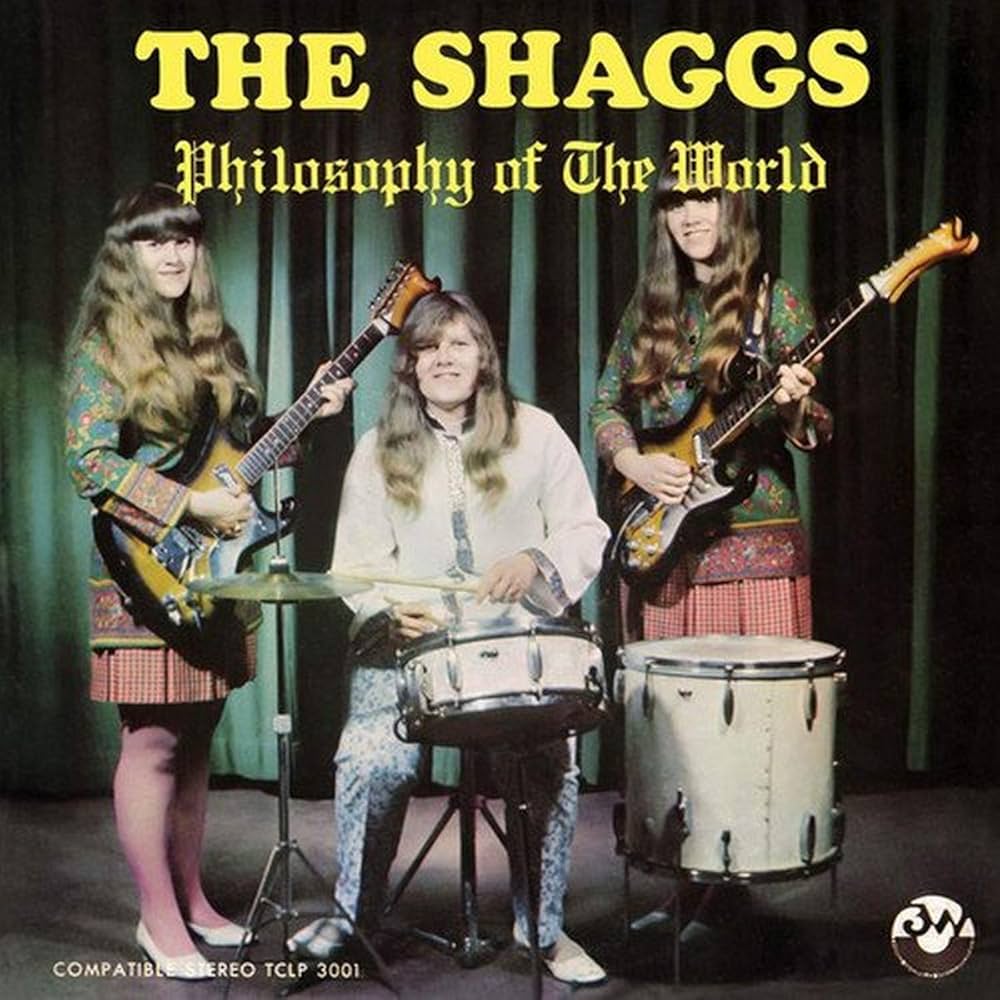
The story of the Shaggs is one of the strangest and most unlikely in American music history. Their existence as a band was not the result of personal passion, commercial dreams, or youthful rebellion. Instead, it was driven by the obsessive determination of a father who believed he was fulfilling a decades-old prophecyr.
A Fateful Prophecy

Austin Wiggin was a factory worker from rural New Hampshire. He lived a modest and quiet life, working long hours and raising his family in relative isolation. He was strict, controlling, humorless, and deeply religious. When he was a boy, his mother read his palm and made three predictions. He would marry a strawberry blond, he would have two sons after her death, and his daughters would form a popular band. As it turned out, he did end up marrying a strawberry, and had two sons after his mom died. Convinced that his mom was a prophet, Austin set out to make sure her third prediction also came true.
The family had no musical background, no resources, and no connection to the entertainment world, but Austin was determined. Over the years, the prophecy lingered in his mind and gradually grew in importance. He came to see it not as a vague fortune-teller’s statement, but as a promise that had to be fulfilled. His daughters – Dot, Betty, and Helen – were quiet, shy, and socially withdrawn girls. They had no particular interest in music, and showed no obvious talent. That did not dissuade Austin. In the mid-1960s, he bought instruments for them: a guitar for Dot, drums for Betty, and a bass for Helen. He assigned each girl a role, and forced them to practice regularly. The girls were not skilled, and did not enjoy playing. Their practice sessions were driven by obligation, not inspiration. Austin supervised them closely, and demanded obedience.
Creating the Shaggs

Austin’s daughters received little meaningful instruction. They briefly had a teacher, but the lessons were limited and did not provide a solid foundation. So the girls struggled with timing, coordination, and basic musical technique. Their playing was awkward and often out of sync. They hated the band, but kept at it to keep from getting punished by their crazy dad. Despite those shortcomings, Austin, who named them the Shaggs after a popular hairstyle, was convinced they were destined for greatness.
Austin was so convinced that he pulled his daughters out of school so they could focus on their music full time. He even made them hold séances to try and communicate with his by-then-deceased mom and get some guidance from her. Austin arranged for his girls to perform at local talent shows, schools, and community events. Their first outing, before hundreds of teenagers at a local community hall, was a disaster. They obviously had no talent, could not sing, play their instruments, or keep a tune.

The audience laughed, booed, and threw objects at the stage. Austin persisted, however, and interpreted every opportunity to perform as proof that the prophecy was unfolding. His determination culminated in 1969, when he paid for the Shaggs to record an album. The result was Philosophy of the World, a record unlike anything else ever produced. Only about 1,000 copies were pressed, and it received almost no attention at the time. The songs were simple and direct, with lyrics about everyday experiences, family relationships, and social anxieties. Dot, the primary songwriter, expressed herself with complete sincerity, without concern for metaphor or artistic sophistication.
An Objectively Awful Band

The Shaggs’ music was unconventional in the extreme. The instruments often seemed disconnected from one another, with rhythms drifting apart and melodies failing to align. The girls struggled to stay in sync, and their technical limitations were obvious. However, there was something strangely compelling about the album. It was completely honest. There was no irony, no attempt to imitate popular trends, and no awareness of how unusual it sounded. The band’s existence was entirely dependent on Austin’s will. When he died suddenly of a heart attack in 1975, the group immediately ceased to exist.
Without Austin’s pressure, the girls had no desire to continue playing music. They abandoned their instruments and pursued ordinary lives, working regular jobs and avoiding discussion of their musical past. For years, Philosophy of the World was almost entirely forgotten. It was saved from obscurity by growing interest in outsider art in the late 1970s and 1980s. Music collectors and experimental musicians began to rediscover the album and recognize its uniqueness. Unlike conventional music, it had not been shaped by commercial expectations or artistic self-consciousness. It was pure and unfiltered.
An Unlikely Revival

Philosophy of the World had disappeared almost immediately when it was released in 1969. Pressed in a tiny run of roughly 1,000 copies and sold mostly around the Shaggs’ hometown of Fremont, New Hampshire, the album attracted virtually no attention. There was no marketing campaign, no radio play, and no touring outside small local events. To most people, the record simply didn’t exist. After Austin Wiggin died in 1975 and the band dissolved, the album seemed destined to fade into permanent obscurity.
Its rediscoverybegan quietly in the 1970s through underground record collector networks. They specialized in finding obscure, forgotten, and unusual recordings from outside the mainstream music industry. They prized rarity, and Philosophy of the World was extremely rare. Its scarcity alone made it an object of curiosity. Frank Zappa was among the key figures in the album’s rediscovery. Zappa was already famous for his embrace of unconventional music, and his belief that artistic value did not depend on technical skill or commercial polish.
Zappa encountered Philosophy of the World in the mid-1970s, and was fascinated by it. He reportedly described the Shaggs as “better than the Beatles”. A provocative statement, it reflected his genuine appreciation for unconventional music. Zappa’s endorsement had a powerful effect. His fans and fellow musicians trusted his judgment, especially when it came to unusual or experimental work. As word spread that Zappa admired the Shaggs, collectors began actively seeking copies of the album. It became an underground legend – a strange and rare album few had actually heard, but many were curious about.
Learning to Like Philosophy of the World

The rise of independent record stores and collector culture in the late 1970s and early 1980s further contributed to the rediscovery of Philosophy of the World. Record stores that specialized in obscure or unusual music began sharing information about rare recordings. Collectors traded tapes of the album, allowing people to hear it without owning an original copy. Those tape-trading networks were essential in spreading awareness of forgotten music long before the internet existed. Another major factor in the Shaggs’ rediscovery was the growing interest in what became known as “outsider music”. It referred to music created outside the traditional music industry, often by people with little formal training or commercial ambition.
Listeners began to value authenticity and originality over technical perfection. The Shaggs fit perfectly into this category. Their music was not influenced by trends, producers, or commercial expectations. It was simply the result of their father’s insistence and their own sincere efforts. By the 1980s, influential music critics and underground publications began writing about the album. One of the most important voices was Lester Bangs, a highly respected and controversial rock critic known for unconventional views. Bangs praised the Shaggs, and argued that their lack of technical skill did not diminish the emotional honesty of their music. His support helped legitimize the album in the eyes of critics who might otherwise have dismissed it.
Becoming a Cult Classic

Independent record labels soon recognized the album’s growing cult reputation. In 1980, Rounder Records reissued Philosophy of the World, making it available to a wider audience for the first time. That reissue was crucial. For more than a decade, the album had been nearly impossible to find. Now, musicians, critics, and curious listeners could finally hear it. The reissue sparked intense debate. Some listeners found the album fascinating and deeply authentic. Others considered it unlistenable. But even those who disliked it recognized that it was unlike anything else. Its uniqueness became its greatest strength. The album’s reputation grew even further in the 1990s when alternative and indie musicians began citing it as an influence. Kurt Cobain included it on lists of his favorite albums, and praised its sincerity and emotional purity.
Cobain’s endorsement introduced the Shaggs to a new generation of listeners who were already interested in unconventional and independent music. By the late twentieth century, Philosophy of the World had transformed from an obscure private pressing into a cult classic. What had once been ignored was now celebrated as one of the purest examples of outsider art in music. The album’s rediscovery was not the result of commercial promotion, but of curiosity, collector culture, and the willingness of influential musicians and critics to look beyond conventional standards of quality. In the end, the album’s rediscovery demonstrated that artistic significance is not always recognized immediately. Sometimes, it takes years – or even decades – for the world to understand something truly unusual.
Significance and Legacy of the Shaggs

The Shaggs’ cult following continued to grow. Musicians and critics began to appreciate Philosophy of the World not despite its flaws, but because of them. Its awkwardness and sincerity gave it a rare authenticity. It was music created without ego or ambition, driven entirely by a father’s deluded belief in destiny. In a strange and unexpected way, the prophecy that inspired Austin Wiggin actually did come true. The Shaggs did become famous in a way, but not in his lifetime, and not in the way he likely imagined. They did not achieve mainstream success or wealth. Instead, they became legends in underground and alternative music circles, admired for their originality and honesty.
The Shaggs’ story raises difficult questions about control, belief, and artistic expression. The girls did not choose to become musicians. They were forced to become musicians by their nutty father’s obsession. However, the result was genuinely unique – music that could never have been created intentionally. The Shaggs’ legacy endures because their work represents something rare: creativity untouched by self-consciousness or commercial influence. Their music was not designed to impress or entertain in the conventional sense. It was simply the product of ordinary people trying to fulfill an extraordinary expectation. The band started with a prophecy and a father’s obsession. It ultimately became one of the most unusual and fascinating stories in music history.

_________________
Some Sources & Further Reading
New Yorker, September 20th, 1999 – Meet the Shaggs
New York Times, June 7th, 2011 – Three Sisters, a Deluded Dad, and Some Wretched Rock
Reynolds, Simon, and Press, Joy – The Sex Revolts: Gender, Rebellion, and Rock ’n Roll (1995)
Newest Articles
- The Johnstown Flood – Thousands Perished When A Dam Collapsed After Gilded Age Tycoons Modified it for their Private Resort
- The Jacquerie: The Medieval Peasant Uprising That Terrified France’s Aristocrats
- Things That Weren’t Thought Through: WWII’s Sticky Bomb Stuck to Users’ Hands Once Activated
- German Tanks of World War II – The Panzer 38(t), a Czech Tank in German Service
- Nicholas Alkemade: The WWII Airman Who Survived an 18,000 Foot Fall From a Bomber Without a Parachute

