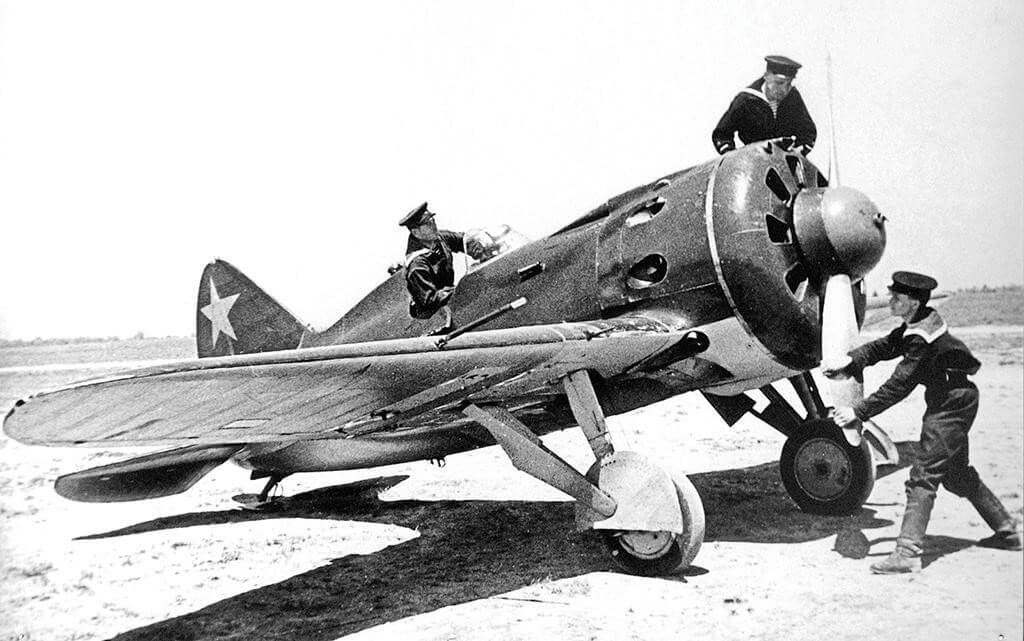
The Polikarpov I-16 was one of the most revolutionary fighter aircraft of the interwar period. It became a symbol of the Soviet Union’s drive to modernize its air forces in the 1930s. The I-16 combined radical aerodynamic features with mass production on a scale few countries could match at the time. Though later overshadowed by more advanced designs, the aircraft played a crucial role in shaping air combat doctrine and remains one of the most distinctive fighters ever built.
A Cutting Edge Flying Donkey

Designed by Nikolai Polikarpov, often called the “King of Fighters”, the I-16 was startlingly modern for its era. First flown in late 1933, it was the world’s first low-wing cantilever monoplane fighter to enter operational service. It was also one of the earliest fighters to feature retractable landing gear. At a time when many air forces still relied on biplanes with fixed gear and open cockpits, the I-16’s sleek profile represented a leap forward in performance. Its small wings and short, stubby, compact appearance contrasted sharply with long-nosed fighters that dominated later years. The aircraft was powered by a series of radial engines. First, the American-derived Wright Cyclone built under license in the Soviet Union, and later more powerful indigenous Shvetsov engines.
Early versions were capable of speeds exceeding 450 km/h (about 280 mph). That made the I-16 one of the world’s fastest fighters in the mid-1930s. That speed advantage allowed Soviet pilots to outpace many potential adversaries in the aircraft’s early service life. Despite its advanced design, the I-16 was not an easy aircraft to fly. Its short fuselage and rearward center of gravity made it highly maneuverable, but also unforgiving. The aircraft had a tendency to enter flat spins if mishandled, and landings could be particularly dangerous for inexperienced pilots. Soviet pilots nicknamed it “Ishak” (Donkey), a reference both to its stubborn handling characteristics and its squat appearance. Nonetheless, the I-16 could be a formidable dogfighter in the hands of a skilled aviator.
The Polikarpov I-16 in Spain and Asia

Polikarpov I-16 armament evolved significantly over the aircraft’s long production run. Early variants carried two 7.62 mm ShKAS machine guns. Later models added additional machine guns or 20 mm ShVAK cannons. Some versions were even equipped to carry rockets or small bombs, reflecting Soviet interest in using fighters for ground-attack roles. That adaptability helped keep the I-16 relevant even as newer enemy aircraft appeared. The I-16 first saw extensive combat service and gained international attention during the Spanish Civil War (1936–1939). Supplied to the Republican forces, it was known to them as the “Mosca” (Fly), while Nationalist pilots called it the “Rata” (Rat).
The I-16 initially outperformed many German and Italian biplane fighters in Spain, demonstrating the clear advantages of monoplane design. However, the arrival of more advanced opponents such as the Messerschmitt Bf 109 soon exposed the I-16’s limitations. Chief among them were lack of pilot protection and relatively short range. Beyond Spain, I-16s were supplied to China in the Sino-Japanese War. They also fought in the Soviet-Japanese border clashes at Khalkhin Gol in 1939. The I-16’s agility proved useful in dogfights in those conflicts. Once again, however, it struggled against newer aircraft with higher speeds and better climb rates. Those experiences highlighted the rapid pace of aviation development on the eve of World War II.
Obsolescence and Withdrawal from Service

By the time Nazi Germany invaded the Soviet Union in June, 1941, the once-cutting edge I-16 was already becoming obsolete. However, it still formed the backbone of the Red Air Force’s fighter inventory when the Germans launched Operation Barbarossa. Against modern German Bf 109Es and Fs, Polikarpov I-16 pilots were at a clear disadvantage in speed, armament, and survivability. Despite that, many Soviet aviators flew the aircraft with determination, courage, and ingenuity. They even resorted to ramming enemy airplanes when nothing else worked. The I-16 suffered horrific losses during the war’s early months. It continued to serve, however, until replaced by newer fighters like the Yak-1 and LaGG-3.
In total, more than 10,000 I-16s were produced, which made it one of the most widely built fighters of its generation. Its true legacy lies not only in its combat record, but in its influence. The aircraft demonstrated that advanced monoplanes could be built and deployed in large numbers. That pushed air forces worldwide to rethink fighter design. Like all pioneering designs, the Polikarpov I-16 was eventually overtaken by the march of technological progress. However, it still remains a bold and influential step in the evolution of modern air combat.

_________________
Some Sources & Further Reading
Gordon, Yefim, and Dexter, Keith – Polikarpov’s I-16 Fighter: Its Forerunners and Progeny (2001)
History Halls – Lavochkin La-5: The WWII Fighter that Changed the Air War on the Eastern Front
Newest Articles
- The Daimler Armoured Car: Britain’s Most Successful WWII Reconnaissance Vehicle
- The Sinking of the Scharnhorst: Ending Germany’s Surface Fleet Threat in WWII
- SS War Criminal Joachim Peiper Burned Hundreds of Innocents, and Was Burned to Death in His Home After WWII
- Anne Bonny: Fierce Female Pirate of the Caribbean
- The Little-Known 1977 Four Day War Between Egypt and Libya: A Turning Point in Middle Eastern Geopolitics

