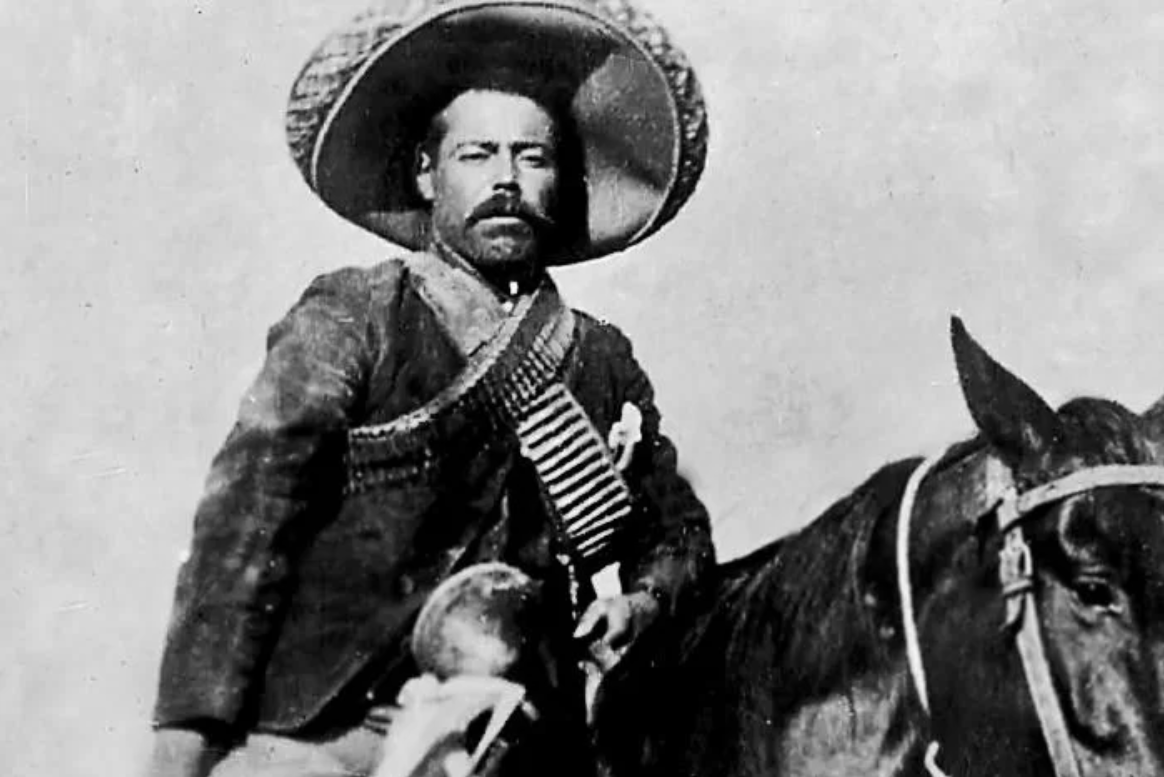
There is no more fitting end to a romantic hero’s legend than romantic last words to cap off the story. Coming up with memorable last words is hard, though. What if the hero can’t think of anything? The last moments of Pancho Villa illustrate what might happen then.
Rise of a Teenage Bandit

Francisco “Pancho” Villa (1878 – 1923) was born into an impoverished family of Mexican sharecroppers. He received some elementary schooling, but had not progressed beyond basic literacy when his father died and he had to quit school and help his mother. Villa worked a variety of menial jobs, interspersed with stints of banditry. When he was sixteen-years-old, he killed his first man: a hacienda owner he accused of assaulting his sister. He then stole his victim’s horse, fled to the hills, and started his career as a full time bandit.
Villa was captured in 1902, but was spared the death penalty, and got drafted into the Mexican army instead. He deserted after he killed an offer, stole his horse, and returned to banditry. Notice a pattern? The Mexican Revolution erupted in 1910, and Villa wanted to join. He was persuaded that he could fight for the people by directing his banditry against hacienda owners. He turned out to be a natural at the Revolution’s mobile style of warfare. Indeed, he played a key role in defeating the government’s forces in northern Mexico.
Pancho Villa, the International Celebrity

The rebels trounced the government, but unfortunately, their victory did not restore peace to Mexico. Once the government forces were defeated, the rebel alliance split when the new government failed to enact promised land reforms. Pancho Villa supported the new government, and was appointed a brigadier general. He had a hot temper, though, which got him into hot water. Villa struck a superior general during a quarrel, and was sentenced to death. He was saved from the firing squad by a last minute telegram from the president, which commuted his sentence to prison.
Pancho Villa did not stay locked up for long. He managed to breakout from prison, and fled to the United States. He secured American support to fight against a new government that had seized power in a coup, and returned to Mexico in 1913. Villa again achieved considerable success, and was appointed governor of the state of Chihuahua. As governor, he implemented major land reforms. He confiscated grand haciendas, and broke them up into smaller plots which he redistributed to the families of fallen revolutionaries. Villa became internationally famous, and was depicted as a romantic bandit-warrior who took from the rich to help the poor.
“Tell Them I Said Something!”

The Mexican government that had seized power through a coup was overthrown, but the victorious allies again fell out. This third round of fighting did not go well for Pancho Villa, who was dealt a series of defeats. By 1915, his forces had shrunk to a small band hiding in the hills. As to Villa’s backers north of the border, the US shifted its support from Villa to his opponents. He took it personal. Feeling betrayed, Villa began to attack American interests in northern Mexico. He upped the ante in 1916, when crossed the border and attacked the town of Columbus, New Mexico. The US responded with a military expedition to Mexico, to hunt down Villa. He eluded the Americans, and his popularity rose among Mexicans resentful of the intrusion.
Villa continued guerrilla warfare until 1920, when he finally agreed to lay down his arms. He made peace, and recognized the Mexican government in exchange for an amnesty and a 25,000 acre hacienda. In 1923, he declared his intention to run for president, which threatened to rock the boat of Mexican politics. Soon thereafter, his car was ambushed and shot up. Fatally wounded, Villa realized that a life as interesting as his should end with an interesting final statement. However, he could think of nothing to say that befitted the occasion. So his last words to his companions as he lay dying were: “Don’t let it end like this! Tell them I said something!”

_________________
Some Sources & Further Reading
Encyclopedia Britannica – Pancho Villa
History Halls – The 1916 Columbus Raid: When Francisco Villa Attacked an American Town
Newest Articles
- The Johnstown Flood – Thousands Perished When A Dam Collapsed After Gilded Age Tycoons Modified it for their Private Resort
- The Jacquerie: The Medieval Peasant Uprising That Terrified France’s Aristocrats
- Things That Weren’t Thought Through: WWII’s Sticky Bomb Stuck to Users’ Hands Once Activated
- German Tanks of World War II – The Panzer 38(t), a Czech Tank in German Service
- Nicholas Alkemade: The WWII Airman Who Survived an 18,000 Foot Fall From a Bomber Without a Parachute

