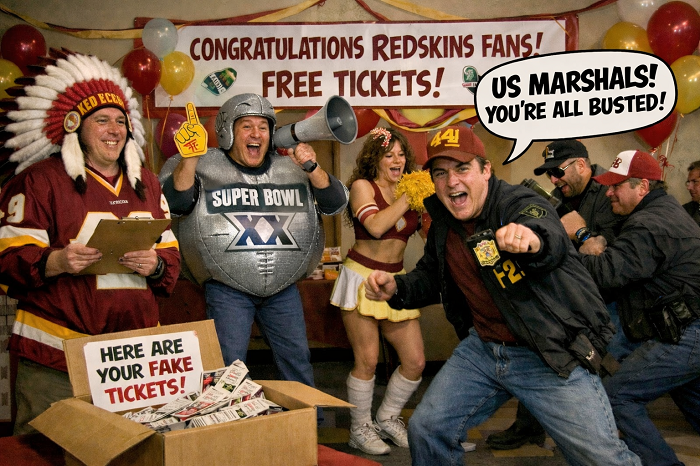
The NFL’s Washington Commanders have been mostly “meh” for the past few decades. In the 1980s, though, back when they were the Redskins, they were a dynasty and people were crazy about them. That included criminal people – a fact the US Marshals Service, whose remit includes hunting fugitives, exploited with Operation Flagship. A bold and unusually theatrical law-enforcement sting, Flagship was carried out in Washington, DC, in late 1985. It aimed to arrest dozens of fugitives in one fell swoop. What made it stand out was not just its effectiveness, but the audacity of its method. Rather than chase suspects individually, authorities lured them all to a fake party with the promise of free Redskins tickets.
An Innovative Plan to Round Up Fugitives

Washington, DC, was struggling with high crime rates in the mid-1980s, particularly violent offenses connected to drugs and firearms. Many wanted suspects had outstanding warrants, but were difficult to apprehend individually. Traditional arrest methods often led to dangerous foot chases, armed standoffs, or collateral harm to bystanders and officers. The Marshals Service, whose mission includes tracking down fugitives, began to think creatively about how to neutralize multiple targets at once with minimal risk. The idea behind Operation Flagship was simple but daring: create a believable social event that would attract fugitives voluntarily. The Marshals identified around 3,000 individuals with outstanding warrants, many for serious crimes such as armed robbery, assault, and drug trafficking, and sent invitations to their last known addresses.
The suspects were known to associate within similar social circles, which made it plausible to target them with a single event. Planners posed as promoters for an exclusive NFL-themed party celebrating the Washington Redskins on the morning of their December 15th. Carefully crafted invitations were sent out. The flyers promised free food, live entertainment, women, two free tickets to the Redskins-Bengals game later that afternoon, and a chance to win Super Bowl XX tickets and other prizes. Crucially, the event was presented as invitation-only, which enhanced its appeal and sense of legitimacy. Many of the fugitives, despite their legal status, were drawn in by curiosity, social pressure, and the promise of rewards.
Free Redskins Tickets

The fake party was to be held at the Washington Convention Center. In preparation, law enforcement transformed the venue into a trap. Officers from the US Marshals Service, DC Metropolitan Police, FBI, and Bureau of Alcohol, Tobacco, and Firearms took part. All in all, more than a hundred law enforcement personnel were involved. Many were disguised as caterers, security guards, Redskins cheerleaders, mascots, or party staff. The layout was carefully planned so that exits could be sealed quickly once the operation began. As guests arrived, they were greeted normally, checked in, and given food and drinks. The atmosphere was intentionally relaxed. Loud music played, and a master of ceremonies announced upcoming prize drawings. The invitees were then taken in batches of around a dozen or so to a smaller ballroom to hear a short speech and receive their tickets.
There, the party came to a screeching halt soon as the speaker uttered a signal – the word “surprise”. The lights were turned on, the music stopped, and heavily armed officers burst into the room, identifying themselves and ordering everyone to the ground. The arrests were swift and remarkably calm. Most suspects were caught completely off guard and offered little resistance. Handcuffed, the fugitives were rushed to waiting buses that took them to the DC jail. The room was then cleared for the next batch, and the process repeated. In total, 101 fugitives were arrested. No shots were fired, no officers were injured, and there were no serious injuries among the suspects. For an operation targeting violent offenders, that outcome was a major success.
The Legacy of Operation Flagship

Operation Flagship drew global attention. Media outlets were fascinated by the creativity and nerve involved in the sting. It was praised it as an example of intelligence-led policing and risk reduction. Law enforcement agencies in the US and around the world contacted the Marshals Service to find out how it was it was done and how they could replicate it. In the years that followed, Operation Flagship became a case study in law-enforcement training and criminology courses. It inspired similar large-scale stings in other cities, though few matched its scale or cultural impact.
However, although the sting avoided dangerous street arrests and protected both officers and the public, it raised ethical questions. Courts have generally sided with law enforcement in that and similar stings. Nonetheless, over time, agencies became more cautious about replicating such operations due to concerns about liability, public perception, and changing standards of policing. Today, Operation Flagship stands as a striking snapshot of 1980s law enforcement: aggressive, imaginative, and willing to take unconventional risks. It illustrates how psychological insight and careful planning can sometimes succeed where brute force might fail.

_________________
Some Sources & Further Reading
History Halls – How the Tiny Town of Skidmore Dealt With its Resident Bully
Time Magazine, December 30th, 1985 – Football Sting: US Marshals 98, Crooks 0
US Marshals Service – Fugitive Investigative Strike Teams: No Such Thing as a Free Lunch
Newest Articles
- The Johnstown Flood – Thousands Perished When A Dam Collapsed After Gilded Age Tycoons Modified it for their Private Resort
- The Jacquerie: The Medieval Peasant Uprising That Terrified France’s Aristocrats
- Things That Weren’t Thought Through: WWII’s Sticky Bomb Stuck to Users’ Hands Once Activated
- German Tanks of World War II – The Panzer 38(t), a Czech Tank in German Service
- Nicholas Alkemade: The WWII Airman Who Survived an 18,000 Foot Fall From a Bomber Without a Parachute

