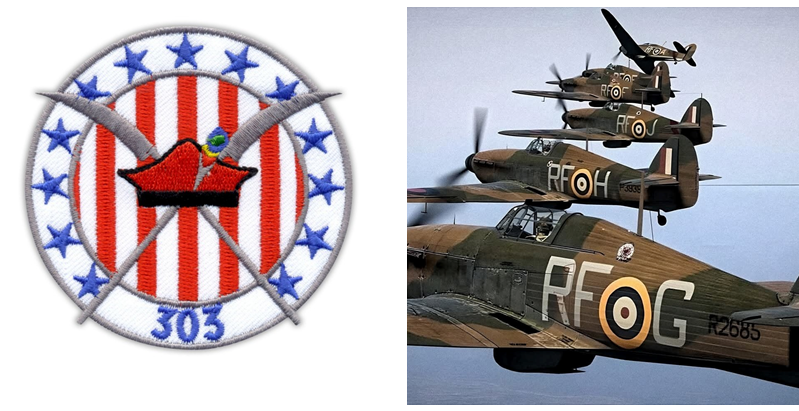
No. 303 Squadron of the Royal Air Force was one of World War II’s most celebrated units. Its significance went beyond its combat record, which was extraordinary. There was also its symbolic importance as a unit composed largely of Polish airmen fighting on after their homeland fell. Its story combines exile, perseverance, tactical brilliance, and controversy. It has become central to the Battle of Britain narrative, and foreign pilots’ contributions to the Allied victory.
Polish Airmen in Exile

The roots of No. 303 Squadron lie in the catastrophe that befell Poland in 1939. When Germany invaded that September, the Polish Air Force fought courageously, but was overwhelmed by superior numbers and modern tactics. Many Polish pilots escaped via Romania and Hungary, and eventually made their way to France. There, they flew for the Armée de l’Air and fought again, this time in the Battle of France, in 1940. They scored significant victories, but the overall battle was lost and France collapsed in June, 1940. Thousands of Polish servicemen escaped once more, this time to Britain. Initially, British authorities were skeptical about the integration of large numbers of foreign pilots into the RAF. Language barriers, unfamiliarity with British procedures, and lingering doubts about training standards all combined to cause delays.
It was a frustrating time for Polish pilots, many of whom were experienced combat veterans. They found themselves grounded or assigned menial duties at a time when Britain faced the threat of imminent invasion. Eventually, agreements between the Polish government-in-exile and Britain’s government led to the creation of Polish-manned squadrons within the RAF structure. No. 303 Squadron was officially formed on August 2nd, 1940, at RAF Northolt. It was designated a Polish fighter squadron, but operated under RAF command, with British equipment and procedures. The squadron was named “Kosciuszko” in honor of Tadeusz Kosciuszko, a Polish national hero who had also fought in the American War of Independence, symbolizing a shared struggle for freedom.
No. 303 Squadron Joins the Battle of Britain

The early days of No. 303 Squadron were marked by tension and frustration. The squadron was initially equipped with the Hawker Hurricane Mk I, robust but less glamorous fighter than the Supermarine Spitfire. While effective, it required careful handling, and the RAF insisted on thorough conversion training before allowing the Poles into combat. Language difficulties caused misunderstandings, and British instructors sometimes underestimated the Poles’ experience. Many had already flown combat missions against the Luftwaffe in Poland and France, and they resented being treated as novices.
Canadian Squadron Leader Ronald Kellett, the unit’s first commanding officer, played a crucial role in bridging the cultural gap. He quickly recognized the Polish pilots’ skill and aggression, and became a strong advocate for them. Despite official orders to remain in training, No. 303 Squadron’s first combat encounter came almost accidentally on August 30th, 1940. During a training flight, several pilots engaged a formation of German aircraft and shot down one confirmed enemy plane. That unauthorized action highlighted both the Poles’ eagerness to fight, and their combat readiness. Within days, the squadron was declared operational.
The Highly Aggressive Poles

No. 303 Squadron entered full combat at a critical moment, as the Luftwaffe strove for air superiority over British skies. The squadron was based at RAF Northolt, tasked with the protection of London and southeast England’s vital airfields. What followed was one of the battle’s most remarkable combat records. In just over six weeks of intensive fighting, No. 303 Squadron claimed 126 enemy aircraft destroyed, with 75 confirmed. That made it the Battle of Britain’s highest-scoring fighter squadron, despite having joined two months after the battle had started. The squadron’s achievement is even more striking considering the small number of pilots involved: only twenty one initially.
Several factors contributed to the Polish pilots’ success. Their experience from earlier campaigns had taught them that hesitation could be fatal. So they tended to favor aggressive, close-range attacks, and often pressed home their assaults until they were certain of results. While British doctrine emphasized disciplined formations and controlled engagement, the Poles were more flexible and individualistic. Their style proved highly effective against German bombers and fighters alike. Notable aces emerged from the squadron, including Josef Frantisek. A Czech pilot flying with the Poles, he became one of the battle’s top-scoring Allied aces. His fearlessness bordered on recklessness, and while his career was short – he was killed in a flying accident in October, 1940 – his impact was profound.
The Spear Tip of “The Few”

No. 303 Squadron’s combat performance rapidly silenced doubts within the RAF. Senior commanders, including Air Chief Marshal Hugh Dowding, acknowledged the Polish pilots’ decisive contribution. Winston Churchill’s famous remark that “Never in the field of human conflict was so much owed by so many to so few” encompassed all Fighter Command pilots. The Poles of No. 303 Squadron were undeniably among “the few” who bore the brunt of the fighting. Despite recognition by those in the know, the squadron’s achievements were not always fully acknowledged at the time. Administrative issues, confirmation standards, and occasional skepticism meant that some claims were downgraded or disputed. Nevertheless, postwar research has largely upheld the squadron’s extraordinary effectiveness.
The unit’s emblem, with a Polish checkerboard and scythes associated with Kosciuszko, became one of the RAF’s most recognizable insignia. It symbolized not only Polish national pride, but also the multinational nature of Britain’s air defense in 1940. After the Battle of Britain, No. 303 Squadron continued to serve throughout the war. It transitioned to Spitfires in 1941, and conducted offensive sweeps over occupied Europe, bomber escort missions, and air superiority operations. The squadron participated in the Dieppe Raid in 1942, and later supported the Allied invasion of Normandy in 1944.
Stuck in Exile

As the war progressed, many original No. 303 Squadron pilots were killed, wounded, or moved on to other units. The squadron maintained a strong Polish identity, though. Replacement pilots continued to arrive from training units in Britain or from Polish personnel who had escaped from occupied Europe. By the end of the war, No. 303 Squadron had flown thousands of sorties and was credited with the destruction of hundreds of enemy aircraft. Behind the impressive statistics, however, lay a deeply human story of loss and displacement.
For most of the Polish pilots, victory in 1945 did not mean a return to a free homeland. Poland fell within the Soviet sphere of influence, and the establishment of a communist government there made return dangerous or undesirable for many veterans who had fought in the West. As a result, numerous pilots of No. 303 Squadron remained in exile. They settled in Britain, or emigrated to countries such as Canada, Australia, and the United States. Some struggled to adapt to civilian life, and faced economic hardships and a sense of abandonment after years of sacrifice.
Disappointment and a Sense of Betrayal

While they had played a crucial role in Britain’s survival, many felt forgotten once their military usefulness had ended. No. 303 Squadron occupies a prominent place in both British and Polish historical memory. In Poland, it is celebrated as a symbol of national resilience and the unbroken struggle for independence. In Britain, it stands as a reminder that the Battle of Britain was not fought by Britons alone but by a coalition of nations united against Nazi Germany. The squadron has been commemorated in books, films, and memorials. One of the most influential accounts is Arkady Fiedler’s wartime book “Dywizjon 303”, which became immensely popular in Poland and helped cement the unit’s legendary status.
RAF Northolt still maintains memorials to the Polish airmen who served there, and annual ceremonies honor their contribution. It was not always so, though. In the immediate aftermath of WWII, the British government was eager to maintain good relations with the new Polish authorities. So as not to offend them, it offered limited recognition or assistance to Polish veterans in the immediate postwar years. As a result, a sense of betrayal has become an integral part of the squadron’s legacy.
Legacy of No. 303 Squadron

In recent decades, there has been a renewed effort in Britain to acknowledge the role of Polish forces during the war. Memorials in London and elsewhere, along with educational initiatives, have brought their story to a wider audience. No. 303 Squadron RAF was far more than a highly successful fighter unit. It was a testament to the determination of displaced men who refused to accept defeat. They fought on even after their country had been conquered and their futures thrown into uncertainty. Their combat record during the Battle of Britain was the best of any squadron.
At the same time, the squadron’s story highlights the complexities of alliance warfare. It was a tale of cultural misunderstanding, and the moral ambiguities of the postwar settlement. The Polish pilots fought not only for Britain’s survival, but for the hope of a free Poland. It was a hope that would not be realized until decades later. Today, No. 303 Squadron stands as a powerful symbol of courage in exile, and international cooperation. Its pilots embodied the enduring human desire to resist tyranny, even – or especially – when the odds seem overwhelming.

_________________
Some Sources & Further Reading
Cynk, Jerzy B. – The Polish Air Force at War: 1939-1943 (1998)
Fiedler, Arkady – 303 Squadron: The Legendary Battle of Britain Fighter Squadron (2010)
History Halls – Hawker Hurricane: Unsung Hero of the Battle of Britain
Newest Posts
- The Johnstown Flood – Thousands Perished When A Dam Collapsed After Gilded Age Tycoons Modified it for their Private Resort
- The Jacquerie: The Medieval Peasant Uprising That Terrified France’s Aristocrats
- Things That Weren’t Thought Through: WWII’s Sticky Bomb Stuck to Users’ Hands Once Activated
- German Tanks of World War II – The Panzer 38(t), a Czech Tank in German Service
- Nicholas Alkemade: The WWII Airman Who Survived an 18,000 Foot Fall From a Bomber Without a Parachute

