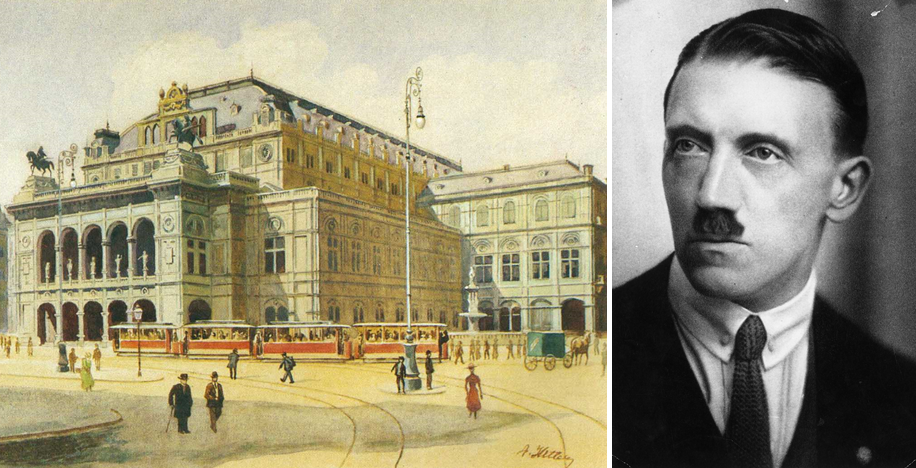
Adolf Hitler’s artistic ambitions and his rejection from the Vienna Academy of Fine Arts are among the most significant aspects of his early life. They shed light on the young man who would later plunge the world into chaos. Before he became the dictator of Nazi Germany, Hitler was a struggling artist who dreamed of fame, recognition, and beauty. His failure in those pursuits helped shape his embittered worldview and sense of destiny. Understanding Hitler’s art and his rejection from the Vienna Academy of Fine Arts is crucial to understanding the psychological and ideological formation of one of history’s most infamous figures.
Young Hitler Dreamt of Becoming an Artist

From an early age, Hitler demonstrated a genuine interest in art, architecture, and culture, and saw himself as an artist. Just a month before his invasion of Poland started World War II, he told the British ambassador: “I am an artist and not a politician. Once the Polish question is settled, I want to end my life as an artist”. Born in 1889 in Braunau am Inn, Austria, Hitler grew up in Linz, where he attended secondary school. He was not a particularly good student. His academic performance was uneven, and he often clashed with teachers and authority figures. In art class, however, he excelled. He sketched constantly, and produced landscapes, buildings, and detailed architectural drawings. Hitler idolized the grandeur of classical and romantic art – the works of painters such as Hans Makart and Rudolf von Alt, and the monumental architecture of Vienna’s Ringstrasse.
Hitler became more convinced that art was his true calling after his father’s death in 1903. His mother, Klara Hitler, supported his ambitions as he spent hours painting. Hitler dreamt of becoming a famous artist someday, and envisioned himself living the bohemian life of a painter in Vienna. However, he lacked formal artistic training and had never received professional instruction beyond secondary school. His art consisted mainly of watercolors and pencil sketches that often depicted buildings, cityscapes, and pastoral scenes. People rarely appeared in his paintings, and when they did, they were stiff and lifeless. That revealed a weakness in human anatomy and figure drawing – a flaw that proved critical to his rejection.
Rejection from the Vienna Academy of Fine Arts

In 1907, at the age of eighteen, Hitler left Linz for Vienna. The Austro-Hungarian Empire’s capital and one of Europe’s great cultural centers, Vienna was a city alive with innovation. It was home to Freud, Klimt, and Mahler, but was also a place of intense social divisions, nationalism, and anti-Semitism. Hitler arrived with dreams of studying at the prestigious Akademie der bildenden Künste Wien – the Vienna Academy of Fine Arts. He saw acceptance into the academy as the gateway to his artistic future.
That same year, Hitler applied to the Academy’s painting school. The entrance exam required submission of several original works for evaluation. Out of hundreds of applicants, only a small number were admitted each year. Hitler’s drawings were judged to show talent, particularly in architectural elements. He passed the preliminary exam but failed the main entrance test in October 1907: examiners criticized his lack of human figures and poor grasp of anatomy. One of the professors advised Hitler that his abilities were better suited for architecture, rather than fine art.
A Bitter Blow

Hitler was devastated by the rejection, but not entirely discouraged. He returned to Vienna determined to try again. However, tragedy struck in December, 1907, when his mother died of breast cancer. Her death affected him deeply, as she had been his closest emotional support. After a period of mourning, he resumed his efforts to prepare for the Academy’s next admissions round. In 1908, Hitler applied again to the Vienna Academy, this time to both the painting and architecture departments. His second attempt was even less successful: he failed the preliminary examination outright, and was not allowed to sit for the main test.
The Academy’s report was blunt: his samples demonstrated some architectural skill, but were “unsatisfactory” as works of fine art. The examiners reiterated that he should pursue architectural studies, a field where his precision and eye for structure might be better applied. The suggestion was reasonable, but it presented a practical problem. To study architecture at a technical college, Hitler needed a high school diploma. However, he had no diploma because he had dropped out of high school. Rather than return to school, Hitler refused to accept the advice and grew increasingly bitter. He saw the rejection as unjust and humiliating.
Descent Into Poverty and Homelessness

Later, in Mein Kampf, Hitler recalled his rejection from the Vienna Academy of Fine Arts with resentment. He wrote that it was “a painful blow” to his ambitions, and that it “seemed to strike me like lightning from a clear sky”. He believed that the Academy’s decision reflected bias or favoritism, and his bitterness gradually deepened into suspicion of certain groups. Key among them were Jews, who were prominent in Vienna’s cultural life. While there is no evidence that Jewish professors played any role in his rejection, the episode contributed to the development of his paranoid worldview.
As to the quality of the works he submitted to the academy, American journalist John Gunther examined them in 1936, and had this to say: “They are prosaic, utterly devoid of rhythm, color, feeling, or spiritual imagination. They are architect’s sketches: painful and precise draftsmanship; nothing more. No wonder the Vienna professors told him to go to an architectural school and give up pure art as hopeless”. After his second rejection, Hitler remained in Vienna, but his life descended into poverty. He rented cheap rooms, and survived on the small inheritance left by his mother, which soon ran out. By 1909, he was living in homeless shelters and men’s hostels. Those years were marked by hardship, humiliation, and growing bitterness.
When Hitler Started to Blame the Jews

Despite the hardships, Hitler continued to draw and paint. He produced hundreds of small watercolors and sketches that he sold to tourists and shopkeepers. His subjects were typically city scenes, old buildings, churches, and monuments. They were rendered with careful architectural detail, but little emotional depth. He worked tirelessly to eke out a living, selling paintings for a few crowns each. Contemporary accounts from those who knew him in the Vienna shelters describe Hitler as reclusive, proud, and argumentative. When not drawing, he spent hours reading newspapers, political pamphlets, and books on art and architecture. He also began to absorb the anti-Semitic and nationalist ideologies circulating in Vienna’s right-wing press. Karl Lueger, the city’s populist mayor, was particularly influential in shaping Hitler’s anti-Semitic world view.
Hitler’s years of poverty thus intertwined his personal frustrations with political radicalization. The bitterness of rejection blended with a growing belief that society was corrupt and dominated by hostile forces. Before he moved to Vienna, there is no indication that Hitler was anti-Semitic. His mother’s doctor was Jewish, and he had no problem with him. Nor did he seem to have a problem with the Jewish art dealers who sold his paintings in Vienna. By the time he left Vienna, though, Hitler had clearly become an anti-Semite. He blamed Jews for all of Austria’s social and economic problems in general, and for his life’s disappointments in particular. Hitler believed that the academy’s administrators and faculty were mostly Jewish, so he blamed Jews for his failed art career. Ironically, the majority of those who bought his paintings in Vienna were Jewish.
An “Artist-Statesman”

Hitler’s surviving artworks number in the hundreds, and they have been studied extensively by historians, art critics, and psychologists. Technically, his works are competent and sound, but uninspired. They show skill in perspective, architectural accuracy, and composition. However, they lack imagination and emotional resonance. His preference for empty buildings, cold streets, and static landscapes suggests both a fascination with order and a discomfort with human complexity. Those traits echo later elements of Nazi aesthetics such as depersonalized monumental architecture and idealized classicism.
After World War I and his rise to power, Hitler never entirely abandoned his artistic self-image. He continued to see himself as a kind of “artist-statesman” who would reshape Germany and Europe in accordance with his aesthetic ideals. Nazi art policies reflected his tastes: he promoted neoclassical art, heroic sculpture, and monumental architecture, and condemned modernist and abstract movements as “degenerate”. The grandiose urban plans designed by Albert Speer for Berlin, known as Germania, were in many ways Hitler’s attempt to fulfill the architectural dreams denied to him in Vienna.
Rejection from the Vienna Academy of Fine Arts Played a Key Role in Shaping Hitler

The Vienna Academy of Fine Arts’ rejection of Hitler is one of history’s most haunting “what ifs”. Had he been accepted, might Hitler have lived a quiet life as a painter, rather than a genocidal dictator? To be sure, such speculation oversimplifies the complex mix of personal ambition, ideology, and historical circumstance that shaped him. Still – his failure in Vienna clearly marked a turning point in Hitler’s life. It reinforced his sense of being misunderstood, fueled his resentment toward intellectual elites, and deepened his obsession with destiny. The combination of artistic idealism and personal failure became part of the psychological foundation of his later authoritarianism and tyranny.
Hitler’s artistic aspirations and rejection from the Vienna Academy of Fine Arts reveal the frustrated dreamer behind the tyrant. In his youth, he was not yet a monster, but an ambitious young man with limited talent and immense pride. His inability to gain acceptance into the world of art became, in part, the crucible in which his bitterness and megalomania were forged. The Vienna Academy’s verdict that Hitler was better suited to architecture than painting was tragically accurate, not only in artistic terms but metaphorically: he would go on to build empires, reshape cities, and destroy far more than he ever created.

_________________
Some Sources & Further Reading
Chronicles Magazine, February, 1995 – The Art of Adolf Hitler
Pastore, Stephen R. – The Art of Adolf Hitler: A Study of His Paintings and Drawings (2013)
If you liked this article, you will probably like The Hitler Who Fought the Fuhrer: Adolf Hitler’s Nephew Joined the US Navy in WWII

